---
title: BioDrop Alternative for Developers in 2026
description: BioDrop (formerly LinkFree) shut down in June 2024. Here's what developers use instead in 2026 — and how to avoid picking another dead tool.
keywords: biodrop alternative, biodrop shut down, linkfree alternative, open source link in bio, self-hosted developer profile
published: 2026-07-22
updated: 2026-07-25
url: https://devbio.me/blogs/biodrop-alternative-developers
word_count: 2987
---
## Related Pages
- [019f6d9d-8196-70eb-8d95-a67478e37fa5](https://devbio.me/blogs019f6d9d-8196-70eb-8d95-a67478e37fa5)
- [019e8b0f-7e22-73ac-b5ec-4423ce30aec2](https://devbio.me/blogs019e8b0f-7e22-73ac-b5ec-4423ce30aec2)
- [019efc57-8a80-7070-869f-fabac438719d](https://devbio.me/blogs019efc57-8a80-7070-869f-fabac438719d)
- [019f4990-7ace-771b-b093-a830c03bf585](https://devbio.me/blogs019f4990-7ace-771b-b093-a830c03bf585)
- [019f5e2d-f18a-7633-aee1-1fa6fd1b448b](https://devbio.me/blogs019f5e2d-f18a-7633-aee1-1fa6fd1b448b)
- [019ee7b8-b3b7-74d4-a3d8-f782a8bae55d](https://devbio.me/blogs019ee7b8-b3b7-74d4-a3d8-f782a8bae55d)
*Photo by [Mohammad Rahmani](https://unsplash.com/@afgprogrammer?utm_source=quillly&utm_medium=referral) on [Unsplash](https://unsplash.com?utm_source=quillly&utm_medium=referral)*
Looking for a BioDrop alternative? Start here: BioDrop is gone. **BioDrop — the open-source, GitHub-native answer to **[**Linktree**](/linktree-alternative-developers)** built by the EddieHub community — took its hosted platform offline and wiped its database on June 10, 2024, then archived its 5,700-star GitHub repository two months later.** No wind-down period, no acquisition, no pivot. Here's what actually happened, and the best BioDrop alternative for developers in 2026.
*Updated July 2026. Covers why BioDrop shut down, what "archived" means for your old data, a framework for judging any bio tool before you build on it, and a real comparison of what replaces it.*
## What Happened to BioDrop (Formerly LinkFree)
BioDrop started life as **LinkFree** — a livestream side project from the EddieHub community with a simple pitch: an open-source, developer-native alternative to Linktree. It grew fast. Contributors poured in, GitHub stars climbed past 5,000, and the project was accepted into the [GitHub Accelerator program](https://github.com/EddieHubCommunity/BioDrop), a 10-week cohort that funds and mentors open source maintainers trying to make their work sustainable.
Somewhere in that growth, LinkFree ran into a naming problem. "LinkFree" read too close to "Linktree" for comfort, so the team rebranded to **BioDrop** — new name, new logo, same codebase, same community.
The rebrand didn't fix the underlying issue. On June 10, 2024, BioDrop's hosted platform went offline. User data, including every profile hosted on biodrop.io, was deleted. The [GitHub repository](https://github.com/EddieHubCommunity/BioDrop) was archived on August 7, 2024, which on GitHub means read-only: no more commits, no more issues, no more pull requests, no more releases. The biodrop.io domain itself was later repurposed and now serves unrelated blog content, so there isn't even a dead homepage left pointing at the old project.
## Why a 5,700-Star Open Source Project Still Shut Down
Stars aren't a survival metric. BioDrop had nearly 6,000 of them and over 4,000 active users, and it still didn't make it. In [his own account of the decision](https://eddiejaoude.substack.com/p/why-we-archived-a-5k-stars-open-source-project), founder Eddie Jaoude laid out exactly why, and it's worth reading in full if you're evaluating any community-run tool for your own profile.
Four things compounded at once. Costs outran what a small base of paid subscribers covered, so "those premium features you would like to work on are sidelined." Maintainer inboxes filled with round-the-clock notifications while the team was simultaneously trying to build a business. Low-quality contributions — made, in his words, "for the wrong reasons (such as swag or a green square only)" — ate maintainer time without moving the project forward. And running an open community turned out to require a fundamentally different mindset than running a SaaS business, one he described as "completely different."
His summary: **"This was no longer sustainable. It may seem like an all or nothing attitude but we needed to move on from the project and also start making money to live."**
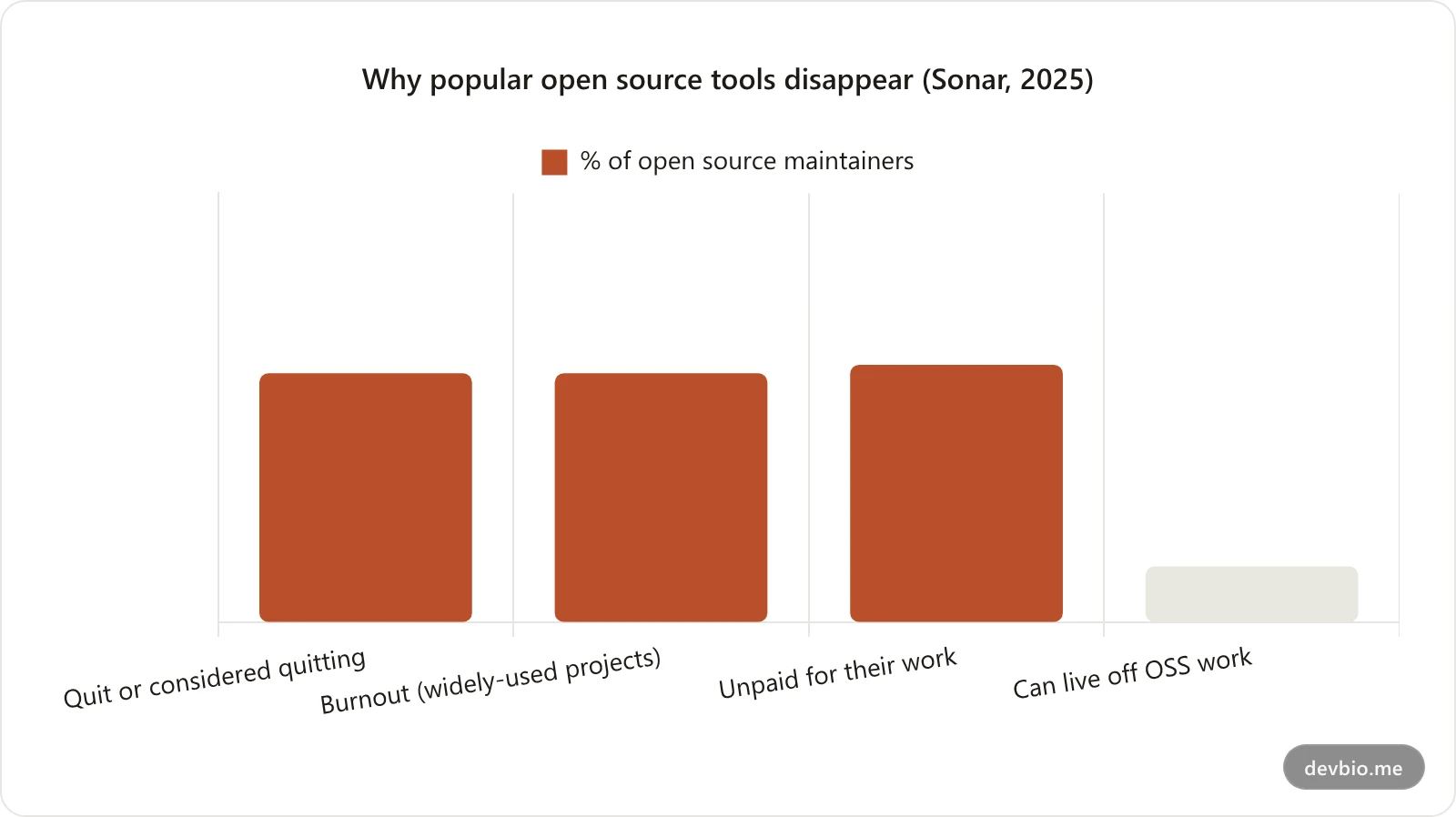
That story is common, not rare. A 2025 [Sonar survey of open source maintainers](https://www.sonarsource.com/blog/maintainer-burnout-is-real/) found 58% have quit or seriously considered quitting a project they maintain, and burnout runs even higher — 58% — among maintainers of widely-used projects specifically. Roughly 60% of maintainers do the work unpaid, and only 12–13% can live off their open source work at all. BioDrop wasn't an outlier. It was the median outcome for a popular solo-led project, playing out on a slightly longer timeline.
## Can You Still Self-Host BioDrop, or Do You Need an Alternative?
Technically, yes. The source is still public, even in archived form, and it's a fairly standard Next.js application. You can fork the repository, deploy it yourself, and run your own instance. Several community forks and derivatives already exist, including a CLI tool and a couple of self-hosted variants built by former contributors.
Practically, that's a bigger commitment than most developers want for a profile page. Archived means archived: no security patches, no dependency updates, no bug fixes, ever, from the original team. You inherit full responsibility for hosting, patching, and eventually re-platforming when the underlying dependencies drift too far out of date to safely run. That's a real job, not a checkbox.
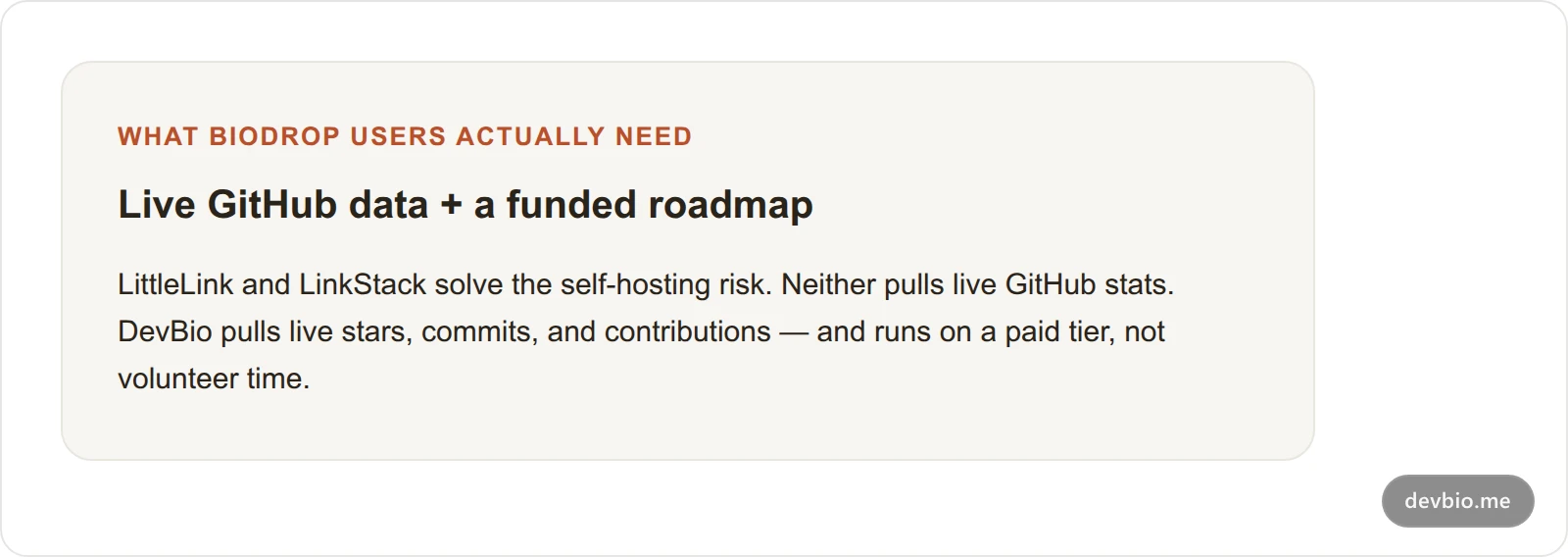
If you're comfortable with that tradeoff and want a genuinely open-source, self-hostable link page, two forks-of-the-idea are worth knowing: **LittleLink**, a lightweight static option, and **LinkStack**, a more full-featured self-hosted platform with an active maintainer base as of 2026. Neither pulls live GitHub data the way BioDrop did — that was BioDrop's specific differentiator, and it's the gap most former BioDrop users actually need filled.
## The Continuity Test: 4 Questions Before You Trust Any Bio Tool
BioDrop's collapse is a useful lesson precisely because it wasn't a scam, a bad actor, or bad code. It was a well-built, well-loved project that ran into an ordinary, predictable failure mode. Before you put your GitHub link, your resume, and your contact info behind any tool — DevBio included — run it through four questions:
1. **Who pays for this to keep running?** A tool funded by real subscriptions, not just goodwill, has a reason to still exist next year. "Free forever, run by one person in their spare time" is not a business model — it's a countdown.
2. **How many people can keep it alive?** A single maintainer is a single point of failure. Check the contributor graph. If one person can burn out and take the project with them, that's your risk profile too.
3. **What happens to your data if it disappears?** Ask specifically: is there an export? Could you self-host a copy if the hosted version vanished tomorrow? BioDrop's answer, in practice, turned out to be no — the database was gone before most users even knew to ask.
4. **What's the real usage signal, not the vanity one?** Stars measure interest at some point in the past. Commits, releases, and support responses in the last 90 days measure whether anyone is still actively keeping the lights on right now.
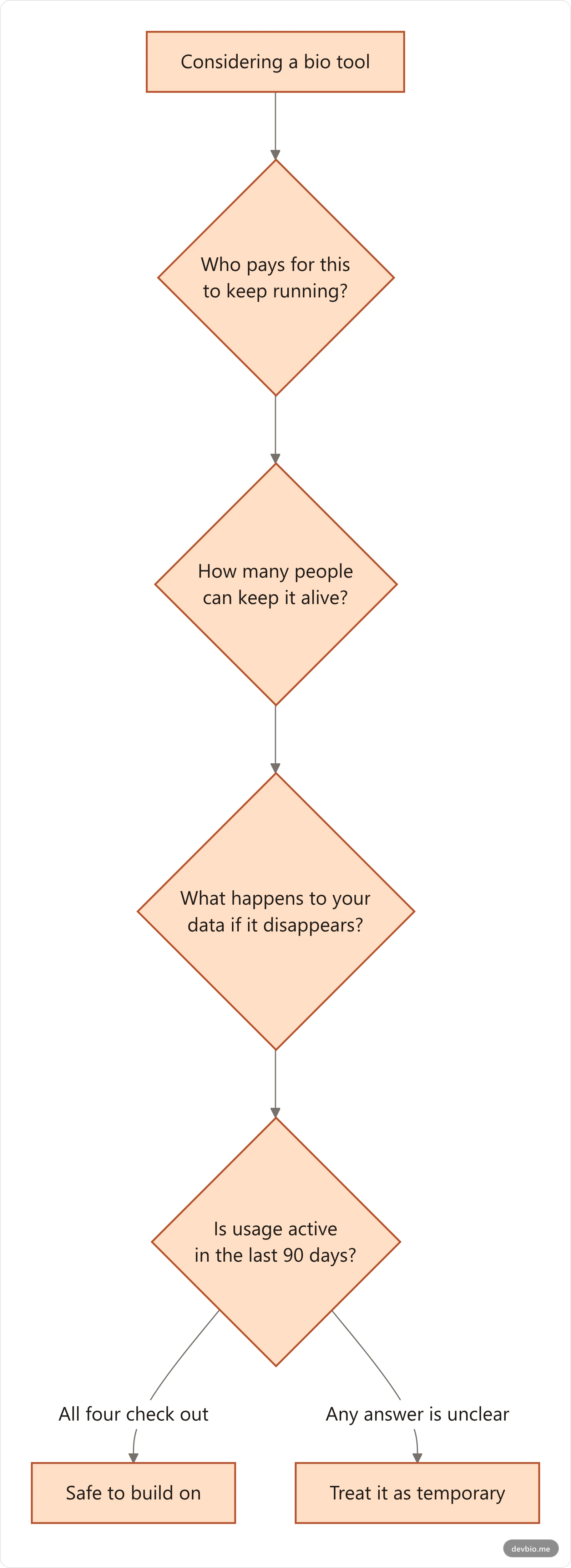
Run this against BioDrop retroactively and every answer points the same direction: unpaid premium tier, one core maintainer, no export, and — by mid-2024 — a maintainer publicly saying it was unsustainable. None of that was hidden. It just wasn't the question most users were asking before they built their profile there.
## BioDrop Alternatives Compared: DevBio vs. LittleLink vs. LinkStack vs. Linktree
Former BioDrop users are looking for one specific thing most link-in-bio tools don't offer: a bio that actually understands GitHub, not just a link to your GitHub profile.
| Tool | Live GitHub data | Self-hosted option | Revenue model | Resume export | Cost |
| --- | --- | --- | --- | --- | --- |
| **BioDrop** (archived) | Was strong (stars, repos) | Yes, unmaintained fork | None — this is why it died | No | N/A — offline |
| **DevBio** | Yes — live stars, commits, contribution heatmap | No, managed SaaS | Paid Pro tier + founding memberships | Yes, ATS-ready PDF | Free plan, or $2/mo ($12/yr) for Pro |
| **LittleLink** | No | Yes, static and lightweight | Community-maintained, no paid tier | No | Free, self-hosting costs only |
| **LinkStack** | No | Yes, actively maintained as of 2026 | Community-maintained, optional donations | No | Free, self-hosting costs only |
| **Linktree** | No | No | VC-backed, freemium | No | Free, Premium from ~$5/mo |
Two things stand out in that table. First, none of the self-hosted successors replicate BioDrop's actual selling point — live GitHub stats woven into the profile itself, not just a link out to your GitHub page. Second, "self-hosted" solves the *company-disappearing* risk but not the *maintainer-disappearing* risk; LinkStack and LittleLink are healthier than BioDrop was in 2026, but the Continuity Test above still applies to them, same as it applies to everything else on this list.
For developers who specifically valued BioDrop's GitHub-native angle, [DevBio](https://devbio.me){cta=signup} covers that ground directly: live contribution graphs, real star and commit counts pulled from the GitHub API, and — going further than BioDrop ever did — live MRR from a connected payment provider (Stripe, Dodo Payments, Lemon Squeezy, or Polar) for developers who ship paid products. [Here's the full breakdown of what to actually put on a developer bio.](/developer-bio-components)
## Rebuilding Your Profile After BioDrop (Your Data Is Gone)
There's no migration path, because there's nothing left to migrate. BioDrop's database was deleted the day the hosted platform went offline, and the project never shipped a bulk export tool before that happened. If your profile lived at `biodrop.io/yourusername`, that URL now serves someone else's blog content — treat the rebuild as a fresh start, not a data transfer.
The good news: rebuilding is faster than the original setup, because you already know exactly what worked.
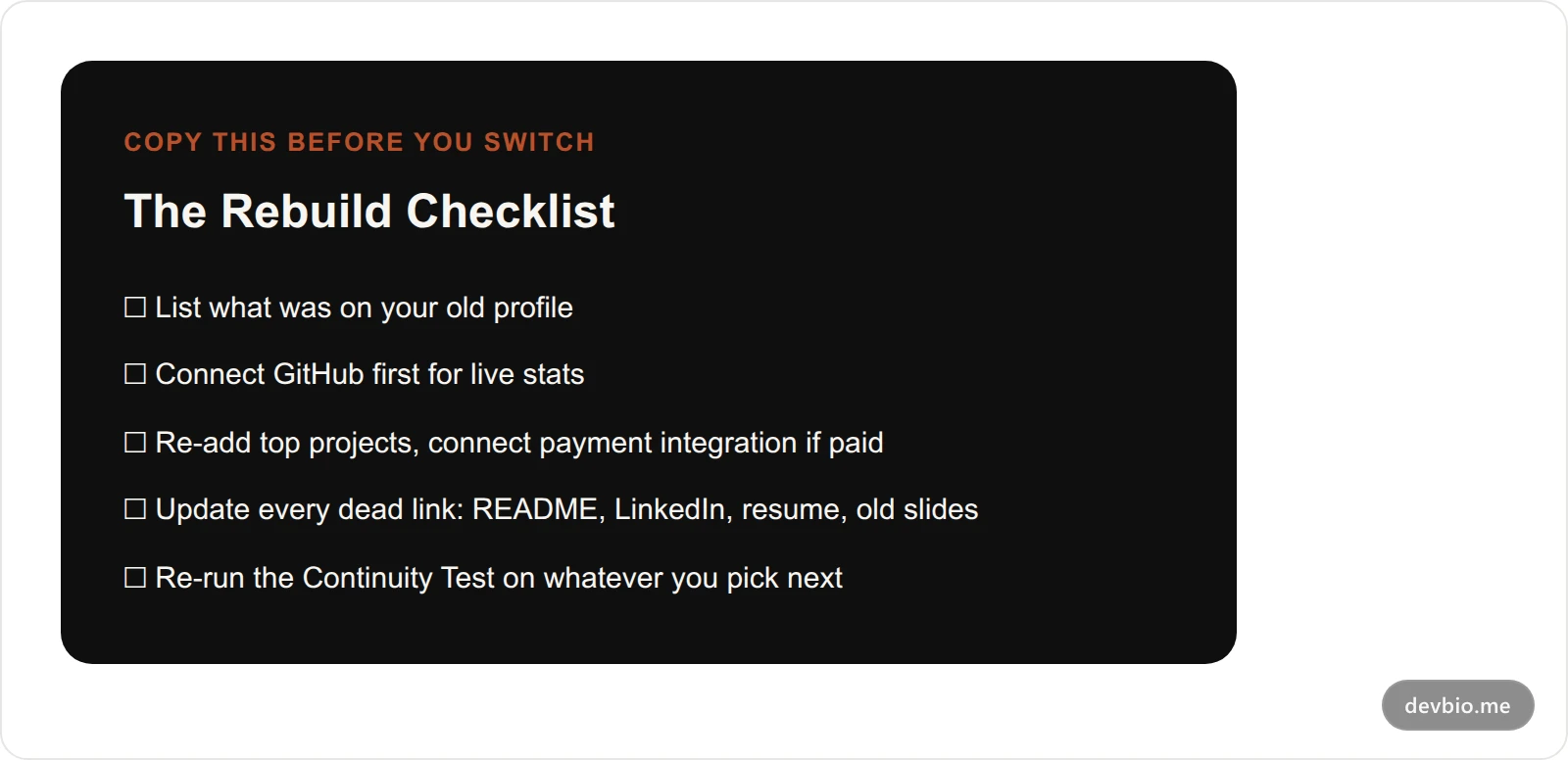
1. **List what was actually on your old profile.** Most BioDrop users had roughly the same shape: name, tagline, a handful of pinned repos, social links, and GitHub stats. Write that list down before you start rebuilding anywhere.
2. [**Connect GitHub first**](https://devbio.me){cta=signup}**.** On DevBio, this single step restores the part BioDrop users miss most — live contribution activity and repo stats — without manually re-entering anything.
3. **Re-add your top projects.** If any of them earn revenue, connect a payment integration so the project card shows real numbers instead of a static description. [Here's what that setup looks like.](/best-link-in-bio-developers-2026)
4. **Update every place the old link lived.** GitHub README, LinkedIn, email signature, old conference slides if you can still edit them. This is the step most people skip, and it's the one that actually matters — a dead link in your GitHub README does more damage than no link at all.
5. **Pick a tool that answers the Continuity Test cleanly**, this time, before you invest another year of updates into it.
## Before and After: Losing a Profile You Didn't Choose to Lose
**Before:** A backend developer — call him Dan — built a BioDrop profile in 2023, pointed his GitHub README at it, and put the link on his resume and in three job applications. It quietly worked for months. In early 2026, a recruiter mentions his portfolio link 404s. Dan checks: `biodrop.io/dan` now loads a blog post about AI coding tools. His README link is dead. His resume PDF, already sent to two companies, points at a page that no longer exists. He didn't get a notification. He didn't get a warning. He found out because someone else did first.
**After:** Dan [rebuilds on a tool that passes the Continuity Test](https://devbio.me){cta=signup} — a real subscription funding it, a public roadmap with recent commits, and a resume export he controls directly instead of a static PDF pointing at a third-party link. He sets up a custom domain this time, so future changes route through DNS he owns instead of a URL he's borrowing. Total rebuild time: about 20 minutes, most of it reconnecting GitHub and re-pasting project descriptions he'd already written once.
The lesson isn't "don't use open source tools." It's "check who's actually paying to keep the lights on" — the same lesson [Bento.me's shutdown in February 2026](/bento-alternative-developers) taught the link-in-bio side of this market a few months later.
## What to Look For in a Developer Bio Tool in 2026
Run any candidate through the same four checks from the Continuity Test, then add developer-specific requirements on top:
- **Live GitHub data**, not a static link to your profile — [contribution graph](/github-profile-guide-2026), real star and commit counts, updated automatically.
- **Data portability** — can you export your content, or point a custom domain at it, so a platform change doesn't mean starting from zero.
- **A revenue model you can see** — free tiers are fine, but check whether the paid tier funding the product actually exists and has real subscribers, not just a pricing page.
- **Proof over claims** — the entire reason BioDrop resonated with developers in the first place was that it showed real activity instead of a resume's static claims. [That principle didn't go away with the project.](/open-source-portfolio-github)
- **An actual maintenance signal** — recent commits, a changelog, responsive support. Check this the same way you'd check it before adding any dependency to a production codebase, because that's functionally what your bio tool is.
None of this guarantees permanence. No tool, DevBio included, can promise it'll exist unchanged in five years — that's not a claim worth making about any startup. What the Continuity Test gives you instead is a way to price the risk honestly before you build a year of updates on top of someone else's roadmap.
## Frequently Asked Questions
### What happened to BioDrop?
BioDrop, the open-source EddieHub community project formerly called LinkFree, shut down its hosted platform on June 10, 2024, and deleted all user data. Its GitHub repository, which had grown to roughly 5,700 stars, was archived on August 7, 2024, making it read-only. The founders cited financial unsustainability and maintainer burnout as the reasons.
### Is BioDrop still available in 2026?
The hosted version at biodrop.io is gone; the domain now redirects to an unrelated blog. The source code is still publicly viewable on GitHub in read-only archived form, so technically minded developers can still self-host it, but there have been no updates, security patches, or bug fixes since it was archived in August 2024.
### Can I still access my old BioDrop profile?
No. The project's own shutdown notice confirmed the database was deleted when the hosted platform went offline on June 10, 2024. There's no export tool, no backup you can request, and no way to recover a BioDrop profile's data. Anything you built there needs to be rebuilt from scratch on a different tool.
### What was BioDrop before it was called BioDrop?
BioDrop launched as LinkFree, an open-source Linktree alternative started by the EddieHub community. It was renamed to BioDrop to avoid trademark confusion with Linktree and to establish its own identity, shortly before joining the GitHub Accelerator program. The rename didn't change the project's eventual outcome.
### What's the best free alternative to BioDrop?
For a self-hosted, fully open-source route, LittleLink and LinkStack are the closest matches to what BioDrop offered — free, deployable on your own infrastructure, and not dependent on a single maintainer's SaaS revenue. For a managed option with zero maintenance burden, DevBio's free plan covers a public GitHub-linked bio at no cost.
### Should I self-host an open source link-in-bio tool?
Only if you're prepared to own the server, apply security patches, and handle upgrades yourself indefinitely, since 58% of open source maintainers have abandoned or considered abandoning their projects. Self-hosting removes the risk of a company disappearing, but it doesn't remove the risk of the underlying project itself going unmaintained.
### Does DevBio require GitHub to sign up?
You need a GitHub account to pull live stats like contributions, stars, and commits into your profile, which is the core of what made BioDrop useful to developers in the first place. The free plan covers public repository stats; Pro adds private repository data and an hourly sync.
### How is DevBio different from BioDrop as an open source project?
DevBio isn't open source — it's a managed SaaS product with a paid tier funding its development, which is precisely the revenue structure BioDrop's founders said they lacked. It adds live MRR display, an ATS-ready PDF resume, custom domains, and QR/vCard export, none of which BioDrop offered even before it shut down.
## Key Takeaways: Put Your Proof Somewhere That's Still There Next Year
BioDrop didn't fail because the idea was wrong. Developers do want a bio that shows real GitHub activity instead of a static claim — that instinct was correct, and it's exactly what made the project earn 5,700 stars in the first place. It failed because good ideas still need a way to pay for their own upkeep, and "premium subscriptions on top of a volunteer-run community" wasn't enough runway.
Three things worth doing this week if you're a former BioDrop user, or just evaluating tools before you commit to one: run any bio platform through the four-question Continuity Test before you build on it, rebuild your GitHub-linked profile somewhere your data can't vanish overnight, and update every dead link — README, resume, LinkedIn — pointing at a URL that no longer exists.
Your code already proves you can build. [Put it on one link that's still going to be there next year — devbio.me](https://devbio.me){cta=signup}.