

The fastest-growing segment of the indie hacker market right now isn't building new SaaS products. It's learning to buy micro SaaS businesses from indie founders — and compound from there.
Q3 2025 set a record: 746 SaaS transactions in a single quarter — more deals than entire years a decade ago. Flippa reported a 73.5% surge in SaaS transactions over 2025, with 400K+ weekly active buyers on the platform. Total SaaS M&A hit 2,698 deals in 2025, up 28% from 2024. The market is mature, the supply is large, and the buyers who know what they're doing are compounding faster than the ones building from zero.
What it means to buy micro SaaS: You're acquiring a small bootstrapped software business — typically under $10K MRR — from an indie founder via a marketplace or private deal. You pay 2.5–4.5x annual SDE (seller discretionary earnings), and you own the recurring revenue. The typical sub-$10K MRR business sells for $30K–$200K depending on growth rate, churn, and market. Your job as a buyer: verify the numbers, assess the tech debt, clear the legal title, and structure a clean handover.
This guide covers every step of that job. If you're on the other side of the table, we've already covered how to sell your SaaS side project in 2026. This one is for buyers.
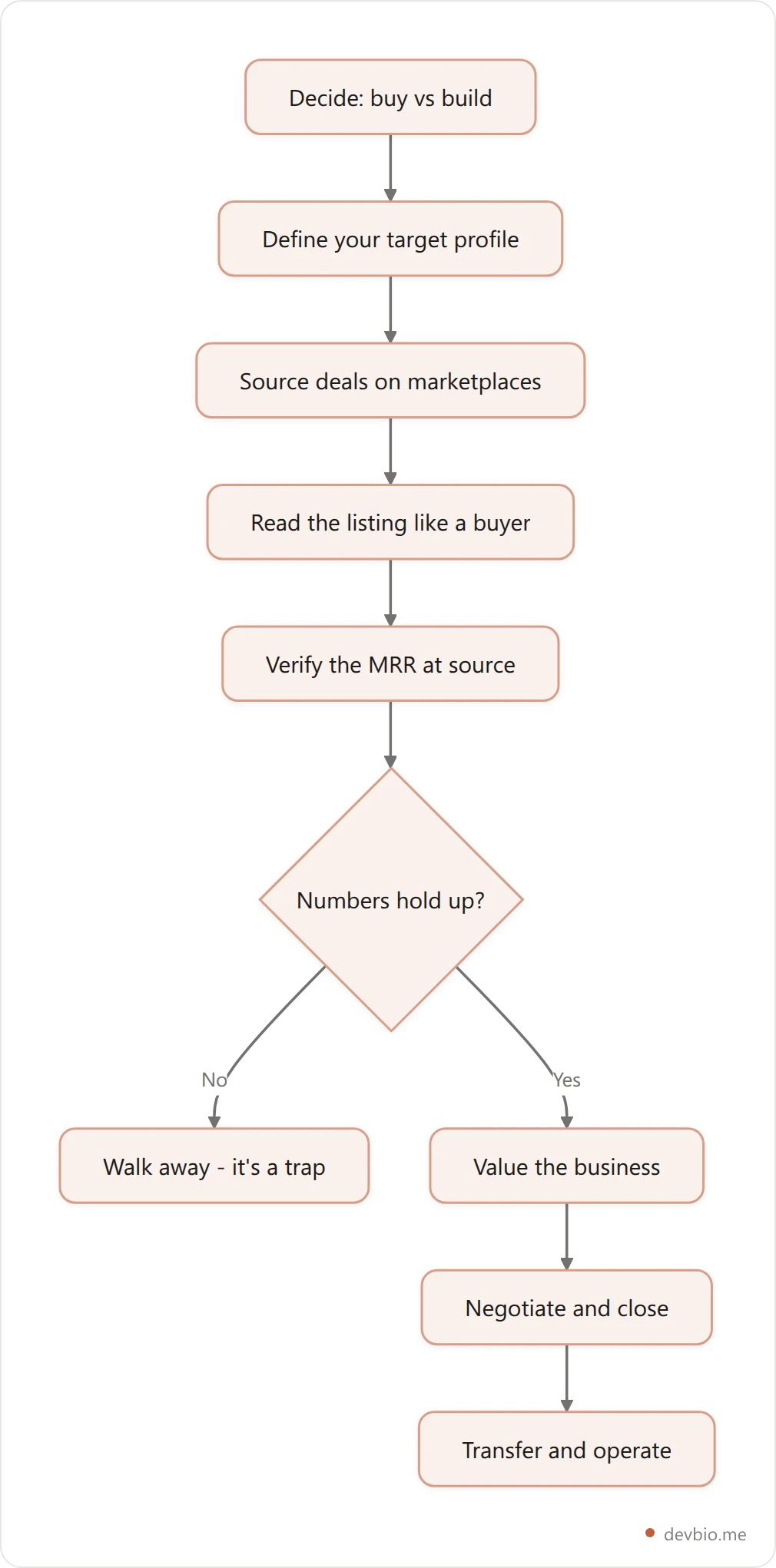
Why Developers Buy Micro SaaS Instead of Building#
Building a SaaS from zero takes 12–18 months to reach $10K MRR at the median, based on data from Indie Hackers and MicroConf surveys. That's assuming you reach it at all. Most products don't find product-market fit on the first attempt. You spend the first six months not knowing if the problem is even real.
Buying skips all of that. You're acquiring:
Proven product-market fit (customers are paying, not just signed up)
A functioning tech stack with no greenfield architecture decisions
12–24 months of historical MRR data you can actually model from
An existing customer base with support history and real churn rates
A product doing $400/month MRR with under 8% monthly churn typically sells for $4,000–$5,000. At a flat trajectory, you break even in 10–12 months. At 10% MRR growth month-over-month, you're looking at a significantly better ROI than building cold. Most developers who decide to buy micro SaaS for the second time do it again — the operating model is that different from starting from scratch.
That doesn't mean buying is easier than building. It's a different kind of work. You're skipping the "does anyone want this?" question and going straight to "can I keep this running, improve it, and grow it?" For experienced developers, that's often the right trade.
What a Good Micro-SaaS Target Looks Like#
Before you browse listings, build a target profile. Buyers who get bad deals are the ones who "know it when they see it." The ones who close well have a shopping list.
Revenue profile to look for:
$500–$5,000 MRR (the sweet spot for a first acquisition)
12+ months of consistent revenue history (rules out seasonal spikes)
Monthly churn below 5% (2% or less is excellent)
Net Revenue Retention (NRR) at or above 100%
No single customer representing more than 25–30% of MRR
Business model to prefer:
Monthly recurring subscriptions, not one-time licenses
Self-serve onboarding — not sales-led (you won't be hiring a sales team)
B2B or prosumer (consumer SaaS churn rates are brutal for small operators)
Low support overhead — async, ticket-based, not live-chat-dependent
Tech stack to target:
A mainstream language you can maintain: Node, Python, Ruby, PHP, Go
Hosted on standard infrastructure: AWS, GCP, Vercel, Railway, Fly — not a bespoke VPS the seller configured by hand
Third-party integrations documented somewhere other than the seller's head
Dependencies not deprecated or end-of-life
What to avoid:
Products where the founder IS the distribution (personal-brand-driven signups dry up post-close)
Revenue from consulting bundled into "MRR"
Tools with a dominant free tier and a thin conversion rate that's never been optimized
Any codebase older than the support tickets, where neither is documented
Before you browse a single listing, know what your own numbers look like — see how live revenue proof is presented on the seller side.
Where to Buy Micro SaaS: The 2026 Marketplace Comparison#
Several platforms exist for buying small internet businesses. They differ significantly in deal quality, buyer competition, fee structures, and how well they verify what sellers claim.
Marketplace | Typical price range | Listing model | Buyer fee | Revenue verification |
|---|---|---|---|---|
Acquire.com | $5K–$2M+ | Self-serve + broker | 2–4% | Optional (Stripe connect) |
Empire Flippers | $50K–$10M+ | Vetted broker | 2.5–5% | Required (fully vetted) |
Flippa | $1K–$10M | Auction + fixed price | 2–7.5% | Manual upload |
Quiet Light | $500K–$50M+ | Full-service broker | Seller-side only | Required |
DevBio Marketplace | Varies | Self-serve | None | Live-synced from payment processor |
Indie Hackers classifieds | $1K–$100K | Community post | None | None |
Direct / Twitter DMs | Any | Private deal | None | None |
Each has tradeoffs. Empire Flippers vets listings heavily — fewer deals, cleaner data, higher prices. Flippa has volume but also noise; the quality floor is low. Acquire.com sits in the middle: self-serve with optional payment verification, a large pool of indie buyers, and a median profit multiple of 3.9x across 2024–2025 transactions.
DevBio's marketplace pulls MRR live from connected payment processors (Stripe, Dodo Payments, Lemon Squeezy, Polar) — not from screenshots or seller-uploaded CSVs. Listings also show the seller's verified GitHub contribution history and open source activity and, for Pro sellers, a verified founder badge tied to confirmed MRR. For buyers filtering real deals from inflated listings, that live-synced revenue data is a meaningful signal at the discovery stage.
For a first acquisition: start with Acquire.com or Empire Flippers for the guardrails. Use Indie Hackers classifieds and Twitter DMs for deals that haven't been listed yet — less buyer competition, occasionally better prices, and a chance to negotiate directly before a broker sets the price.
How to Read a Micro-SaaS Listing Like a Buyer#
Most listings are written to maximize appeal. Reading them like a buyer means decoding the language.
"MRR" vs "ARR" vs "Revenue" Some listings state ARR (annual) and call it "revenue" — technically true, but it inflates the headline by 12x. Always convert to MRR for apples-to-apples comparisons. If they only show ARR: divide by 12. If they show "revenue" without specifying recurring vs one-time: ask before going further.
"Growth" that peaked six months ago Listings highlight the best three-month window in the revenue chart. Look at the full history. An MRR line that peaked at $3K in January and sits at $2.1K in June is not a growing business — it's a declining one with a flattering chart starting point.
Churn described in words, not numbers "Low churn" is meaningless. "2.3% monthly gross MRR churn, net churn -0.4%" means something. If a seller can't give you monthly cohort retention data going back at least 12 months, that's a gap you need to close before making an offer.
Traffic sources without attribution "12K monthly visitors" without a source breakdown is useless. If 10K of those visitors come from a single blog post the seller wrote two years ago, the traffic has a shelf life. Ask for a Google Analytics or Plausible export with source/medium breakdown.
Support time omitted Any listing that doesn't disclose hours per week spent on support is hiding a number they don't want you to price in. Ask specifically: "How many support tickets per week, and how many hours does that take?" The answer determines whether you're buying a business or a part-time job.
The 5-Layer Due Diligence Framework#
Most buyers do surface-level checks: verify a Stripe screenshot, skim the reviews, look at the code for fifteen minutes. Then they discover the real problem three months post-close.
Here's a framework that goes deeper. Work through all five layers before making an offer — in order, because earlier layers determine whether you need the later ones.
Layer 1: Revenue Verification#
The goal: confirm the MRR you see is real, recurring, and not about to collapse.
Request read-only Stripe (or equivalent) API access and export 24 months of transaction data yourself — don't accept a screenshot
Cross-reference MRR with actual bank deposit amounts — timing gaps flag revenue recognition games
Separate gross MRR churn (cancellations) from net MRR churn (cancellations minus expansion)
Calculate customer lifetime value and compare it to the asking price
Flag annual contracts: a $2K MRR business where 60% of revenue is on annual plans just had a good renewal month. In 8 months you're re-earning that same cohort — the forward cash flow picture is different from the MRR snapshot
Benchmarks: Monthly gross MRR churn above 8% is a serious problem. NRR below 90% is a red flag. NRR above 100% means existing customers are growing their spend — that's one of the most valuable properties a micro-SaaS can have. Best-in-class NRR runs 110–120%.
Layer 2: Churn and Retention Health#
Don't just look at current churn. Look at the trend.
A business at 4% monthly churn that was at 2% six months ago is getting worse. A business at 5% churn that was at 9% six months ago is getting better. The trajectory matters more than the snapshot.
Request monthly cohort retention tables covering the last 8 quarters — month-0 through month-12 for each cohort. This tells you whether customers who signed up 6 months ago are staying, at what rate, and where the cliff is. Most sellers have this data in Stripe, Baremetrics, or ChartMogul.
Also ask: what's the primary cancellation reason? Sellers who have this data are operating the business intentionally. Sellers who shrug are flying blind — and so will you on day 31.
Layer 3: Technical Assessment#
You don't need weeks for this. You need 4–6 focused hours.
What to audit:
Language and framework versions — is it current, or three major releases behind?
Dependency audit (
npm audit,pip-audit,bundler-audit) — how many known vulnerabilities?Test coverage — any tests at all? What breaks silently when something changes?
Secret management — are credentials hardcoded? Are they in version control history?
Infrastructure ownership — who owns the cloud account? Are there manual deployment steps only the seller knows how to execute?
Third-party API dependencies — which core features break if a vendor changes pricing, terms, or uptime?
A Ruby on Rails 4 app with zero tests, deployed via SSH to a VPS only the seller has access to, is not a cheap acquisition. It's a rewrite project you're paying for.
The practical test: on day 30, can you push a bug fix to production without the seller's help? If the answer isn't a clear yes, price the dependency into your offer or walk away.
Layer 4: Legal and IP Ownership#
This layer gets skipped most often, and it bites hardest.
Code ownership: Did contractors build parts of the product? Do you have signed IP assignment agreements for each of them? Software written by contractors is owned by the contractor unless there's a written work-for-hire clause or IP assignment. Many small SaaS businesses have chunks of code they don't legally own.
Domain: Does the domain belong to the business entity being sold, or to the founder's personal account?
Data agreements: What GDPR/CCPA obligations transfer with the customer database?
Trademark: Is the product name trademarked? By you post-close, or by someone else who could create problems later?
API terms: Check the terms of service for every third-party API you depend on. Some prohibit assignment to a new owner without approval.
Open source licenses: Any copyleft (GPL/AGPL) code baked into the product? That can restrict your commercial use.
For deals under $20K: a $300 conversation with a startup lawyer is worth it. For anything above: budget for a proper Asset Purchase Agreement (APA) with IP assignment clauses. This is the one area where cutting corners creates post-close problems that cost far more than the legal fee.
Layer 5: Seller Dependency Risk#
The most underrated risk in micro-SaaS acquisitions is the seller themselves.
If 70% of signups came from the seller's Twitter audience or personal newsletter: that distribution dries up when they leave. A strong developer personal brand is an asset to the seller, not to you as the buyer
If the seller is the only person who understands how the payment webhooks actually work: your 30-day transition window has a countdown
If users expect a personal, responsive support style that reflects the founder's personality: that relationship doesn't transfer
If the seller is publicly announcing their exit: some customers will churn on the announcement alone
Ask for: a structured 30-day transition call plan, written documentation of every system and integration, and the names and MRR of the top 10% of customers. Can you reach them independently? Do you understand why they're staying?
A high seller-dependency score doesn't kill the deal, but it lowers the multiple you should pay — and it determines how aggressively you negotiate the transition scope.
MRR vs ARR vs SDE: Which Multiple Actually Matters When You Buy Micro SaaS#
Three metrics dominate headlines in listings. Here's when each one is the right lens.
MRR multiple — e.g., "listed at 35x MRR"
Common for small listings. A 35x MRR multiple equals a 2.9x ARR multiple. The typical range for micro-SaaS is 25–45x MRR. Quick mental math: $1,000 MRR × 35 = $35,000 asking price.
ARR multiple — e.g., "3.5x ARR"
More standard for deals above $100K. For sub-$1M ARR micro-SaaS: 2.5–4.5x is typical in 2026, with higher-growth businesses (Rule of 40+ score) commanding the upper end.
SDE multiple — e.g., "3.2x SDE"
SDE (Seller Discretionary Earnings) = annual profit + owner salary add-backs + one-time expenses. This is the most accurate measure for owner-operated businesses. For a $5K MRR business with 75% margins, monthly SDE runs roughly $3,750 — or $45K annually. At a 3.5x SDE multiple, that's a $157,500 business. Typical micro-SaaS SDE multiple: 2.5–4x.
Which to use: SDE is the fairest for evaluating what you're actually buying — it accounts for the real profit available once the owner's work hours are priced in. MRR multiples are quick shortcuts that work when margins are consistent. ARR multiples are most useful when benchmarking against broader private SaaS market data.
The Rule of 40 has become the dominant buyer heuristic: monthly MRR growth rate + gross margin ≥ 40 signals a healthy business. Above 40 = standard multiple. Above 50 = justifies a premium. Businesses hitting Rule of 40 typically command a 15–25% premium on their baseline multiple.
If you're on the other side of this table one day, publishing live MRR is what turns an asking price into a defensible one.
What Micro-SaaS Businesses Actually Sell For in 2026#
Based on 520+ real transactions from public marketplace data:
Under $1K MRR: $10K–$40K. These trade on MRR multiples (25–35x) since SDE is hard to isolate when the business barely covers its own hosting costs. Buyer competition is limited — most institutional buyers don't look here.
$1K–$5K MRR: $35K–$200K. SDE multiples apply. The median multiple on Acquire.com across 2024–2025 transactions was 3.9x annual profit. Average profit margins across listed micro-SaaS: 71%.
$5K–$20K MRR: $150K–$700K. Portfolio acquirers and small holding companies enter this range. More buyer competition means better-priced listings clear faster.
$20K+ MRR: Broker territory. Empire Flippers, Quiet Light, and FE International handle most of these.
By category in 2026:
Content creation SaaS: 4–6x multiple (high average MRR, sticky users, low churn)
Developer tools: 3–5x (technical users have lower churn; harder to acquire)
Niche vertical B2B SaaS: 3.5–5x (high switching costs once embedded)
AI-wrapper tools: 1–2.5x (1,213+ competing startups in the category, thin defensibility, buyers pricing in disruption risk)
Real case: Noosa Labs started acquiring micro-SaaS products in 2021. Four acquisitions in the first year — Sendtric, Evalart, Mava.app, and one shut down. The approach: standard due diligence per deal, portfolio compounding over time. The portfolio now generates $120K MRR, built entirely through acquisition, not from scratch.
Buying? Look for verified revenue, not screenshots
The listings worth your money show live MRR straight from the payment gateway. See what that looks like on a seller's public profile before you evaluate your next deal.
See a live revenue profileHow to Spot a Deal vs a Trap#
A deal is undervalued by the seller, structurally sound, with low seller-dependency. A trap is priced to look like a deal, with a fatal flaw buried in the metrics, the tech, or the seller's trajectory.
Signs you've found a deal:
Seller pricing on last month's MRR, not a trailing 12-month average — beneficial if the business is growing
Seller exiting due to life circumstances, not product problems
Distribution wedge is organic (SEO, integrations, community) — doesn't require the seller's name or audience
MRR is accelerating, but the seller used a conservative starting point
No competing bids yet — early listing, or a private deal you found before it hit the marketplace
Signs you've found a trap:
ARR that bank statements don't support
Churn rising month-over-month under a flat ARR headline
Revenue recognized upfront on 12-month contracts (monthly cash will be lower than MRR implies)
The listing says "easy to grow with just a bit more marketing" — a phrase that reliably means growth has stalled and the seller doesn't know why
Support inbox with 50+ open tickets and no canned response system
Traffic from a single source with zero diversification
Contractor-written code with no IP assignment agreement in place
As Andrew Gazdecki of Acquire.com noted after reviewing hundreds of deals: "Multiples have compressed, buyers have gotten more selective, and the founders who exit well are the ones who understood that shift before going to market." The inverse is true for buyers: the well-priced opportunities are found by people who can spot quality before it becomes obvious to everyone else.
Structuring the Deal: Escrow, Earn-Outs, and APA#
Asset purchase vs entity purchase
For micro-SaaS: almost always buy the assets — the code, domain, customer list, brand, and IP — rather than the entity (the LLC or Ltd). Buying assets limits your exposure to the seller's historical liabilities. Exception: if the business holds contracts or licenses that can't be transferred without the entity, you may need to acquire the entity itself. Talk to a lawyer before deciding.
Escrow
Use Escrow.com or a broker-facilitated escrow for anything above $5K. The flow: buyer sends funds to escrow → seller transfers all assets → buyer confirms receipt during a 5–15 day inspection period → funds release. Never wire directly to the seller before receiving and verifying all assets.
Earn-outs
An earn-out — a portion of the purchase price paid over 6–24 months based on revenue performance — makes sense when:
The seller is pricing on future potential, not current metrics
You want to hedge against customer churn spiking post-announcement
The asking price exceeds what current MRR can justify on its own
One firm rule: if the deferred portion exceeds 30% of total consideration, you're writing the seller an option on their own business, not closing a deal. Keep earn-out terms tied to specific, auditable MRR figures — not vague "growth" language. Negotiate the metric definitions and separation of books at the LOI stage, not during purchase agreement signing when your leverage is gone.
Transition period
For sub-$100K deals: a 30-day structured handover is standard. Get in writing: a complete credentials inventory for every system, every integration and API key, all canned support responses, and a schedule of 3–5 live calls during the transition window. The handover scope is the thing most buyers under-negotiate — it costs nothing to be specific and saves weeks of confusion post-close.
Verifying MRR: The Revenue Proof Problem#
"Verified MRR" means different things on different platforms.
On most marketplaces, it means the seller uploaded a Stripe screenshot or a Baremetrics embed. Screenshots can be edited. Manual uploads can be cherry-picked for a good month. The only truly verified MRR is pulled live from a connected payment API — not a static image the seller exported at a convenient moment.
When running your own verification, ask for:
Read-only API access to the payment processor (Stripe restricted API key, Lemon Squeezy read token, Polar API, or equivalent)
A self-export of the last 24 months of transaction data — you pull it, not the seller
Bank statements for the same period — cross-reference monthly deposits against MRR figures
A breakdown of MRR by plan tier — are the numbers plausible given the pricing page?
On DevBio's marketplace, MRR is pulled directly from connected payment processors and refreshed on a regular cadence. Sellers with a verified founder badge have both confirmed revenue data and GitHub contribution history visible on their profile — giving buyers signal beyond just the headline financials. For buyers browsing listings, the revenue number shown is system-generated from the actual payment account, not uploaded manually.
That said, even live-synced MRR doesn't replace Layer 1 due diligence. Revenue recognition timing, refund patterns, and annual contract renewal clustering can all make MRR look healthier than the underlying monthly cash flow.
For more on what verified revenue data looks like in a founder's public profile, read Live MRR Developer Profile: The Setup Guide for 2026.
The First 90 Days After You Buy a Micro-SaaS#
Most acquisition failures happen after close, not before. The first 90 days determine whether you inherited a business or adopted a problem.
Days 1–7: Secure everything
Transfer all credentials: hosting, DNS, payment processor, email provider, social accounts
Change passwords and revoke the seller's API keys — don't wait
Verify backups exist and that you can restore from them without the seller's help
Move all subscription billing to your own payment methods
Days 8–30: Go slow on changes
Don't push new features. Answer every support ticket personally — this is the fastest way to understand what users need and what's broken. Map every user-facing flow end-to-end. Set up error tracking, uptime monitoring, and payment failure alerts before you touch anything else.
Days 31–60: Understand churn
Email the last 10 users who cancelled. Three or four will respond. Their reasons are the most valuable market research you own. Identify which features the highest-MRR customers actually use — not what the product description says, but what they actually click. Document what you've learned vs what the seller told you. The gaps are your roadmap.
Days 61–90: Your first real decision
Now you have enough context to prioritize the first improvement. Pick the single thing most likely to reduce friction for existing users — based on support tickets and churned user responses, not what you think looks interesting to build. Ship it. Small, validated, low-risk.
Founders who document this process publicly — sharing MRR updates, what they fixed, and what changed post-acquisition — often find that building in public compounds into a distribution channel for the product itself.
The Micro-SaaS Acquisition Checklist#
Copy this before any offer. Work through every item — in order.
Revenue
24-month MRR history verified directly from payment processor (not screenshots)
Gross MRR churn below 5% monthly (2% or less preferred)
NRR at or above 95%; identify if above 100%
No single customer represents more than 25% of MRR
Annual contracts identified and normalized to monthly cash flow
Bank statements cross-referenced against reported MRR figures
Product and tech
Tech stack is a language you can maintain, or you've budgeted to hire for
Framework versions current or at most one major release behind
Dependency audit run — no critical unpatched vulnerabilities
Test coverage above 0% (ideally 40%+)
Infrastructure fully documented — you can deploy without the seller
No credentials hardcoded or in version control history
Third-party API terms of service reviewed for assignment restrictions
Legal and IP
IP assignment agreements exist for all contractor-written code
Domain name owned by the entity being acquired (or transfer structured separately)
Trademark search done for the product name
GDPR/CCPA data processing obligations reviewed
Open source component licenses audited for copyleft restrictions
Business
Seller dependency score assessed (what % of new signups come from the seller personally?)
Weekly support hours quantified
Traffic sources broken down: organic, direct, referral, paid
Top 10 customers by MRR identified — are they reachable without the seller?
Seller available for a structured 30-day transition period post-close
Cancellation reason data requested from seller
Deal structure
Asset Purchase Agreement drafted (entity purchase only if contractually required)
Escrow established for all funds
Earn-out terms (if any) tied to specific, auditable MRR metrics — not vague growth language
Transition scope and knowledge transfer deliverables agreed in writing
Seller's communication plan for existing customers post-announcement agreed
Frequently Asked Questions#
What does micro-SaaS mean when buying a business?
Micro-SaaS refers to small, typically bootstrapped software businesses generating under $10K MRR, usually run by one or two people. When you buy micro-SaaS, you're acquiring the code, domain, customer list, and recurring revenue — not a team, office, or infrastructure staff. Deals typically range from $5K to $500K, with standard multiples of 2.5–4.5x annual SDE (seller discretionary earnings). The appeal is immediate revenue from day one without the 12–18 month runway to product-market fit that building from scratch requires.
What's the best marketplace to buy a micro-SaaS in 2026?
Acquire.com (formerly MicroAcquire) and Empire Flippers are the most reputable marketplaces for micro-SaaS acquisitions. Acquire.com has more volume at lower price points; Empire Flippers focuses on vetted, higher-value deals ($50K+). Flippa has the most listings but also the most noise — buyer discipline matters there. DevBio's marketplace is worth checking specifically for indie developer products, since MRR is live-synced from connected payment processors rather than manually uploaded, which reduces initial verification work.
How is a micro-SaaS valued?
Micro-SaaS businesses typically trade at 25–45x MRR, 2.5–4.5x ARR, or 2.5–4x annual SDE. SDE multiples are most meaningful for owner-operated businesses because they account for the actual profit available once the owner's working hours are priced in. The Rule of 40 (monthly MRR growth rate + gross margin ≥ 40) is the main quality heuristic buyers use to justify paying at the top of the range. Businesses scoring above 40 tend to command a 15–25% premium on their baseline multiple.
What's a good churn rate for a micro-SaaS you're buying?
Monthly gross MRR churn under 2% is excellent. Under 5% is acceptable for a sub-$5K MRR business. Above 8% is a serious red flag — you're buying a leaky bucket and will spend your first year refilling it instead of growing. NRR (net revenue retention) at or above 100% means existing customers are expanding their spend, which is one of the most valuable properties a small SaaS can have. Best-in-class micro-SaaS NRR runs 110–120%.
How do I verify the MRR a seller is claiming?
Request read-only API access to the seller's payment processor (a Stripe restricted API key, for example), export the transaction history yourself, and cross-reference monthly deposits against their stated MRR. Screenshots can be modified; bank statements are harder to fake. Some marketplaces pull MRR live from connected payment processors — on those, the revenue number is system-generated rather than seller-provided, which reduces verification friction at the discovery stage. Always layer this with bank statement cross-referencing before closing.
What's the biggest mistake buyers make in micro-SaaS acquisitions?
Not assessing seller dependency. Many micro-SaaS products get 40–80% of new signups from the founder's personal audience: their Twitter following, newsletter, or GitHub reputation. When the founder exits publicly, that distribution disappears. Always ask: "Where did your last 20 paying customers come from?" If the answer involves the seller's personal platform more than twice, model what the acquisition looks like when that channel stops. The business may still be worth buying — at the right price.
Do I need a lawyer to buy a micro-SaaS?
For sub-$5K deals: not strictly required, though an Asset Purchase Agreement template is worth the $50–$100 it costs. For $10K–$50K: a one-hour review with a startup lawyer ($200–$500) is worth it — especially for IP assignment and contractor code issues. Above $50K: a proper APA is non-negotiable. The IP assignment issue alone — contractor-written code that the business doesn't legally own — has derailed post-close integrations and created expensive disputes on deals that looked clean on the surface.
Buy vs build: how do I decide?
Build when the product is your core thesis and you want full ownership of the architecture decisions from day one. Buy when you want revenue faster than the 12–18 month bootstrapped median to $10K MRR, when you're building a portfolio rather than betting everything on one product, or when you're a developer who's better at operating and distributing than ideating from scratch. For a second or third product, acquiring a $3K–$5K MRR business with under 5% monthly churn is almost always faster and cheaper than building cold.
The Next Step#
Buying a micro-SaaS isn't a shortcut — it's a different kind of work. You skip the "does anyone want this?" question and land directly on "can I run it, improve it, and grow it?" For most experienced developers, that's the more interesting challenge anyway.
The market has never had more supply. Flippa's SaaS transaction volume grew 73.5% in 2025. Acquire.com has hundreds of bootstrapped products listed at any given time. The founders who built three to five years ago are now ready to exit, and 37% of 2025 buyers were portfolio acquirers — meaning the competition you're facing knows what they're doing.
The buyers who win aren't the ones who move fastest. They're the ones with a target profile, a due diligence process they actually work through, and the patience to walk away from deals that fail any of the five layers.
Your next product might already exist. It might be doing $2K MRR, have 3% monthly churn, and need a new operator who knows how to grow it.


