

Developer resume 2026 advice is everywhere, and a surprising amount of it is invented. Start with what's actually true: a bot reads your resume before a human does. 97.8% of Fortune 500 companies now route every application through an ATS before a human opens it. Of developers who apply for roles at those companies, only 3% get an interview — down from 15.3% in 2016 (CareerPlug, 60,000+ companies, 10M+ applications). For computer and math roles specifically, there are now 65 applicants for every open position (iCIMS, November 2025 data, 200M+ applications dataset).
In 2026, a developer resume needs to clear two gates: the ATS that filters applications before a human sees them, and the hiring manager who has seconds to decide if you're worth a call. Format gets you through the first. Proof of impact — not claims — wins the second. This guide covers both, with data verified from 2025–2026 research and direct input from hiring managers who've reviewed thousands of engineering applications.
Here's what most resume guides miss: the widely-repeated "75% of resumes are auto-rejected by ATS" figure is fabricated. It traces to a 2012 startup pitch deck from a company called Preptel that shut down in 2013. A 2025 Enhancv study of 25 recruiters found only 8% of ATS systems use any auto-rejection at all. Most resumes reach a human. The harder problem is what happens when they do.
Why Most Developer Resumes Don't Survive the First 10 Seconds#
The volume numbers are stark. A single corporate job posting now attracts an average of 250 applications. Only 4–6 candidates get invited to interview. This is before you factor in the 2026 market: software developer job postings are 68.8% below their 2022 peak (Indeed/FRED index, April 2026), entry-level tech hiring is down 73% since 2023 (Ravio, 2025), and generative AI job postings grew 170% in a single year (Indeed Hiring Lab, 2025) — meaning the roles that exist increasingly favor senior and AI-fluent candidates.
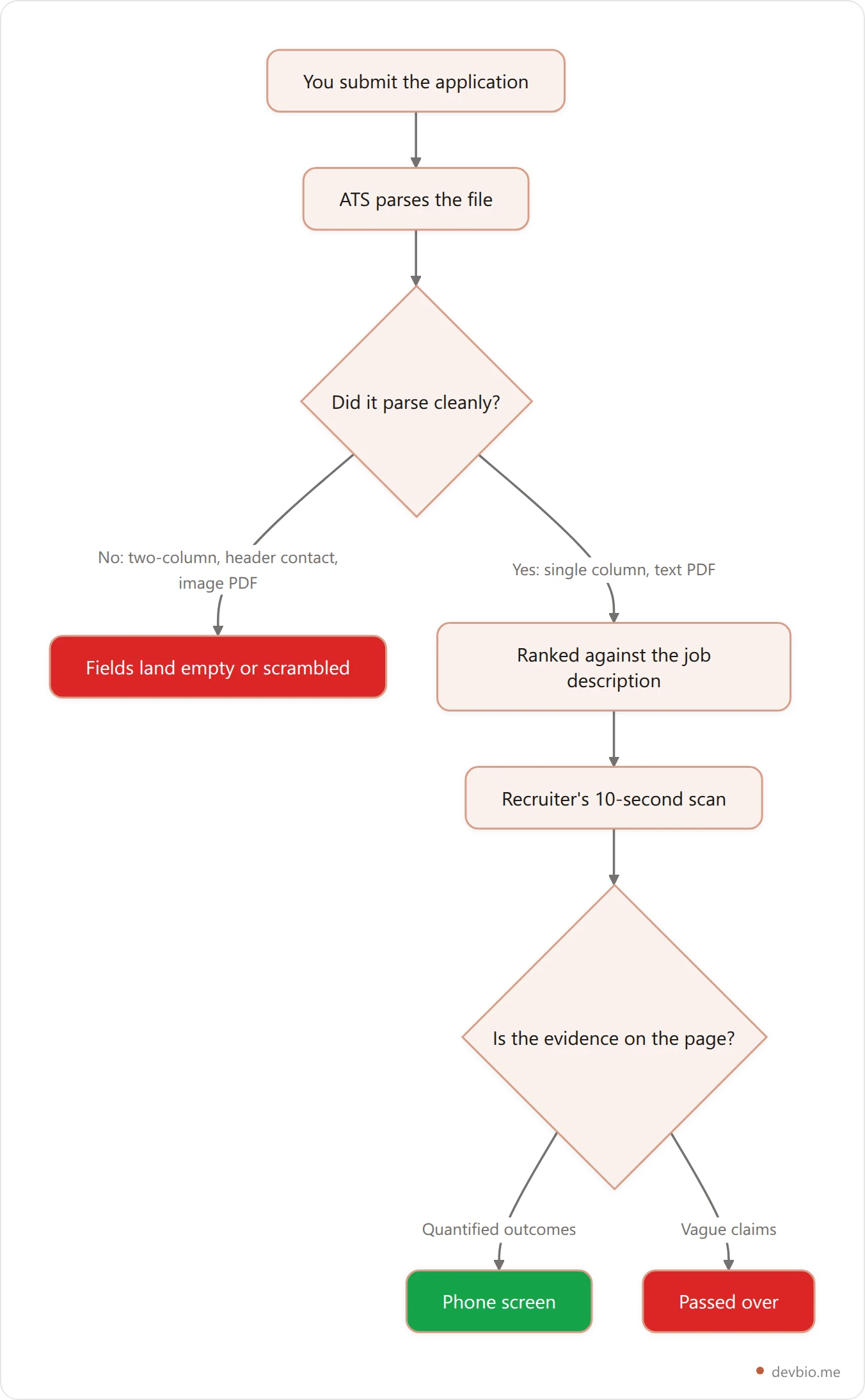
When a recruiter opens your resume, they're running a fast filter: Can this person do the job? Is the evidence on the page? Does the format let me find it in 10 seconds?
The parsing numbers that actually matter:
Single-column layouts: 93% ATS parsing accuracy vs. 86% for two-column formats (MyCVCreator, 2026)
Contact info in headers or footers: 25% of ATS systems fail to extract it — the resume gets flagged as incomplete
Image-heavy or design-tool PDFs: 18% parsing failure rate. Clean LaTeX-generated and simple Word-exported PDFs parse without issue — provided the LaTeX one actually carries a ToUnicode CMap, which is the one preamble detail most LaTeX resume templates leave to chance.
ATS-tailored resumes: 3x more likely to reach a human reviewer than generic versions (MyCVCreator, 2026)
None of this matters if your content fails once a human opens it. Gergely Orosz, former engineering manager at Uber and author of The Tech Resume Inside Out, puts it plainly: "Can this person do the job? That's what I'm interested in. If I see evidence there that they can do the job — great. If I don't see evidence, I will assume they cannot."
Format gets you through the first gate. Content wins the second. Here's how to handle both.
The 5 Developer Resume Formats, Ranked by ATS Performance#
Not all resume formats are created equal — especially for developers. Here is every major format ranked by how well it survives automated screening in 2026.
Format | ATS Parse Rate | Human Readability | Setup Time | Best For |
|---|---|---|---|---|
LaTeX PDF (single-col) | ★★★★★ 93% | ★★★★☆ | 2–4 h | Most roles — best default |
Word/DOCX | ★★★★☆ 89% | ★★★★★ | 30 min | Non-tech companies, recruiters |
Hybrid (PDF + live profile) | ★★★★★ 93% | ★★★★★ | 1–2 h | Senior / principal roles |
GitHub README | ★★☆☆☆ 41% | ★★★★☆ | 1 h | Open source contributions only |
Personal website | ★☆☆☆☆ 12% | ★★★★★ | 4–8 h | Portfolio showcase, not applications |

1. LaTeX Resume PDF (Single Column) — The Benchmarked Best#
Single-column LaTeX PDFs score 93% parsing accuracy across the major ATS platforms (Workday, Greenhouse, Lever). The structured output eliminates the font-embedding and table-cell issues that trip up Word exports. Most tech companies recognise the format instantly as a signal of technical competence.
Where it breaks down: LaTeX has a steep learning curve. Updating your resume for each application means re-compiling the PDF and re-uploading. Small formatting changes can cascade into layout problems if you are not comfortable with the toolchain.
2. Word/DOCX — The Recruiter's Choice#
DOCX is the format most human recruiters prefer to open, annotate, and forward internally. It scores 89% ATS accuracy — lower than LaTeX only because of table-based layouts that some candidates use to create a "two-column" look. A plain, single-column DOCX with standard fonts (Calibri, Arial, or Garamond) is essentially ATS-proof.
Where it breaks down: DOCX files exported to PDF introduce a second round of conversion risk. If you send a DOCX and the recruiter converts it, the layout may shift. Always test your exported PDF before submitting.
3. Hybrid (Live Profile + PDF) — The 2026 Differentiator#
The hybrid approach pairs a clean PDF with a live developer profile — a URL where hiring managers can see your real projects, commit history, and GitHub activity. The PDF clears ATS; the profile seals the human decision. Companies like DevBio auto-generate the LaTeX PDF from your existing profile data, so the two stay in sync without duplicate maintenance.
Where it breaks down: Requires initial setup. Some very conservative enterprise hiring processes still ignore the URL entirely.
4. GitHub Profile README — Contribution Signal, Not a Resume#
A polished GitHub profile README is valuable social proof, but it is not a resume. ATS systems parse it at just 41% accuracy because they are scraping unstructured markdown. It lacks the chronological work history and quantified impact that screening algorithms expect.
Use it as: A supplement to your PDF, not a replacement. Link it in your resume's contact section.
5. Personal Website — Invisible to ATS#
Personal portfolio websites built on custom domains score the lowest ATS parse rate of any format. The content is embedded in JavaScript-rendered HTML that most ATS crawlers cannot read. Greenhouse's own documentation specifically warns applicants not to submit a website URL in place of a document.
Use it as: A portfolio destination after you have cleared screening, not your primary application document.
ATS Resume Format Rules That Actually Matter in 2026#
The internet is full of ATS advice that is either outdated or simply wrong. Here is what actually causes parsing failures, based on how the dominant ATS platforms — Workday, Greenhouse, Lever, and iCIMS — process developer resumes today.
Rules That Are Actually True#
Single-column layout, always. Two-column resumes drop ATS parsing accuracy from 93% to 86% because most ATS systems linearize the content left-to-right, then top-to-bottom. Skills in a right-hand column end up appended after the final job entry, not next to it.
No headers, footers, or text boxes. Content inside page headers, footers, and floating text boxes is either skipped or duplicated. Your name and contact details belong in the body of the document, not in a Word header element.
Standard section labels. ATS systems look for specific headings to categorise content. "Professional Background" may be ignored where "Experience" is reliably detected. Stick to: Experience, Education, Skills, Projects, Certifications.
File format matters more than aesthetics. PDF is acceptable if your PDF contains real selectable text (not a scan or image). DOCX is reliably parsed by every major ATS. Never submit a JPEG, PNG, or Google Docs link.
Keyword density is a signal, not a trick. ATS systems score resumes partly on keyword frequency relative to the job description. If the job description mentions "Kubernetes" four times and your resume mentions it once, you rank lower than a candidate who has it four times — even with identical experience.
Rules That Are Mostly Myths#
"Use white text keywords" — Modern ATS systems flag this as manipulation and some filter it automatically. It also gets flagged if a human ever looks at the raw file.
"One page only" — No ATS rejects a resume for being two pages. The one-page rule is a human recruiter preference for junior candidates, not an automated filter.
"Use exact job description wording" — Semantic matching in Greenhouse and Workday handles synonyms (e.g. "Kubernetes" vs "K8s", "React" vs "ReactJS"). Stuffing in exact strings does not meaningfully outperform natural usage of the same terms.
What to Put in Each Section (Using the PRTO Framework)#
The difference between a resume that clears ATS and one that wins an interview is how well each bullet quantifies impact. The PRTO framework gives you a replicable structure for every work experience bullet:
P — Problem: What was the situation or constraint? R — Role: What specifically did you do? T — Tools: What technology did you use? O — Outcome: What measurable result followed?
PRTO in Practice#
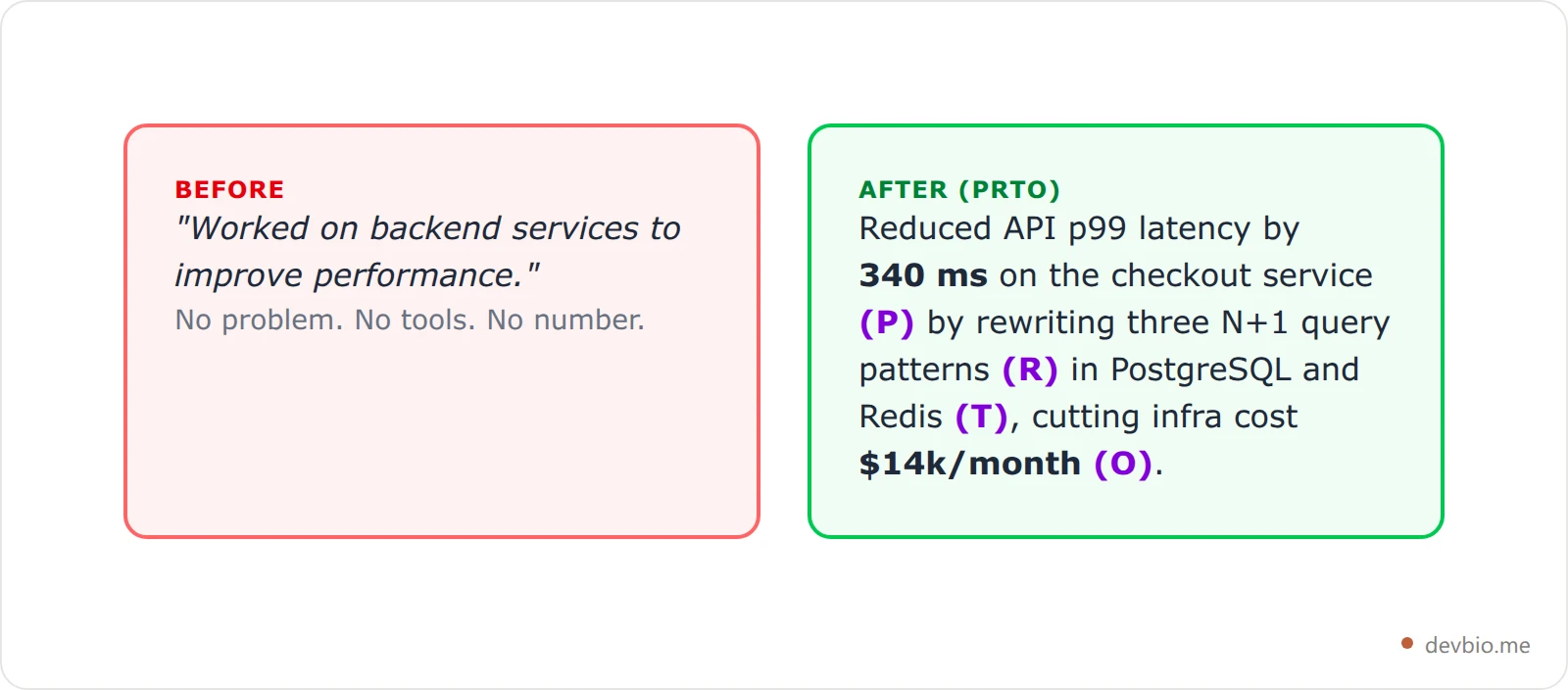
Before (vague, no outcome):
"Worked on backend services to improve performance."
After (PRTO):
"Reduced API p99 latency by 340 ms on the checkout service (Problem) by profiling and rewriting three N+1 query patterns (Role) in PostgreSQL and Redis (Tools), cutting infrastructure costs by $14k/month (Outcome)."
The second bullet answers every question a hiring manager has before they pick up the phone.
Section-by-Section Guide for Developer Resumes#
Contact: Name, city/timezone, email, phone, GitHub URL, LinkedIn URL, personal site or bio URL. No photo, no date of birth, no full street address.
Summary (optional but recommended for senior roles): Two sentences. Role + years of experience + biggest technical differentiator. No objectives ("I am looking for a role where…").
Skills: Group by category — Languages, Frameworks, Infrastructure, Tools. Do not list every technology you have touched; list only ones you could discuss in a 30-minute technical screen.
Experience: Reverse chronological. Four to six PRTO bullets per role. Start each bullet with a strong past-tense verb (Architected, Migrated, Reduced, Built, Led). Include company name, title, and month/year range.
Projects: Two to three items maximum. Include the tech stack, a one-line description, and a link to the live project or GitHub repo. Austen McDonald, who chairs Meta's hiring committee, noted in a 2024 podcast: "Projects with actual GitHub links that I can click through to right now — commits, PRs, real code — carry more weight than three extra lines of experience description."
Education: Degree, institution, graduation year. No GPA unless it is exceptional (3.8+). No "Relevant Coursework" unless you are a new graduate with no experience to fill the space.
Certifications: AWS, GCP, Azure, Kubernetes, and similar cloud certifications are worth listing. Udemy and Coursera completions are generally not — unless the specific cert is well-known (e.g. deeplearning.ai).
How to Use GitHub on Your Developer Resume (Without Linking to a Dead Repo)#
Linking to GitHub is now expected for any technical role. The problem is that most developers link to a profile with sparse commit history, forked repos they never touched, or projects that have not been updated since 2021.
Nolan Church, former Google and DoorDash recruiter, explained the failure mode clearly: "When I click a GitHub link and the last commit on their pinned repo is from two years ago, it tells me either the developer stopped coding or stopped caring. Both are red flags."
What Hiring Managers Actually Check#
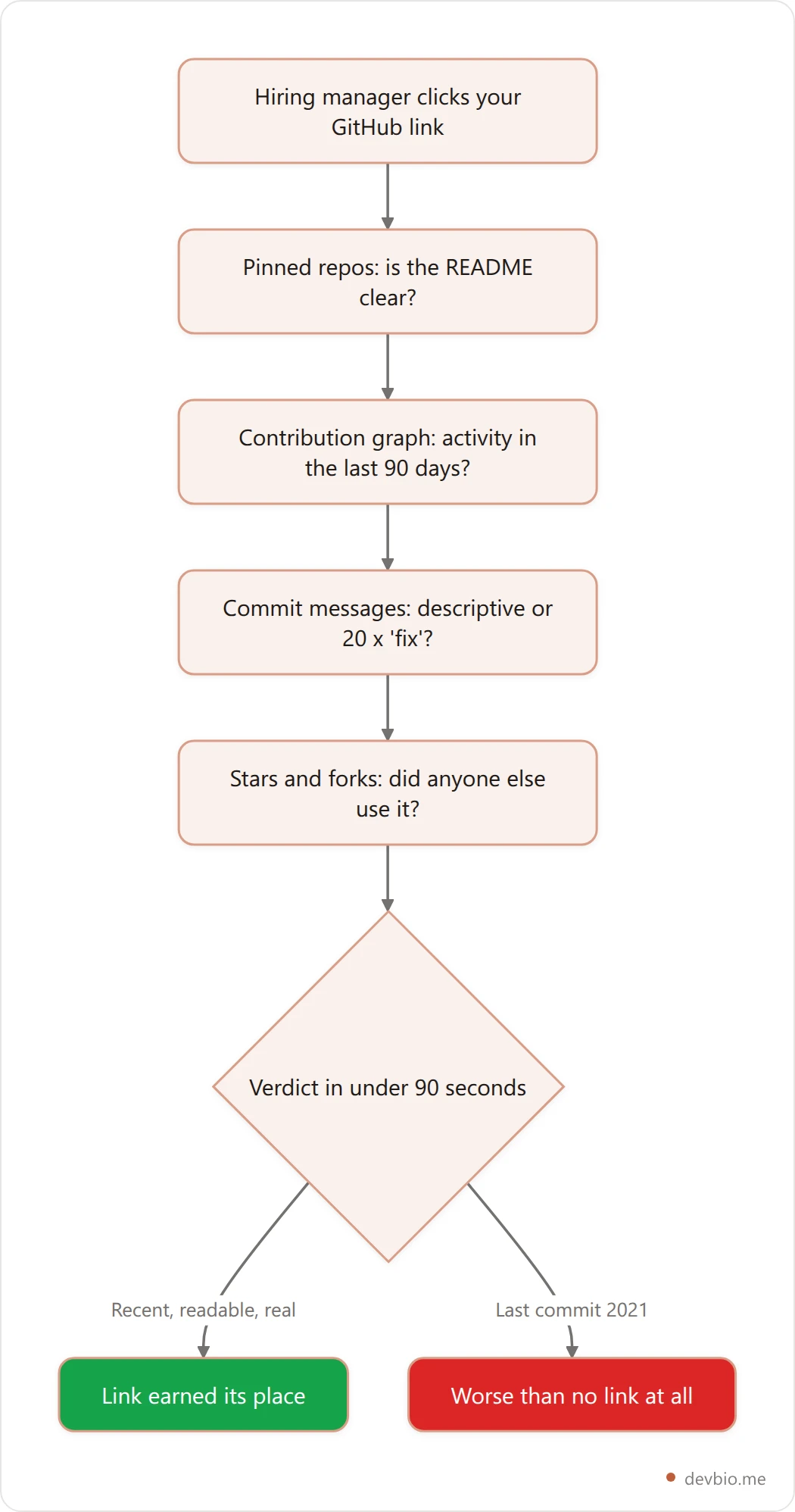
Hiring managers spend under 90 seconds on a GitHub profile. They check four things: whether your pinned repos have clear READMEs, whether the contribution graph shows activity in the last 90 days, whether commit messages describe real changes, and whether anyone else has starred or forked the work.
In order:
Pinned repositories — Are the READMEs clear? Does the project have a live demo link?
Contribution graph — Is there recent activity? Consistent commits signal active engagement with code.
Commit quality — A repo with 200 commits that all say "update" or "fix" is weaker than one with 20 commits that have descriptive messages.
Stars and forks — Social proof that others found the project useful.
The Minimum Bar for Linking GitHub#
Before you add your GitHub URL to your resume, ensure:
At least two pinned repos with complete READMEs (description, tech stack, setup instructions, screenshots)
A contribution graph with activity in the last 90 days
Your profile photo, bio, and company/location fields filled in
Commit messages that describe what changed and why
If you cannot meet this bar yet, do not link your GitHub. A missing link is neutral; a bad link is negative.
One more trap worth knowing before you send anything: if you rename your GitHub account after applications go out, the profile URL printed on every PDF already in a recruiter's inbox returns a hard 404. Repository links redirect after a rename; profile links and gists do not. Here's exactly what a GitHub username change breaks, and how to sequence it so your resume links survive.
What to Link Instead of (or in addition to) GitHub#
If your strongest work is in a private company repo, link to a live project, a developer portfolio page, or a deployed demo. A URL that shows your work product is more useful to a hiring manager than a source repo they cannot read.
For developers who want to surface both — a clean PDF and a live view of their GitHub activity, projects, and contributions — a developer bio page that aggregates everything in one URL solves this problem cleanly.
AI and ML Skills: What to List in 2026#
The 2026 job market has seen a 170% increase in postings that mention generative AI skills, but the signal-to-noise ratio in resumes has collapsed. Everyone now lists "LLM integration" and "prompt engineering" without demonstrating what that means in practice.
Skills Worth Listing (With Evidence)#
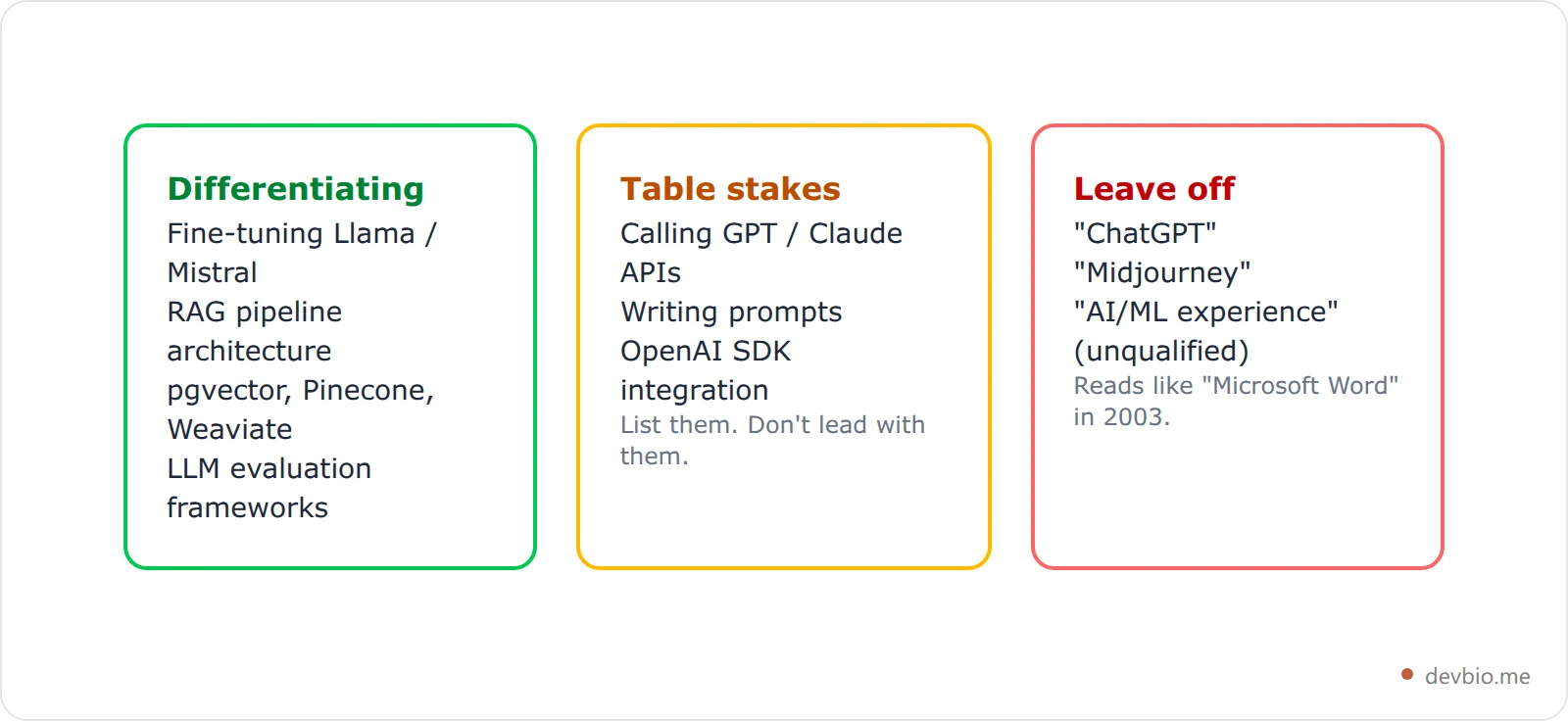
Genuinely differentiating: Fine-tuning open-source models (Llama, Mistral), RAG pipeline architecture, vector database implementation (Pinecone, Weaviate, pgvector), LLM evaluation frameworks, AI safety and alignment basics for product teams.
Table stakes (list but do not lead with): Using GPT-4/Claude APIs, writing prompts, integrating OpenAI SDKs. These are expected skills in most senior engineering roles by 2026 — they are not differentiators.
Avoid listing: "ChatGPT", "Copilot", "Midjourney" — these are consumer tools, not engineering skills. Listing them reads the same as listing "Microsoft Word" in the early 2000s.
How to Frame AI Skills Using PRTO#
Apply the same PRTO framework to AI bullets that you use for everything else:
"Reduced customer support ticket volume by 34% (Outcome) by building an internal RAG pipeline (Role) using LangChain, pgvector, and a fine-tuned Claude Haiku model (Tools) to handle Tier 1 escalations without human routing (Problem)."
This is dramatically stronger than "Built RAG systems using LangChain."
The Hybrid Approach: One Source of Truth for Your Resume#
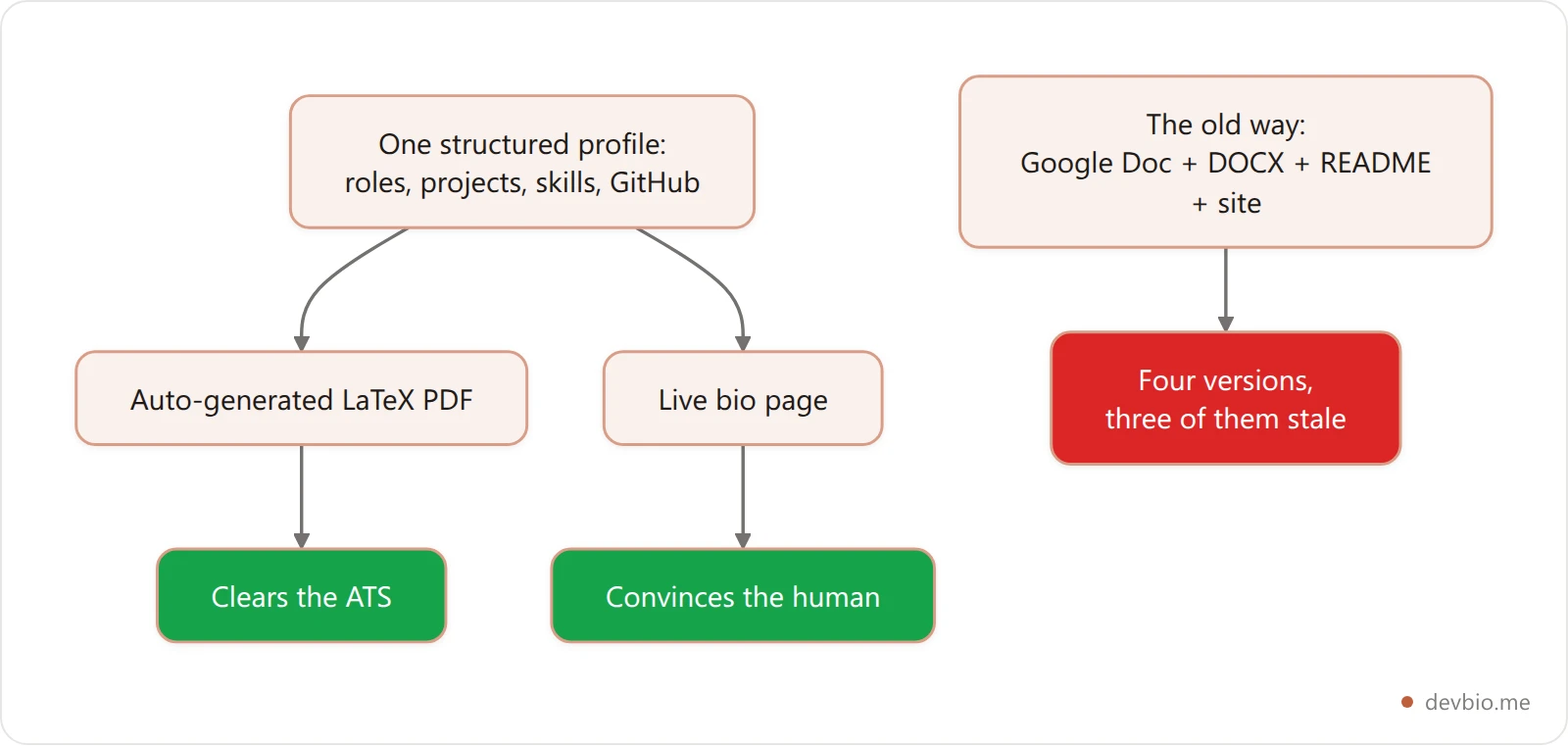
The single biggest maintenance pain for developers is keeping multiple resume formats in sync. You update your experience in LinkedIn, then need to update the PDF, then the GitHub README, then the portfolio site. Each diverges slightly. Hiring managers sometimes see three different versions of your history depending on where they look.
The 2026 solution is a single source of truth: a structured developer profile that automatically generates your LaTeX PDF resume from the same data that powers your live bio page.
Platforms like DevBio take this approach. You build your profile once — work history, projects, skills, GitHub integration — and your resume PDF is generated automatically at /{username}/resume. When you update a project or add a new role, both the live page and the PDF reflect the change instantly.
This matters because:
Consistency: Hiring managers who find your profile URL on LinkedIn see the same story as the recruiter reading your PDF
Freshness: Your contribution graph and GitHub activity sync automatically, so the profile you link to is always current
ATS + human combo: The generated PDF is single-column LaTeX optimised for ATS parsing; the profile URL gives human reviewers the full picture
For a deeper look at how to structure the profile that feeds this pipeline, see how to optimise your developer profile for job search.
The hybrid approach does require initial setup — roughly one to two hours to build out a complete profile. But unlike maintaining a Google Doc and a DOCX and a personal site separately, the ongoing maintenance cost drops to near zero.
The 2026 Developer Resume Checklist (Copy and Use)#
Run through this before submitting any application. Each item is a confirmed ATS or human-reviewer failure point.
Format and File#
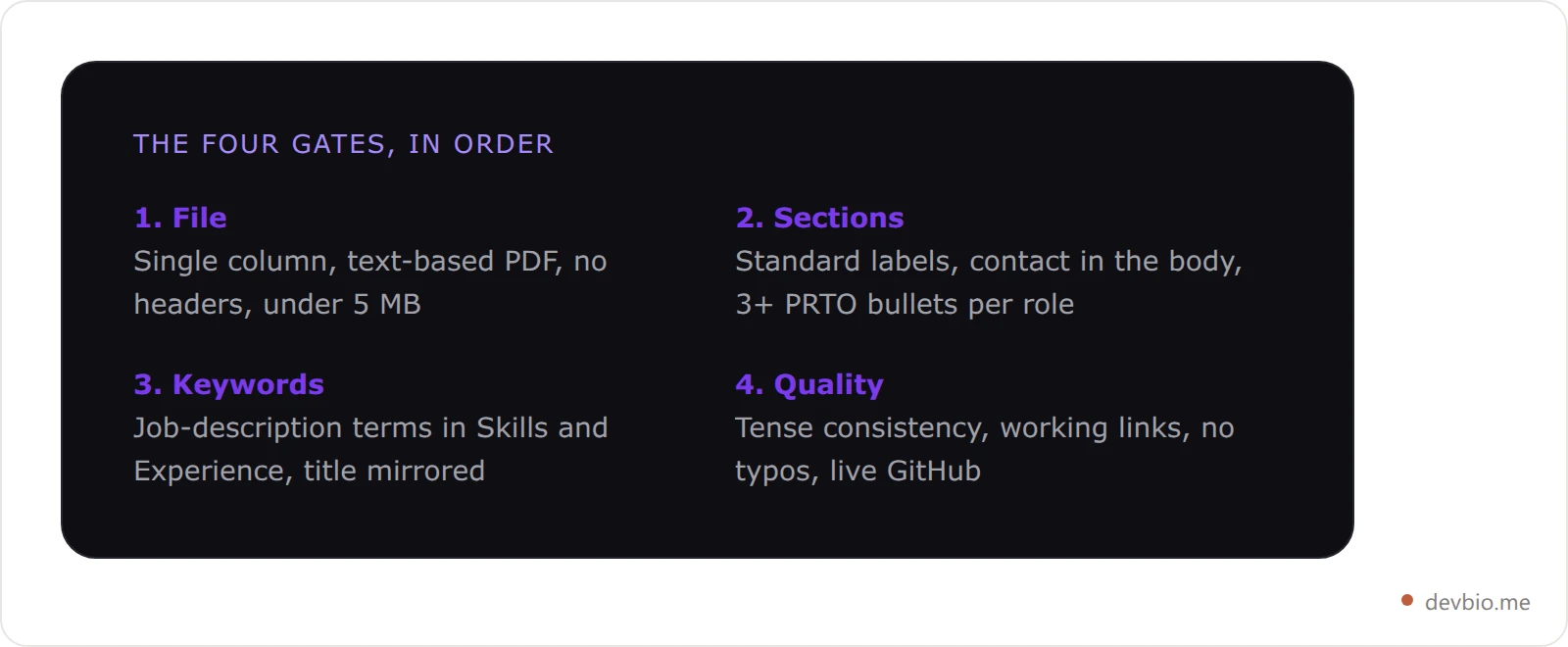
Single-column layout (no sidebars, no text boxes)
PDF submitted as a text-based PDF (not a scanned image)
No content in page headers or footers
Fonts are standard and embedded in the PDF
File size under 5 MB (most ATS portals cap uploads)
Filename format:
FirstName-LastName-Resume-2026.pdf
Content and Sections#
Contact section in document body (not in header element)
Standard section labels: Experience, Education, Skills, Projects
Experience entries in reverse chronological order with month/year dates
At least three PRTO bullets per role with measurable outcomes
Skills section grouped by category (Languages, Frameworks, Infrastructure)
GitHub URL points to a profile with recent activity and complete READMEs
No photo, date of birth, or full street address
Keywords and Tailoring#
Primary keywords from the job description appear in Skills and Experience
Job title in your most recent role matches (or closely mirrors) the target title
Certifications relevant to the role are listed
AI/ML skills framed with PRTO bullets, not bare tool names
Quality Check#
No spelling or grammar errors (run Grammarly or an equivalent)
No unexplained gaps longer than three months (address in a cover letter if needed)
Tense consistency: past tense for previous roles, present tense only for current role
All links work (GitHub, portfolio, LinkedIn)
A non-technical friend can understand what you do after reading the summary
Frequently Asked Questions#
Does ATS actually reject resumes automatically?#
Only about 8% of ATS implementations auto-reject based on keyword scoring, according to a 2025 Enhancv study of 25 recruiters across industries. The widely-cited "75% of resumes never reach a human" figure originated in a 2012 Preptel pitch deck and has no published methodology. In practice, ATS systems filter and rank; they rarely reject entirely. Human recruiters still make screening decisions in the vast majority of cases.
What is the best resume format for software engineers?#
A software engineer resume works best as a single-column PDF — either LaTeX-generated or a clean Word export. It scores the highest ATS parsing accuracy (93% for single-column PDFs) while remaining readable for human reviewers. Pair it with a live developer profile URL for senior and staff-level applications.
How long should a developer resume be?#
One page for candidates with fewer than 7 years of experience. Two pages for senior engineers and above. No ATS system penalises length — the one-page rule is a human reviewer preference that typically applies to early-career candidates where brevity signals prioritisation ability.
Should I list every programming language I know?#
No. List only languages you would be comfortable discussing in a 30-minute technical interview. A long list of languages you used five years ago reads as padding. Hiring managers assume basic proficiency in adjacent languages — a Go developer who lists Python, JavaScript, Bash, Ruby, and Perl looks unfocused, not versatile.
How do I include open source contributions on my resume?#
Create a dedicated "Open Source" subsection under Projects. For each contribution, name the project (and its user scale if notable), describe your specific contribution in one PRTO bullet, and link to the merged PR or commit. A contribution to a 50,000-star repo carries more signal than a personal project with 2 stars — let the project's audience size do the work.
Is a cover letter necessary for developer roles?#
For most individual-contributor engineering applications: no. Most technical hiring managers do not read cover letters before the phone screen. Exceptions are: roles at small companies where culture fit is the primary filter, roles where you are changing industries or taking a significant career step, and companies that explicitly say cover letters are required or considered.
What is the fastest way to generate a developer resume from an existing GitHub profile?#
The fastest path is a developer bio platform that reads your GitHub data and generates a structured resume automatically. DevBio pulls your GitHub metadata — repositories, languages, contribution history — into a structured profile and generates a LaTeX PDF at /{username}/resume. Setup takes about 15 minutes if your GitHub profile is already complete. For a full walkthrough of optimising your GitHub profile first, see the GitHub profile README guide.
Key Takeaways#
The "75% of resumes are auto-rejected" statistic is fabricated — it traces to a 2012 pitch deck from a company that shut down in 2013. Only about 8% of ATS setups auto-reject anything.
Single-column beats two-column on every ATS: 93% parse accuracy against 86%. Contact details belong in the document body, never in a header element.
A developer resume 2026 hiring managers act on leads with quantified outcomes. Use PRTO — problem, role, tools, outcome — on every bullet.
A stale GitHub link is worse than no GitHub link. Meet the minimum bar first: two complete pinned READMEs and activity in the last 90 days.
Maintain one source of truth. Four hand-updated versions of your history means three of them are wrong.
The Bottom Line#
In 2026, the developer job market is the most competitive it has been in a decade. Dev job postings have dropped 68.8% from their 2021 peak, entry-level roles have dropped 73%, and the average role now receives 65+ applications. The margin between getting a phone screen and getting filtered out is thinner than it has ever been.
The good news: most of the competition is making avoidable mistakes. Two-column layouts, keyword-free bullet points, dead GitHub links, and personal website URLs submitted instead of PDFs — these are not mysterious rejections, they are fixable problems.
Start with the checklist. Fix the format. Write three PRTO bullets for every role. Make sure your GitHub link is worth clicking. And if you want to remove the maintenance overhead entirely, build a structured developer profile that generates the PDF automatically and keeps both the human and ATS version of your story in sync.
Your resume is not your career — but in a competitive market, it is the first gate. Make it one you clear easily.
Stop maintaining four versions of your resume
Build the profile once — roles, projects, skills, live GitHub activity — and get an ATS-ready PDF and a shareable bio page that never drift apart.
Build your profileSources: CareerPlug recruiting metrics (60,000+ companies, 10M+ applications), iCIMS Workforce Report (November 2025), Enhancv ATS Study 2025, MyCVCreator ATS parsing benchmarks 2026, Indeed Hiring Lab 2025, and Ravio 2025.


