

Bento.me went dark on February 13, 2026. If your profile lived there, the URL no longer leads to you — Linktree, which had acquired Bento back in 2023, pulled the plug with a 30-day notice, and every old bento.me address now answers with a permanent redirect to Linktree's own homepage. For most people who used it, that's an inconvenience. For developers, it exposed something more specific: none of the half-dozen platforms racing to catch Bento's displaced traffic actually replace what a developer's bio needs to do.
A Bento.me alternative for developers has to do more than recreate a grid of link blocks. It needs to show live GitHub activity, real revenue from a shipped SaaS, and produce a resume an applicant-tracking system can actually parse — because that's proof a generic link page never had in the first place.
Updated July 2026. This covers what actually happened to Bento, why the current wave of "alternative" roundups is solving the wrong problem for developers, a full feature comparison, and a step-by-step migration path.
What Happened to Bento.me (and Why There's No Way Back)#
Bento.me shut down for good on February 13, 2026, after Linktree — which had acquired it in 2023 — chose not to keep running two competing link-page products. There's no official way to get a deleted page back.
The timeline, pieced together from the shutdown notice and coverage at the time:
2023 — Linktree acquires Bento.me.
After November 2024 — No new features ship to Bento. Its signature visual grid layout is never folded into Linktree's core product.
January 13, 2026 — Linktree announces the shutdown, giving existing users a 30-day window.
February 13, 2026 — Bento.me goes offline for good. Pages, images, and account data are permanently deleted. There was no built-in export tool, so anything a user didn't manually screenshot or copy before the deadline is gone. (own.page, popout.page)
One detail still catches people out: the domain didn't go dark in the usual sense. Every bento.me URL returns a 301 to Linktree's homepage, so old links still "work" while quietly sending visitors somewhere you never chose — here's exactly where your Bento.me links go now, and what that redirect costs you.
For most former users, the loss is a nicely arranged grid of links. For developers, the real damage is smaller than it looks: Bento never held anything you couldn't lose in a single acquisition decision. No GitHub data pipeline. No revenue proof. No ATS-readable resume. Nothing an employer or client could verify independently of the page itself.
That gap didn't go unnoticed. Within weeks of the shutdown, developers had already shipped open-source replacements — Bento.you, a self-hosted clone built with Next.js and Tailwind, and Blento, which stores data on a Bluesky-style personal data server specifically so one company's acquisition can't delete it again. That grassroots reaction is itself a signal worth reading: the developers most annoyed by the shutdown weren't chasing a nicer grid. They wanted something that couldn't be switched off by someone else's roadmap decision.
Why the "Best Bento Alternative" Roundups Miss What Developers Need#
Most Bento-alternative roundups rank tools by how closely they clone Bento's visual grid. That's the wrong axis for developers: Bento never showed live GitHub activity or real revenue, so a nicer-looking grid still can't prove what you've actually shipped.
Look at how the existing coverage handles developers specifically:
Popout Page markets itself as the developer-friendly pick and lets you link out to GitHub repos and research papers. But it's still a page that links to your work, not one that pulls it — no live star or commit counts, no revenue proof, no resume generation.
Linktree, Carrd, About.me, Bio.link are general creator tools. None of them connect to a GitHub account or a payment processor. They were never built to.
Even the best-designed grid clones fail the same test: they replace where your links live, not what backs them up.
If the biggest thing you liked about your Bento page was the grid, you were probably underusing it anyway. What got a reply from a hiring manager or a client was never the layout. It was the shipped project underneath it — and a grid of link blocks can't show that on its own.
The No-Second-Bento Checklist#
Before you pick whatever's next, run it through four questions. Call it the No-Second-Bento checklist — because the goal isn't just finding a home that looks nice, it's not getting burned the same way twice.
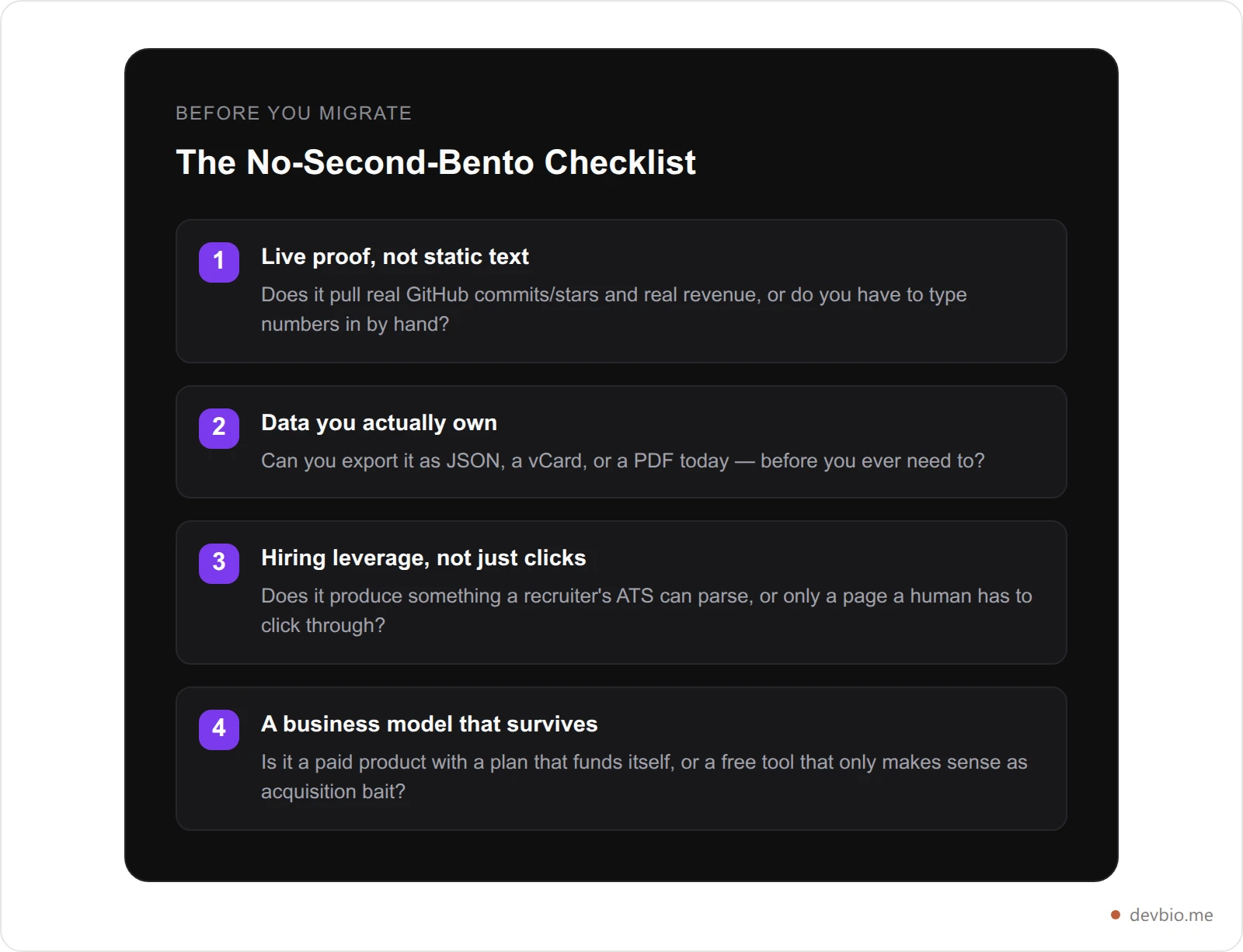
Bento failed questions 1, 2, and 4. It never had live GitHub or revenue data (1), it deleted everything with no export path (2), and it was free — which made it cheap to acquire and cheap to shut down (4). Any replacement worth your time this year should clear all four, not just look better doing question zero: the grid.
Bento.me Alternatives for Developers: Full Comparison#
Here's how the realistic options stack up against those four questions, not against how close they get to Bento's original grid aesthetic.
Platform | Live GitHub data | Live revenue (MRR) | ATS PDF resume | Data export | Starting price |
|---|---|---|---|---|---|
DevBio | Yes (stars, commits, heatmap) | Yes (Stripe, Dodo, Lemon Squeezy, Polar) | Yes (LaTeX-typeset PDF) | Yes (JSON, vCard, llms.txt) | Free |
Popout Page | Links to repos only | No | No | Limited | Paid tiers |
Linktree | No | No | No | Basic link list | Free / $35+/mo Premium |
Carrd | No | No | No | No built-in export | $19/yr |
GitHub README | Static, self-maintained | No | No | It's just markdown | Free |
Two things worth calling out from that table. First, "Live GitHub data" for DevBio isn't a manually-updated badge — it's pulled from the GitHub API on a sync cycle, so a heatmap and star count reflect what you actually shipped this week, not what you typed in six months ago. Second, revenue only shows up at all if you connect a payment integration; nothing is fabricated or estimated. Here's the fuller breakdown of every general link-in-bio tool tested against developer needs.
Where a Bento Replacement Should Be Honest About Its Limits#
DevBio isn't a freeform drag-and-drop grid. Bios are built from fixed, typed components — basic info, projects, skills, work experience, GitHub stats, contribution heatmap, links — not arbitrary photo tiles arranged into a mood board. That's a real tradeoff worth knowing before you switch.
If the single thing you loved about Bento was the visual freedom of stacking image blocks however you wanted, a grid clone like own.page or tini.bio will feel more familiar on day one than a component-based bio will.
What you get in exchange for giving up that layout freedom: every component renders your real data automatically, and the same profile powers a dozen other surfaces without you touching a layout again — a PDF resume at /resume, a link-only view at /links, a QR code, a vCard, and a JSON feed of your projects. Here's the full list of what to actually put on a developer bio and why.
The link-in-bio category isn't small, and it isn't shrinking because Bento left it. The market is worth roughly $1.2 billion and growing at a 14.4% CAGR, serving more than 70 million creators — Linktree alone counts 50 million users. Bento's failure wasn't the category; it was building a product with no data moat inside a company that already had a bigger one.

Migrating From Bento to DevBio, Step by Step#
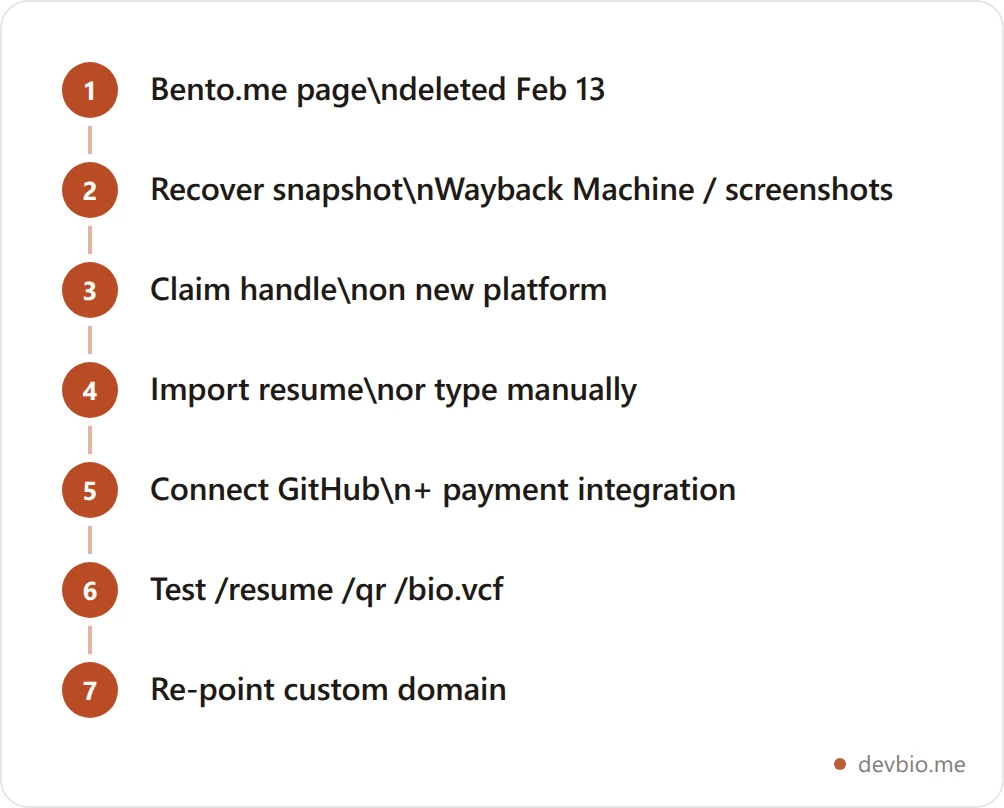
Since Bento shipped no export tool, start by recovering whatever you can — the Wayback Machine sometimes cached a snapshot of your page, and phone screenshots or browser history may hold the rest. Don't count on getting everything back; treat this as a rebuild, not a restore.
Claim your handle. Go to devbio.me and grab the same username you used everywhere else, if it's free.
Import what you can. If you have an existing resume file, DevBio's resume importer uploads and parses it directly into bio components — faster than retyping your work history from memory.
Add basic info, avatar, and a two-sentence about. Skip anything that'll be stale in six months.
Connect GitHub. This turns on live star counts, commit activity, and the contribution heatmap — the proof layer Bento never had.
Connect a payment integration, if you run a SaaS or subscription product — Stripe, Dodo Payments, Lemon Squeezy, or Polar all work. Your project cards start showing real MRR automatically.
Add projects, links, and skills. Prioritize the components that actually get read first.
Test your endpoints. Visit
/resume,/qr, and/bio.vcfon your new profile to confirm the PDF, QR code, and vCard all work before you put the link anywhere public.Re-point your custom domain, if you had one aimed at Bento. The DNS change takes about 10 minutes.
The whole process runs 20–30 minutes for someone with an existing resume to import — longer if you're rebuilding project descriptions from memory.
If Your Bento Page Was Selling a Product, Not Just Networking#
A chunk of Bento's developer users weren't using it as a networking card at all — they were using it as a lightweight landing page for a side project, with a link to a Gumroad or Stripe checkout tucked between the grid tiles. That use case has a specific gap in most of the roundups above: none of the grid-clone alternatives have anywhere to list a SaaS for sale, or show it's making real money to a prospective buyer.
DevBio's marketplace listing exists for exactly that. If your project is far enough along that you're thinking about selling it outright rather than just linking to a checkout page, a live MRR figure pulled from Stripe or Dodo Payments does more to establish asking-price credibility than a testimonial block ever did. Here's how to value a SaaS business before you list it.
If you're not selling anything and just want the checkout link, that still works the same way it did on Bento — add it as a project link, and the live revenue number becomes proof the product isn't vaporware, without you writing a single sentence claiming it.
Before/After: A Contract Developer's Bento Migration#

Before: Priya is a freelance iOS developer. Her Bento page had a clean grid: an intro block, four app-store screenshots, a stack of client testimonials, and a Calendly link. It looked good. It also went offline on February 13 with everything on it — she'd been traveling and missed the export window entirely. Her Upwork profile and email signature both still pointed at a dead link for almost three weeks before a client mentioned it.
After: She rebuilds on a component-based profile instead of hunting for another grid clone. Her GitHub connection shows 340+ contributions this year across two open-source Swift packages. A Stripe connection to her small App Store analytics SaaS shows $890 MRR — a real number, not a claim in an "About" paragraph. Her /resume endpoint generates an ATS-clean PDF she now attaches directly to Upwork proposals instead of a separate résumé file.
The measurable difference: three new client replies in the first two weeks that specifically mention the GitHub activity or the MRR figure — something her old grid, however nicely arranged, never gave a client a reason to bring up.
Other Places Developers Are Rebuilding#
Not everyone displaced by the shutdown wants a hosted product at all, and that's a legitimate path. Bento.you is a self-hosted, open-source clone of Bento's original grid, built on Next.js and Tailwind — a solid pick if you want the original layout back and don't mind maintaining your own deployment. Blento takes it further, storing profile data on a personal data server rather than any single company's database, which sidesteps the "one acquisition away from deletion" problem entirely.
The tradeoff with both: you're back to running infrastructure, and neither pulls live GitHub or revenue data automatically. They solve for portability, not for proof. Whether that tradeoff is worth it depends on whether you'd rather spend an afternoon on server config or on writing your first three project descriptions.
Free vs. Paid: What Actually Costs Money#
One more thing the Bento shutdown should make you check before committing: what's actually free, and what a company needs to charge to stay solvent.
Free | Pro ($2/mo or $12/yr) | |
|---|---|---|
Public bio + all components | Yes | Yes |
GitHub public-repo data | Yes | Private repos + heatmap |
ATS PDF resume | Yes | Yes |
Marketplace listing | Yes | Yes |
Custom domain | No | Yes |
Analytics history | — | 30 days |
Integration sync | 6-hour | Hourly |
A $2/month plan isn't enough to run a company on its own, but it's a real, disclosed number — not a "free forever" pitch that only pencils out if the company gets acquired for its user list. When you're picking where your professional profile lives for the next few years, "how does this business make money" is a fair question to ask before you invest an afternoon rebuilding.
FAQ#
What happened to Bento.me?
Bento.me shut down permanently on February 13, 2026. Linktree, which had acquired Bento in 2023, chose not to continue running it after deciding not to integrate its grid layout into Linktree's own product. Existing pages, images, and account data were deleted with no built-in export tool.
Is there any way to recover my old Bento.me page?
Not officially — Bento offered no export before shutdown. Your best options are the Wayback Machine (search your old URL at web.archive.org), phone screenshots, or browser cache/history from before February 13, 2026. Treat any recovery as partial; plan to rebuild rather than restore.
What's the best Bento.me alternative for developers specifically?
The best fit depends on what you actually used Bento for. If you want a page that shows live GitHub activity, real product revenue, and generates an ATS-readable resume, a developer-native tool like DevBio fits that need directly. If you specifically want Bento's original drag-and-drop grid back, a visual clone like own.page or the open-source Bento.you is closer to that experience.
Does DevBio look like Bento.me?
No. DevBio uses fixed, typed components (basic info, projects, GitHub stats, skills, work experience) rather than a freeform grid of arbitrary blocks. It trades layout flexibility for automatically-updating live data and a set of extra formats — PDF resume, QR code, vCard, JSON — that a grid-based tool doesn't generate.
Can I move my custom domain from Bento to a new platform?
Yes. A custom domain is just a DNS record you control — you can repoint it at any new host in minutes by changing the CNAME or A record in your domain registrar, independent of whatever platform you migrate to.
Will my next platform just shut down again?
No guarantee exists for any company. What you can check: does it have a real, disclosed pricing model that supports the product on its own (rather than relying on a future acquisition), and can you export your data today, before you'd ever need to. Those two answers tell you more than a company's current feature list does.
Do I need a payment integration connected to use a developer bio?
No. Revenue display is optional and only appears if you connect Stripe, Dodo Payments, Lemon Squeezy, or Polar. A profile with just GitHub activity and shipped projects is a complete, useful bio on its own.
What if I want a fully open-source, self-hosted alternative instead?
Bento.you and Blento are both open-source projects built specifically as Bento replacements, and both are viable if you're comfortable maintaining your own deployment. The tradeoff is that neither currently pulls live GitHub or revenue data automatically — you're trading a hosted product's convenience for full control over your infrastructure.
Key Takeaways#
Bento.me shut down February 13, 2026 with no export tool — treat any recovery as partial.
Grid-clone alternatives solve the wrong problem for developers: none pull live GitHub or revenue data.
Run any replacement through the No-Second-Bento checklist: live proof, data ownership, hiring leverage, a business model that survives.
Put Something Bento Couldn't Take With You#
Three things worth doing this week if you were on Bento: pull whatever you can from the Wayback Machine before it ages out of cache, run any replacement you're considering through the four-question checklist above, and connect a data source — GitHub, a payment processor, or both — instead of just retyping the same static text into a new grid.
A page that only holds what you typed can disappear the same way Bento's did: one acquisition, one roadmap decision, gone. A page that pulls from your actual GitHub activity and actual revenue survives any single platform's decisions, because the proof underneath it was never the platform's to delete.
Your code and your revenue already exist independent of any bio tool. Put them on one link that shows it — devbio.me.


