

Your developer bio opens with "results-oriented engineer passionate about leveraging cutting-edge technology," and a recruiter has already decided how to read the rest of it. Not because it's untrue. Because it's the same sentence on the last forty profiles they scanned this week.
A developer bio sounds like AI wrote it when it's built from statistically-average phrasing instead of specific, checkable facts. Words like "leverage," "passionate," and "results-oriented" are overrepresented in AI training data, so AI tools default to them constantly. The fix isn't avoiding AI tools. It's replacing generic claims with details nobody else could have written, then backing them with proof a visitor can verify.
This guide covers the exact words to avoid in resume and bio copy, why a developer bio sounds like AI in the first place, a quick test for catching generic sentences before you publish them, and a full before-and-after rewrite you can copy the pattern from.
Developer Bio Sounds Like AI? Why Recruiters Reject It in 2026#
A developer bio that sounds like AI wrote it isn't really a grammar problem. Hiring teams didn't get pickier about grammar. They got pickier about sameness. When every applicant's summary reads like it came from the same template, a polished bio stops signaling competence and starts signaling that you didn't write it yourself.
The data backs this up directly. 49% of US hiring managers now auto-dismiss résumés and profiles they suspect are AI-generated, and 62% specifically reject copy that reads as generic and lacks personalization, according to a 2026 compilation of hiring statistics. Among those who reject AI-flavored copy, 51% point to unnatural phrasing as the exact tell — a turn of phrase nobody actually says out loud, dropped into a sentence that's otherwise grammatically perfect.
It's not paranoia about AI specifically. It's that 78% of hiring managers actively look for personalized, specific details as their signal of genuine interest and fit. A bio built entirely from safe, average phrasing gives them nothing to key into.
The same reaction shows up in a different corner of self-presentation. A 2026 survey of working professionals found 38% describe AI-generated headshots as "soulless" — technically fine, missing whatever makes a face read as a real person's, according to an analysis of AI vs. real headshots. A bio built from the same statistically-safe phrasing an AI defaults to triggers the identical reaction, just in text instead of pixels.

The Real Problem Isn't Detection. It's Sameness.#
Most advice about "AI-sounding" writing focuses on getting caught by a detector. That's the wrong frame. Detectors are unreliable and recruiters know it. What they're actually reacting to is simpler: volume.
Robert Half's March 2026 survey of 2,000 US hiring managers found that 67% say reviewing AI-generated applications has measurably slowed their hiring process, because so many now read as interchangeable. One recruiter's line from that research, paraphrased across multiple 2026 hiring reports: résumés have started to sound like the same person applied for every job.
That's the actual risk to a developer bio. Not that a classifier flags it as synthetic. That a human skims it, recognizes the shape of a thousand other bios they've read, and moves on before reaching the part that's actually true and interesting about you.
Stack Overflow's own CEO, Prashanth Chandrasekar, made a version of this point about AI output in general, in conversation with OpenAI's Romain Huet: "If you fat-fingered something on a calculator and you got your exam question wrong, it's not on the calculator." The tool isn't the problem. Publishing its default output without editing it into something only you could have written, is.
AI Detectors Won't Save You (or Convict You)#
The instinct after reading stats like these is to run your bio through an AI-detection tool and treat a clean score as proof you're safe. Don't. Detection tools flag statistical patterns, not truth, and they're wrong often enough in both directions that a passing score tells you very little. Human-written text gets flagged as AI-generated regularly, especially from non-native English speakers whose phrasing is naturally more formulaic — and AI-polished text that's been lightly edited slips past detectors constantly.
Recruiters increasingly know this too, which is why the stats above are about human judgment, not detector output — 51% cite unnatural phrasing they noticed themselves, not a tool's verdict. That's actually good news: it means the fix isn't gaming a classifier. It's writing something specific enough that no classifier, human or software, would mistake it for the average.
The Swap Test below does the same job as a detector, except it optimizes for the thing that actually matters — whether the sentence is genuinely about you — instead of whether it matches a statistical fingerprint.
The Swap Test: How to Tell If Your Bio Sounds Like AI#
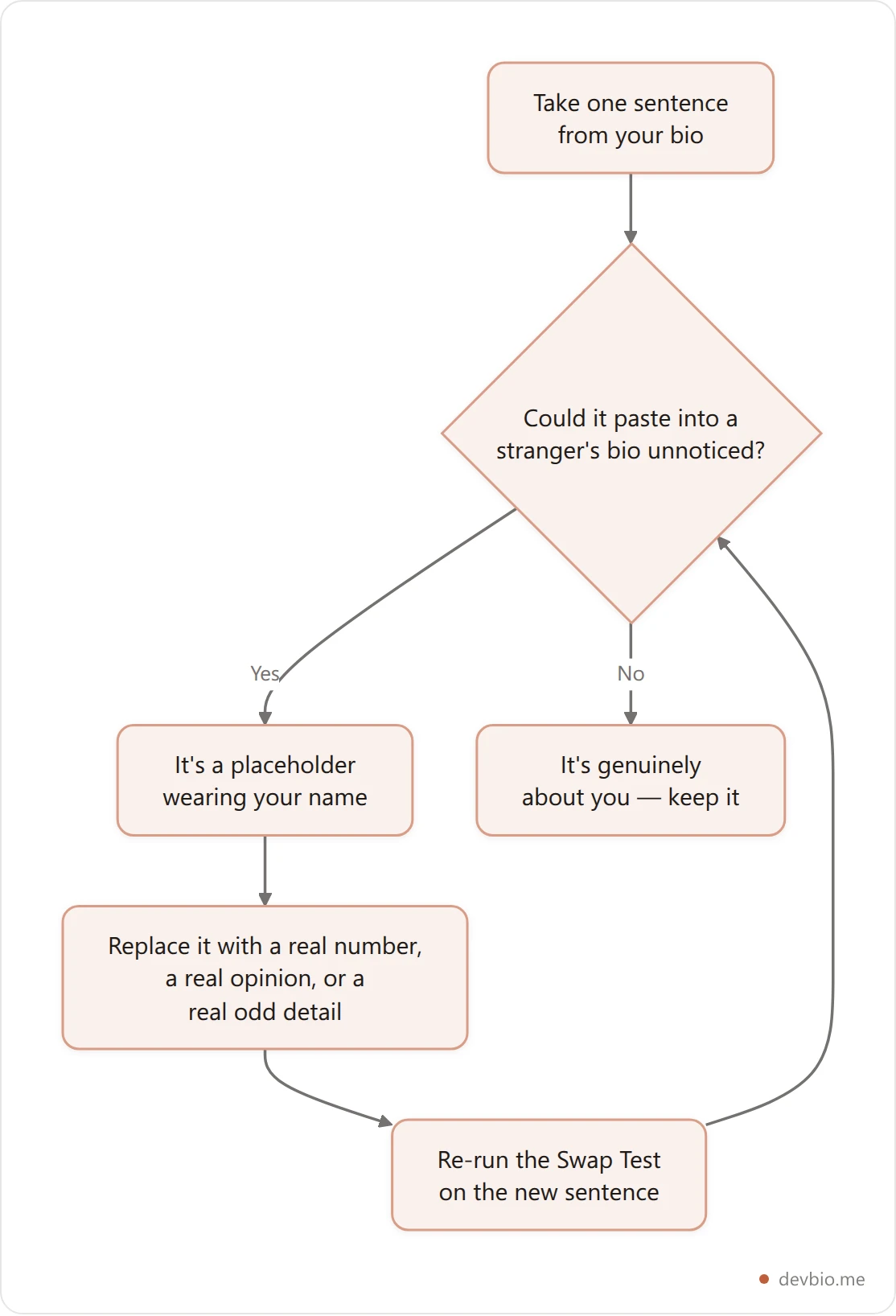
Here's a fast way to audit your own bio without needing an AI detector at all. Call it the Swap Test: for every sentence in your bio, ask — could I paste this into a stranger's profile and would anyone notice it doesn't belong there?
If the answer is yes, the sentence isn't about you. It's a placeholder wearing your name.
"Passionate about building scalable solutions" passes into any bio on the internet without friction. "Rewrote our Postgres connection pooling after a 3 a.m. outage cost us 40 minutes of checkout uptime" does not — it only makes sense attached to the person who actually lived it. The Swap Test doesn't ask you to sound clever. It asks you to be specific enough that the sentence breaks when someone else tries to wear it.
Run every line of your current bio through it. Anything that survives the swap gets cut or rewritten with a real detail standing in its place.
Words to Avoid in Resume and Bio Copy#
Most lists of words to avoid in resume writing are guesswork. These aren't. They're the AI resume cliches that show up in generated text far more often than in how people actually talk about their own work, because they're statistically overrepresented in the training data these tools draw from. A few are worth cutting on sight:
Leverage — just say "use," or better, say what you actually did with it
Passionate about — show the passion via a specific project, don't label it
Results-oriented / results-driven — meaningless without an actual result attached
Delve / tapestry / robust — words nobody uses out loud in a normal sentence
Synergy / cutting-edge / best-in-class — vague enough to apply to anything
Spearheaded / championed / drove — fine occasionally, deadly when every bullet opens with one
Seasoned professional (from someone two years out of school) — an age/seniority mismatch recruiters notice immediately
None of these words are individually damning. The problem is density — a bio that strings four or five of them together in one paragraph reads as generated, even if a human typed every word of it.
What to Write Instead: Specific, Weird, Yours#
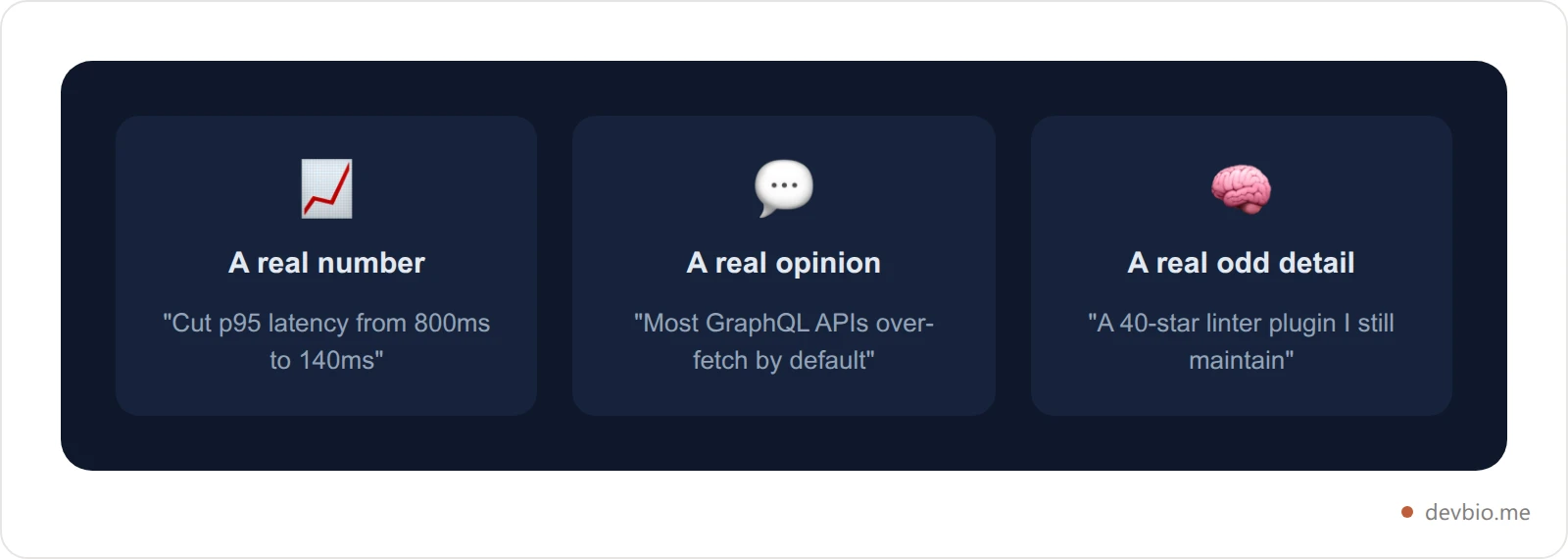
The replacement for a buzzword is not a better buzzword. It's a fact only you could produce. Three categories consistently work:
A real number. Not "improved performance significantly" — "cut our p95 API latency from 800ms to 140ms by batching N+1 queries." A number is either true or it isn't; a recruiter can't mistake it for filler.
A real opinion. "I think most GraphQL APIs over-fetch by default and I've stopped defending mine that way" reads as a person with a position, not a résumé template.
A real, slightly odd detail. The project you built at 2 a.m. because you were annoyed at something. The library you still maintain even though it only has forty stars. Specificity that's a little unusual is the fastest way to signal a human wrote it, because AI-generated bios trend toward the safe middle, not the interesting edge case.
This is also where a bio benefits from sitting next to things that can't be typed. A developer profile built around live components — GitHub activity, shipped projects, revenue — gives every claim in your About text somewhere to point. "I ship fast" reads as filler on its own. Next to a contribution graph and three live project cards, it reads as a claim you can check in five seconds. See what that looks like on a live profile.
Generic vs. Authentic Developer Bio: Side by Side#
Generic (fails the Swap Test) | Authentic (passes it) |
|---|---|
"Results-oriented full-stack engineer passionate about building scalable solutions." | "I build Go backends. Last one handled a 6x traffic spike during a client's product launch without a single restart." |
"Experienced in leveraging cutting-edge technologies to drive innovation." | "I rewrote our auth service in Rust because the Node version was falling over at 200 req/s. It now holds 4,000." |
"Passionate about clean code and best practices." | "I have a 40-star linter plugin I built because our team kept shipping the same off-by-one bug." |
"Strong team player with excellent communication skills." | "I run our team's incident retros. Last quarter we cut mean-time-to-resolution from 50 minutes to 18." |
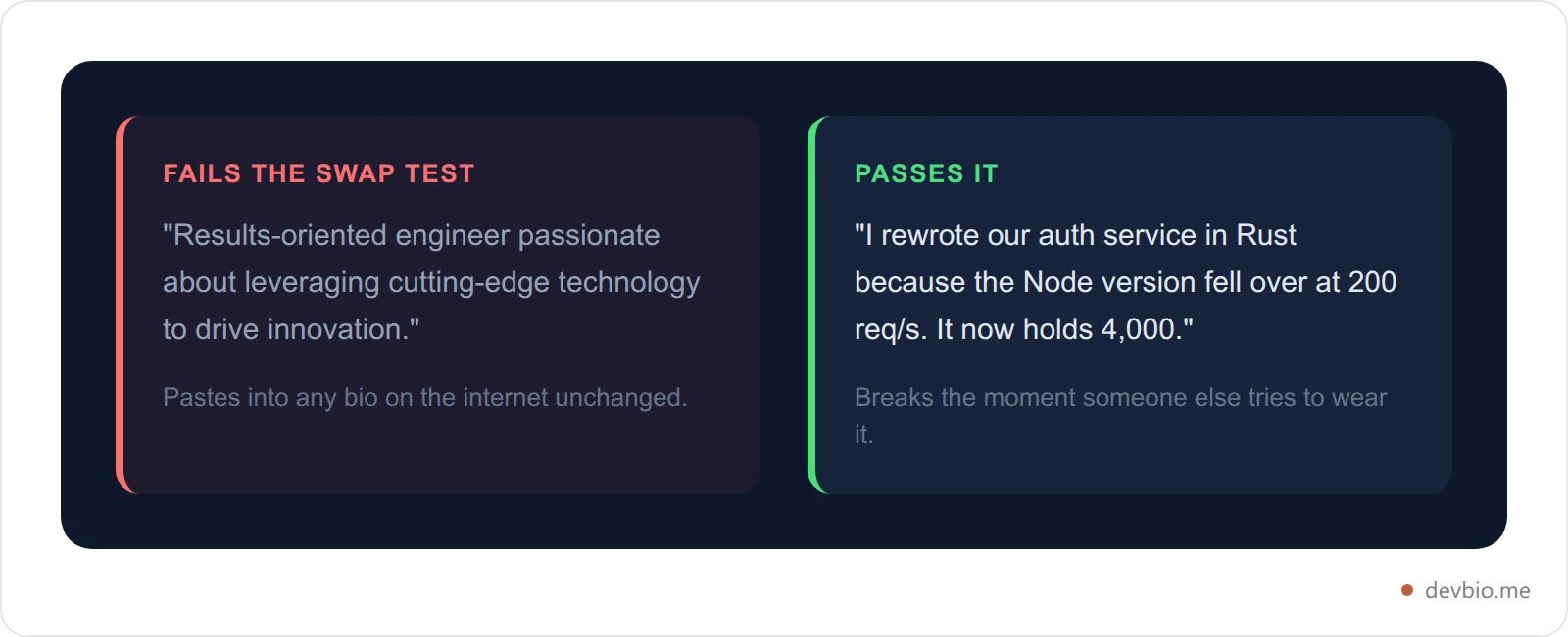
Notice the pattern: every authentic version names a specific system, a specific number, or a specific moment. None of them are better-written in a literary sense. They're just harder to fake, which is exactly why they read as true.
Voice Isn't Enough — Pair It With Proof That Can't Be Faked#
Here's the limit of even a perfectly rewritten bio: text is still text. A recruiter reading "I cut our p95 latency to 140ms" has to take your word for it, and in 2026, taking a stranger's word for a technical claim is worth less than it used to be — the 2025 Stack Overflow Developer Survey found developer trust in AI-generated output down to 29%, from 40% the year before, and that same skepticism spills over into any unverified written claim, AI-assisted or not.
An authentic-sounding sentence and a true sentence aren't automatically the same thing — a well-written bio can still be exaggerated. The fix is putting your bio text next to the parts of your profile a visitor can independently check: your actual GitHub contribution history, a shipped project's real star count, live MRR pulled from a payment processor instead of typed into a sentence. Voice earns the read. Proof earns the belief. A developer profile needs both, and neither one substitutes for the other.
The gap is measurable even before it gets to proof. One 2026 analysis put unedited AI-generated resume copy at a 12–18% callback rate against 15–22% for writing with a specific, human voice — a 20–30% swing that, across fifty applications, is the difference between six callbacks and nine. Rewriting your bio isn't a cosmetic exercise. It's a conversion problem.

A Real Rewrite: Before and After#
Here's a full "About" section, rewritten using the Swap Test and the specific-over-generic rule.
Before:
"Results-oriented software engineer with 5 years of experience leveraging modern technologies to deliver scalable, high-quality solutions. Passionate about clean code, continuous learning, and driving innovation across the full stack. Strong communicator and team player who thrives in fast-paced environments."
Every sentence passes the Swap Test in the wrong direction — all four could sit in any of ten thousand other bios unchanged.
After:
"I've spent the last 5 years mostly in Go and Postgres, with a detour into Rust when our auth service couldn't keep up. Right now I maintain an open-source connection pooler that a few hundred people depend on, and I still get a small thrill every time someone opens an issue instead of just forking it and moving on. I run our team's incident retros because I like the two weeks after a bad outage more than the outage itself — that's when you actually fix the thing."
Same underlying facts, none of the buzzwords, and three details specific enough that nobody else could have written them. Total length barely changed. What changed is that every sentence now points at something checkable — a stack, a real project, a habit — instead of a label.
Your bio is only half the argument
A rewritten sentence earns the read. Live GitHub stars, real commit activity and verified MRR sitting next to it are what earn the belief.
See a bio with live proof attachedWhere This Shows Up Beyond Your About Section#
The Swap Test applies anywhere you're describing yourself in your own words, not just the About paragraph on your profile:
Your GitHub bio field. The 160-character one-liner GitHub shows under your name has the same buzzword problem at a smaller scale — see what to actually write in a GitHub profile bio for character-limited examples that pass the Swap Test.
Cover letter openers. "I am excited to apply for this position" is the resume equivalent of a stock photo. Open with the specific thing that made you want the role.
Project card descriptions. "A powerful, scalable tool for managing X" describes nothing. "The Slack bot our 12-person team runs 400 times a day to skip standup" describes one specific thing.
LinkedIn headlines. "Passionate Software Engineer | Problem Solver | Lifelong Learner" is three buzzwords stacked with pipes. A stack, a project, or a number beats all three.
The pattern is identical everywhere it shows up: generic phrasing is optimized to offend no one and describe everyone, which means it also fails to describe you specifically. Fix it once, in your bio, and you'll start noticing — and fixing — the same tell everywhere else you write about your own work.
The 10-Minute Bio Rewrite Checklist#
Copy this and run it against your current bio today:
Read every sentence and ask the Swap Test: could this paste into a stranger's bio unnoticed?
Circle every instance of leverage, passionate, results-oriented, delve, synergy, seasoned, robust
Replace each circled phrase with a specific number, opinion, or project detail
Cut any sentence that doesn't survive without its buzzword
Read it out loud — if you wouldn't say it to a colleague, don't write it
Place the rewritten bio next to live proof (GitHub activity, shipped projects, real numbers) so claims have something to check against
Ask one person who knows your work if it sounds like you. If they laugh, that's usually a good sign.
Once the words to avoid in resume copy are gone, the bio still needs somewhere to point. Put it next to proof a visitor can check.
Frequently Asked Questions#
How can I tell if my bio sounds like AI wrote it?#
Run it through the Swap Test: read each sentence and ask if it could paste into a stranger's bio without anyone noticing. If a sentence is built from words like "leverage," "passionate," or "results-oriented" with no specific number, project, or opinion attached, it will pass that test in the wrong direction — meaning it isn't really about you.
Is it bad to use AI to help write my developer bio?#
Not inherently. The problem isn't the tool, it's shipping the tool's default output unedited. AI models default to statistically average, buzzword-heavy phrasing because that's what's overrepresented in their training data. Use AI to get a draft moving, then rewrite every sentence to include a specific fact only you could have written.
Do recruiters actually reject bios that sound AI-generated?#
Yes. A 2026 compilation of hiring data found 49% of US hiring managers auto-dismiss applications they suspect are AI-generated, and 62% reject copy specifically for reading as generic. 51% of those who reject it point to unnatural phrasing as the exact giveaway.
What are the words to avoid in resume and bio copy?#
Leverage, passionate about, results-oriented, delve, tapestry, robust, synergy, cutting-edge, and best-in-class are the most overused. None are individually fatal, but a bio that strings several together reads as generated even when a human wrote every word.
What should I write instead of buzzwords?#
A real number ("cut latency from 800ms to 140ms"), a real opinion ("I think most GraphQL APIs over-fetch"), or a real, slightly odd detail (the side project you still maintain for no good reason). All three are specific enough that nobody else could have written the same sentence about themselves.
How long should a developer bio be?#
Long enough to fit two or three specific, checkable details — usually 3 to 5 sentences. Length isn't the issue; density of generic phrasing is. A short bio full of buzzwords still fails, and a slightly longer one full of specifics still works.
Does an authentic-sounding bio matter if my GitHub and projects already prove my work?#
Yes, because voice and proof do different jobs. Live GitHub activity and verified revenue prove you shipped something real. Your bio text is what makes a visitor want to look at that proof in the first place — a generic opening line gets skimmed past before anyone scrolls down to the part that's actually verifiable.
I'm not a native English speaker — will my bio get flagged unfairly?#
Possibly by an automated detector, which is exactly why you shouldn't rely on one. Detectors misfire on non-native phrasing regularly. Human recruiters, per the same 2026 data, are reacting to genuinely generic phrasing rather than grammar — a specific, slightly imperfect sentence about a real project reads as more authentic than a grammatically flawless but content-free one, in any accent of English.
Key Takeaways#
An AI-sounding developer bio isn't a grammar problem. It's a sameness problem, and in 2026 that's costing real callbacks — 49% of hiring managers now auto-dismiss applications on suspicion alone, and 67% say the flood of interchangeable copy has slowed their entire process down.
Run your bio through the Swap Test, cut the words that show up in every other profile on the internet, and replace them with a number, an opinion, or a detail nobody else could have written. Then put that bio next to proof a visitor can actually check — because a distinctive voice earns the read, and it's the live GitHub activity and real numbers next to it that earn the belief.
Your code already proves you can build. Write the sentence next to it that sounds like you actually did — devbio.me.


