1.3 billion people have a LinkedIn profile. 97% of recruiters use it to source candidates. And when you ask developers whether it actually shows what they can build, only 14% say yes.
That gap is the whole developer profile vs LinkedIn story. LinkedIn is where recruiters look first — you can't skip it. But "where recruiters look" and "where they find proof you can code" have quietly become two different places, and most developers are still optimizing only the first one.
The direct answer: LinkedIn wins on reach — 1.3 billion members, 97% recruiter adoption, and a network effect no dev-specific tool can match. A live developer profile wins on proof — verified GitHub activity, real revenue, an ATS-ready resume, none of which LinkedIn can generate. The right setup in 2026 isn't LinkedIn or a developer profile. It's LinkedIn as the front door, pointing to a profile that can actually back up what the door promises.
This piece breaks down what LinkedIn is structurally good at, where it hits a hard ceiling for developers specifically, what LinkedIn's own CEO just admitted about that ceiling, and the two-profile setup that gets you both the reach and the proof.
LinkedIn Isn't Optional. It's Also Not Enough.#
Start with the numbers that make LinkedIn non-negotiable. LinkedIn has 1.3 billion+ total members and roughly 310 million monthly active users as of 2026. On the recruiting side, between 87% and 97% of recruiters actively use LinkedIn for candidate sourcing — depending on which survey you read, it's somewhere between "most" and "nearly all." If you're job-searching, freelancing, or just want to be findable, opting out of LinkedIn isn't a real option.
Now the number that complicates that story: only 14% of developers believe LinkedIn is the best representation of their skills, while 37% prefer GitHub-style platforms instead. Developers don't distrust LinkedIn because they dislike networking. They distrust it because LinkedIn was built to describe your career, not to prove you can build software.

Both things are true at once: LinkedIn has the reach. LinkedIn does not have the proof. Most advice treats this as a contradiction to resolve by picking a side. It isn't. It's two different jobs, and conflating them is exactly why so many well-optimized LinkedIn profiles still get skipped.
The LinkedIn Ceiling#
Here's a useful way to frame it: every professional profile does two jobs — presence (can people find you and does the profile look credible at a glance) and proof (can they verify what you claim). LinkedIn is excellent at presence. It hits a hard ceiling on proof, and no amount of profile optimization moves that ceiling. Call it the LinkedIn Ceiling — the point past which polishing your headline, summary, and skills section stops producing better outcomes, because the platform itself has no mechanism to verify any of it.
Presence | Proof | |
|---|---|---|
What it means | Findable, indexed, looks complete | Verifiable — a third party generated the evidence, not you |
LinkedIn's ceiling | Very high — 1.3B members, deep recruiter integration | Low — self-reported titles, unverified skills, no live data |
What raises it | Headline, summary, keywords, activity | External data sources: GitHub, payment processors, ATS-parseable resumes |
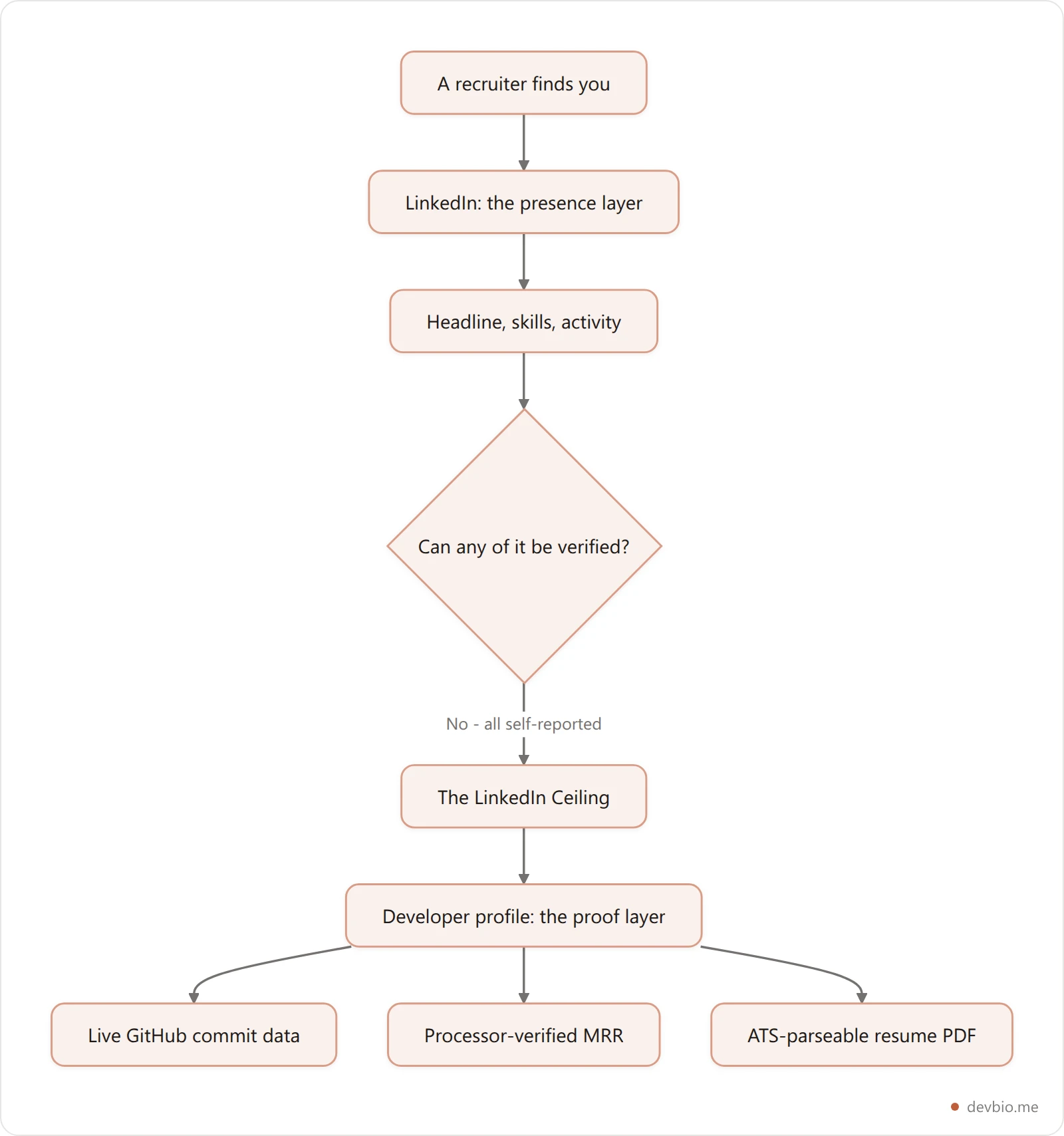
You can max out LinkedIn's presence layer in an afternoon. You cannot max out its proof layer at any amount of effort, because LinkedIn has no pipe to your GitHub commits or your Stripe dashboard. That's not a criticism of the platform — it wasn't built to be a code portfolio. It's a description of what the tool can and can't do, and most developers are spending 100% of their effort on the half of the problem that hits diminishing returns fastest.
What LinkedIn Actually Does Well for Developers#
Before the criticism, the credit. The case for LinkedIn for developers rests on three specific strengths, and none of them are in dispute.
Inbound discovery at scale. A keyword-complete profile keeps a steady stream of recruiter InMails arriving without you doing anything else. No developer-specific platform generates that volume of inbound interest. GitHub doesn't have a recruiter search product; a personal portfolio has zero built-in distribution.
The "Open to Work" signal, when timed correctly. Recruiters who message someone with the green Open to Work banner see a 14.5% positive response rate, versus 4.6% without it — a 37% lift, with some data showing InMail response rates climbing as much as 40%. Roughly 200 million professionals activated it in 2025 alone. It's a blunt tool, but it works.
Recency as a ranking signal. LinkedIn's own guidance states that profiles updated within the last 90 days are roughly 3x more likely to surface in recruiter search results. Conversely, 75% of tech recruiters report skipping profiles that show no recent activity, reading a stale profile as a disengaged candidate — even when the real explanation is that the person has just been heads-down shipping.
None of this is proof of technical skill. It's distribution. And distribution is genuinely valuable — it's just a different job than the one most developers expect their profile to do once someone actually clicks it.
What LinkedIn Structurally Can't Do#
This is the part that matters more, because it's where most developer profiles quietly lose the people LinkedIn just sent them.
Skill endorsements aren't a credibility signal — they're a social reflex. Anyone in your network can endorse you for any skill, with zero verification. As Steven Raz of Cornerstone Search Group put it: "The concept is good but the endorsements have become a little meaningless because everyone is endorsing everyone for everything." Only 31% of developers rate LinkedIn skill-endorsement accuracy at a 4 or 5 out of 5 — most developers know their own endorsements are noise, and assume everyone else's are too.
Profiles rot, and the rot is invisible to the owner. 64.5% of developers say their LinkedIn profile doesn't reflect their actual professional trajectory — the title's stale, the skills list hasn't caught up to the stack they use daily, the summary describes a role from two jobs ago. A recruiter who sees a mismatch between your resume and your LinkedIn doesn't investigate. They move to the next candidate.
There is no live data pipe. LinkedIn can't show a contribution graph pulled from your actual commits. It can't display verified MRR from a payment processor. It can't generate an ATS-ready PDF resume from your work history. Every one of those is a text field you typed once, not a number a third party generated. A recruiter reading "led migration to microservices" on LinkedIn is reading your word for it — the same way they'd read it on a resume you wrote yourself.
Recruiter trust in the channel itself is low. Developers rate their trust in recruiter outreach at just 2.5 out of 5 on average, and 64% suspect recruiter messages are copy-pasted templates. The distribution LinkedIn provides is real, but the audience receiving it is primed to be skeptical before they've read a word of your profile.
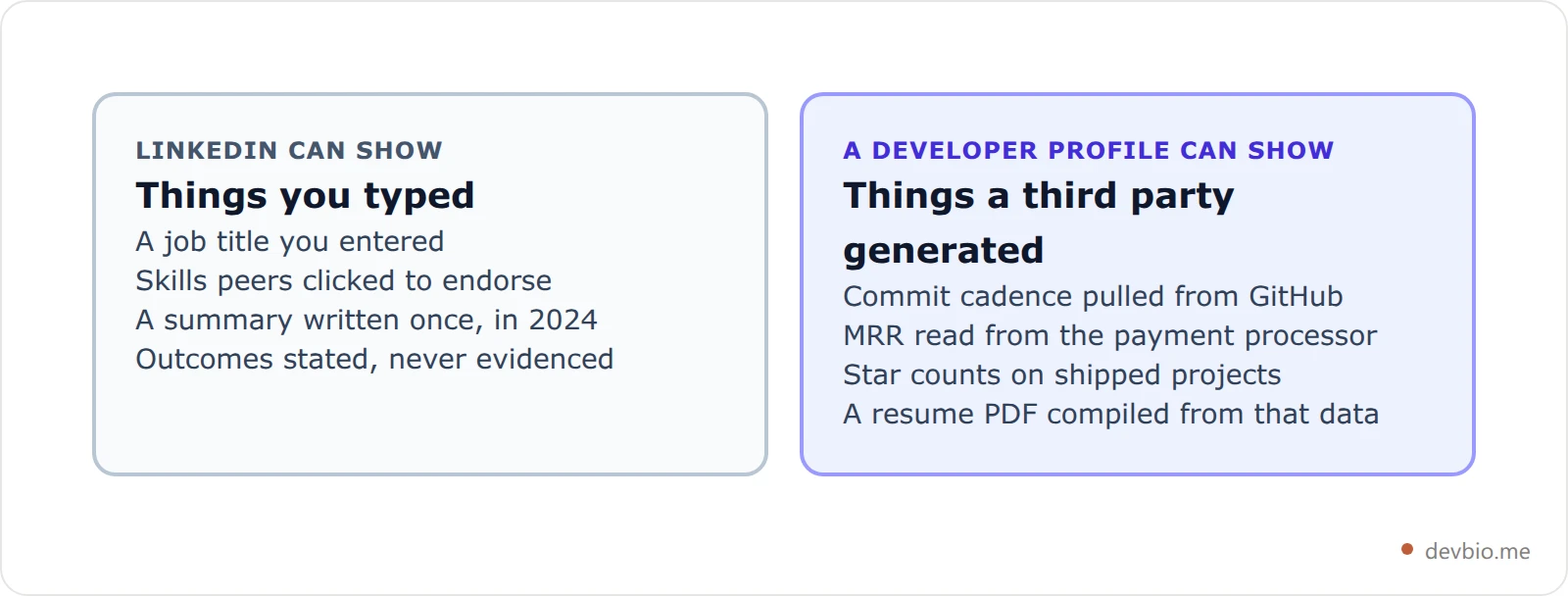
None of this means delete LinkedIn. It means recognize what it's for, and stop expecting the presence layer to do the proof layer's job.
LinkedIn Just Admitted the Problem#
Here's the freshest data point in this whole piece, and it's a strong one: on June 18, 2026, LinkedIn CEO Dan Shapero announced a new feature called Connected Apps — and the reasoning behind it is, functionally, a public admission of everything above. Shapero said the platform is "building new ways for members to show real, credible proof of what they're capable of."
Connected Apps links your actual software usage — activity from tools like GitHub, Replit, and Descript — to your profile, and auto-generates descriptions from that real usage data. Critically, users can't manually edit these summaries. LinkedIn is replacing self-declared skills with machine-verified activity, because self-declared skills stopped meaning anything to the people reading them.
That's the entire proof-over-claims argument, coming from the company with the most incentive in the world to defend the self-reported model. If LinkedIn's own product team is building live-data verification because a headline and a skills list aren't enough anymore, that's not a fringe opinion — it's where the market is heading. A developer profile with a live GitHub sync and a payment-integration-verified MRR figure isn't a workaround for LinkedIn's limitations. It's already the direction LinkedIn is trying to move toward, one feature launch behind.
Developer Profile vs LinkedIn vs GitHub README: The Full Comparison#
Three tools, three different jobs — and the GitHub vs LinkedIn half of it is the part developers get wrong most often. Here's where each one actually delivers.
Signal | GitHub README | Developer Profile (DevBio) | |
|---|---|---|---|
Recruiter discovery / inbound | Very strong (1.3B network) | None | Weak alone; strong via shared link |
Live GitHub commit data | No | Static widget (image) | Live sync, incl. contribution heatmap |
Verified revenue (Stripe, Dodo, Lemon Squeezy, Polar) | No | No | Yes — pulled live from the processor |
ATS-ready PDF resume | Export only, not optimized | No | Auto-compiled LaTeX PDF at |
Skill verification | Self-reported / endorsements | N/A | GitHub stars, commits, shipped projects |
Custom domain | No | No | Yes (Pro) |
AI/LLM discoverability (llms.txt) | No | No | Yes, auto-generated |
Profile analytics | Limited (who's viewed, paywalled) | None | Live visitor view |
Setup time | ~30 min | ~1–2 hrs | ~1 hr |
The pattern: LinkedIn wins on network size. GitHub wins on raw technical signal for people already in that ecosystem. A developer profile is the only format built to carry live proof — from GitHub and your revenue — somewhere that isn't gated behind either platform's own audience. For a deeper look at how a static README compares to a live profile specifically, see GitHub Profile README vs Developer Bio. The same proof-over-claims logic applies across formats — see Developer Portfolio vs Resume for how it plays out against a traditional resume.
One link carrying live GitHub data, verified revenue and a real resume. Claim your devbio profile.
The Two-Profile Playbook#
The mistake isn't using LinkedIn. It's using only LinkedIn, or maintaining LinkedIn and a developer profile as two disconnected, drifting versions of your story — what you could call the split-profile tax: every hour spent updating one without the other is an hour your weakest profile actively works against you, because a recruiter who finds a mismatch trusts neither.
Here's the setup that avoids it.
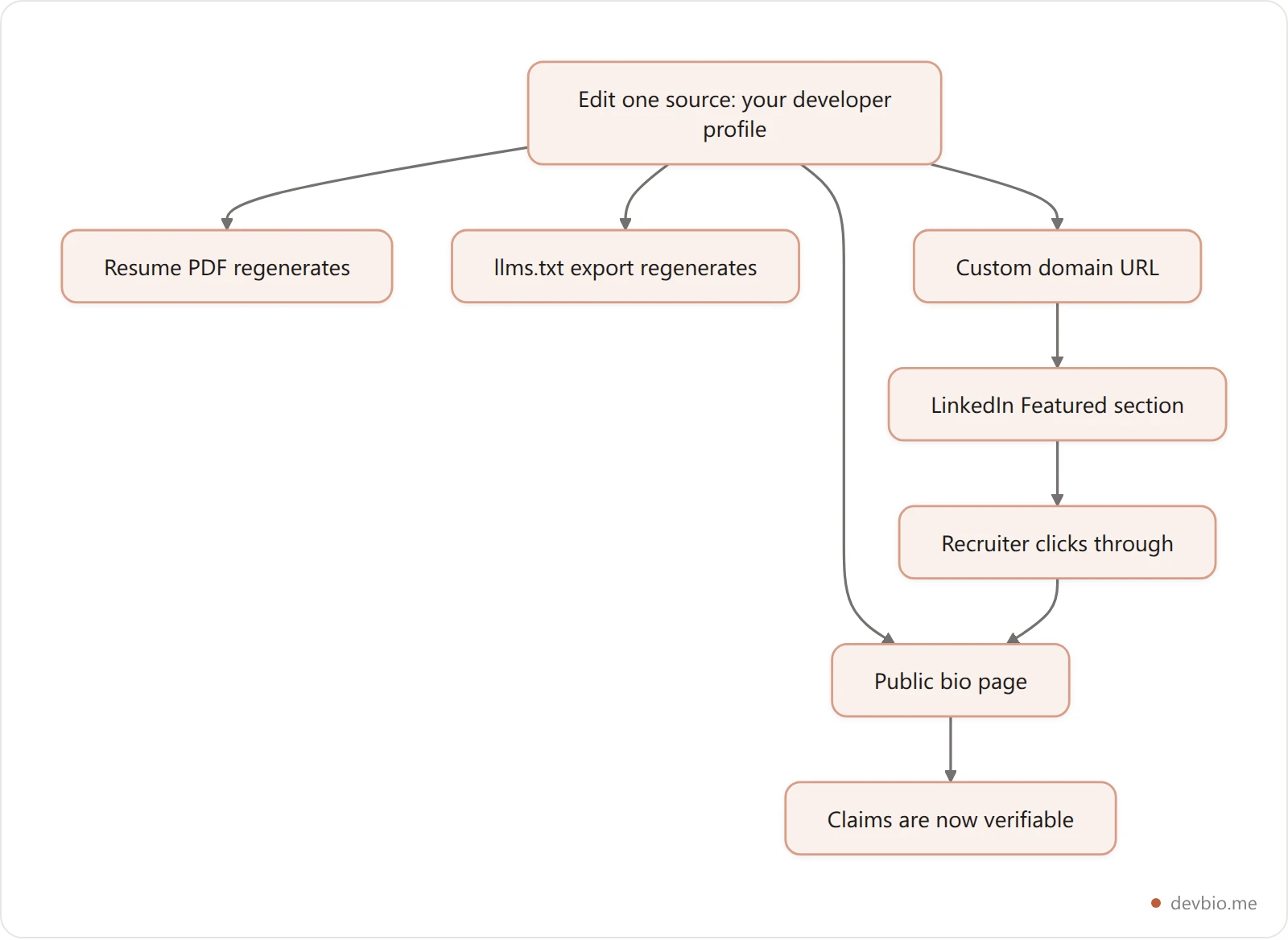
1. LinkedIn is the discovery layer. Keep your headline current, your most recent role accurate, and your activity feed showing signs of life at least monthly — remember, profiles updated in the last 90 days get 3x more recruiter search visibility. Don't try to make LinkedIn prove anything. Its job is to get found and to look credible enough that someone clicks through.
2. One link in your LinkedIn profile does all the proving. Your LinkedIn "Contact info" and featured section should point to one URL: your developer profile. Not four links to four different places. A well-structured developer profile puts your live GitHub activity, project cards with real stars and revenue, and your resume behind that single click.
3. Update the source once. If your developer profile is the one place you edit — new role, new project, new skill — and your resume PDF, your llms.txt export, and your public bio all regenerate from that same data, you've eliminated the sync problem entirely. This is the practical fix for the 64.5%-of-profiles-don't-match-reality stat: there's only one place left to go stale.
4. Let the two profiles specialize. LinkedIn's summary can stay conversational and career-focused — that's what its audience expects. Your developer profile carries the technical depth: the contribution heatmap, the live MRR, and an ATS-parseable resume whose PDF a parser can actually read. Neither one has to do the other's job anymore. The full four-layer version of this setup is in the Developer Personal Brand Guide.
5. Custom domain, cross-posted everywhere. Once your developer profile lives at yourname.dev instead of a platform subpath, that's the URL that goes in your LinkedIn featured links, your email signature, and your GitHub bio. See the 10-minute custom domain setup if you haven't done this yet — it's the cheapest signal-per-minute upgrade in this whole playbook.
Before and After: The Same Developer, Two Setups#
Marcus — backend engineer, 6 years experience, actively job-searching.
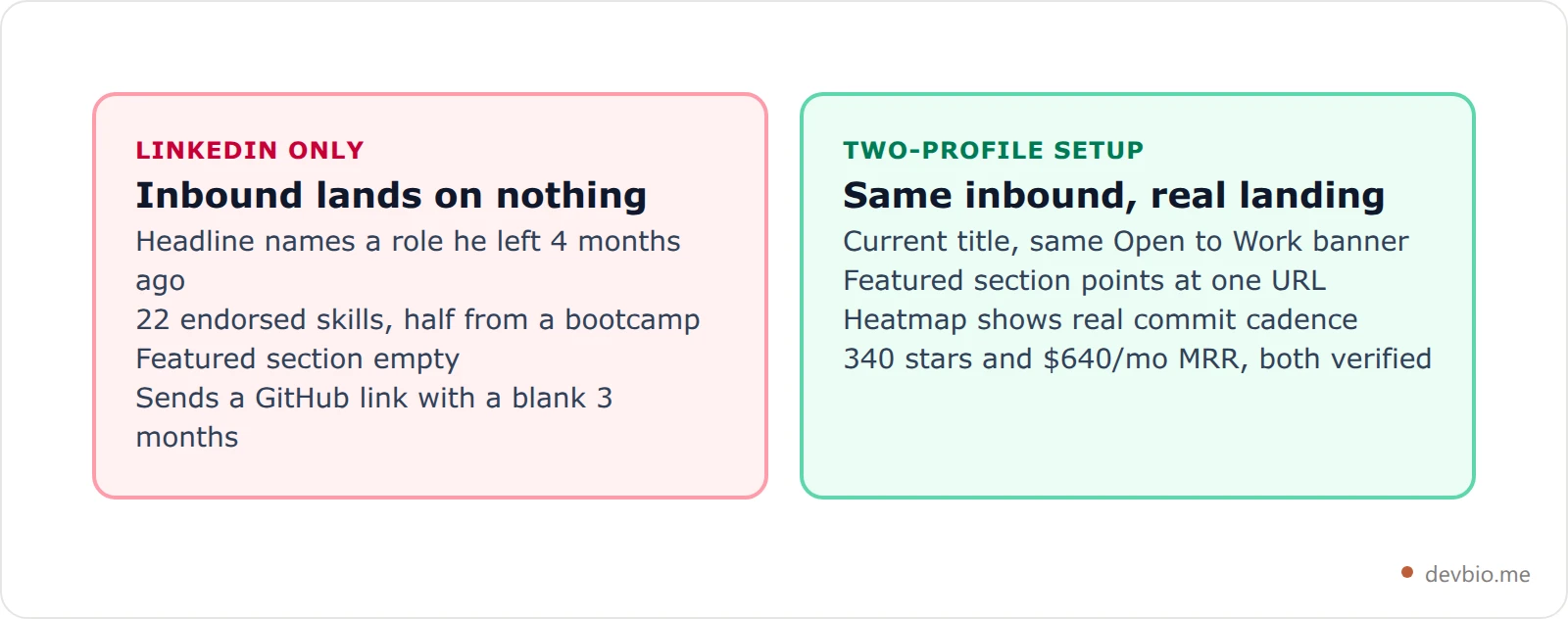
LinkedIn-only setup:
LinkedIn headline: "Software Engineer at [Previous Company]" — a role he left four months ago. Skills section lists 22 endorsed skills, half of them frameworks he hasn't touched since a bootcamp project. Open to Work banner is on. Featured section is empty. When a recruiter InMails him and asks for a portfolio link, he sends a GitHub URL with a contribution graph mostly blank for the last three months, because his real work lives in a private company repo.
Result: Decent InMail volume from the Open to Work banner, but a 40% response-rate-lift signal wasted on a profile with nothing behind it once someone clicks through.
Two-profile setup (LinkedIn + developer profile, ~90 minutes to configure):
Same LinkedIn headline, updated to his current title. Same Open to Work banner. Featured section now links to one URL: his developer profile. That profile shows a contribution heatmap pulling his real commit cadence (including private-repo activity), three project cards — one with 340 live GitHub stars, one showing $640/month MRR verified via Stripe — and an ATS-ready resume PDF one click away.
Result: Same inbound volume from LinkedIn's network. But now every InMail response leads to a profile that answers "can this person actually build things?" before the recruiter has to ask.
The LinkedIn side of the equation didn't change. The difference is what's waiting on the other end of the click.
Build the other end of the click in about an hour. Start free on devbio.me.
The Developer Profile + LinkedIn Audit Checklist#
Run this before your next job search push or client outreach round.
LinkedIn (presence layer)
Current title and company are accurate as of this month
Skills section trimmed to what you'd defend in a technical screen — not 20+ endorsed buzzwords
Featured section links to exactly one URL: your developer profile
At least one activity post or update in the last 30 days
Open to Work banner on, if actively searching
Developer profile (proof layer)
GitHub connected — contribution heatmap reflects real, recent activity
3–5 project cards with live star counts and, if applicable, verified revenue
Work experience bullets state outcomes, not responsibilities
ATS-ready resume PDF accessible at a stable URL
Custom domain configured, or a clean
devbio.me/youlink
The connection between them
Titles and dates match exactly between LinkedIn and your developer profile
The link in your LinkedIn contact info is your developer profile, not a dead personal site
Updating one source (your profile) is enough — nothing requires manual duplication
Run the whole proof-layer column in one place — set up your developer profile.
Checking every box here doesn't guarantee an offer. It does guarantee that the two most-viewed pieces of your online presence tell the same, verifiable story.
Frequently Asked Questions#
Should developers delete LinkedIn and use a developer profile instead?#
No. LinkedIn's reach — 1.3 billion members and adoption by nearly every recruiter — has no substitute. The right move is narrowing what LinkedIn is responsible for (discovery, recency, network) and routing anyone who clicks through to a developer profile that can actually verify your skills with live data.
Why do only 14% of developers think LinkedIn represents their skills accurately?#
Because LinkedIn has no mechanism to verify anything on the page. Titles, skills, and endorsements are all self-reported or peer-endorsed with no accuracy check. Developers know this about their own profile and extend the same skepticism to everyone else's, which is why GitHub-style, data-backed platforms score higher on trust in the same surveys.
What is LinkedIn's Connected Apps feature?#
Announced June 18, 2026, Connected Apps links your real software usage — activity in tools like GitHub, Replit, and Descript — to your LinkedIn profile and auto-generates non-editable descriptions from that data. It's LinkedIn's own attempt to replace self-declared skills with verified activity, which is the same problem a live developer profile already solves.
Does the LinkedIn "Open to Work" banner actually work?#
Yes, for generating inbound interest. Recruiters who message candidates with the banner active see roughly a 37% higher positive response rate than those without it, and some data shows InMail response rates climbing as much as 40%. It increases volume, not quality — what happens after someone clicks through still depends on what your profile can prove.
How often should I update my LinkedIn profile?#
At least every 90 days, even with a minor edit — LinkedIn's own data shows profiles updated within that window are roughly 3x more likely to surface in recruiter searches. If your developer profile pulls live GitHub and revenue data automatically, the harder content (projects, skills, proof) stays current without you touching LinkedIn at all; the manual edit is just enough to signal recency.
Is a GitHub profile a better alternative to LinkedIn for developers?#
Not a replacement — a different audience. GitHub is trusted for technical signal by developers who are already there, but it has no recruiter search product and reaches nobody outside people who go looking. LinkedIn reaches recruiters who aren't already searching GitHub. Most developers need both: LinkedIn for reach, a profile with live GitHub data for proof.
What should I put in my LinkedIn "Featured" section as a developer?#
One link: your developer profile URL. Not a scattered mix of a resume PDF, a GitHub link, and a personal site — each additional link is a decision point that costs you a fraction of the recruiters who would've clicked through. One link that contains everything (GitHub activity, projects, resume) converts better than four links that each show a fragment.
Do recruiters actually check both LinkedIn and GitHub?#
Increasingly, yes, but sequentially — LinkedIn to find and vet basic fit, then a portfolio or GitHub link to verify technical claims before a screen. If your LinkedIn features section routes that second click to a profile with live commit data and shipped projects instead of a stale GitHub graph, you're controlling both steps of that sequence instead of just the first.
Key Takeaways#
The developer profile vs LinkedIn framing was always a false choice — the two aren't competing for the same job. LinkedIn gets you found — 1.3 billion members and near-universal recruiter adoption make that non-negotiable. A developer profile proves what LinkedIn structurally can't: live GitHub activity, verified revenue, and a resume that's actually ATS-ready, not just self-described.
The tell is that LinkedIn itself just built a feature to compensate for exactly this gap. When the platform with the most reach in professional networking starts auto-generating skill proof from your actual tool usage because nobody trusts the honor system anymore, that's confirmation, not a coincidence.
Keep LinkedIn current. Point its one Featured link at a profile that can back up everything LinkedIn only lets you claim.
Your code already proves you can build. Put it on one link — devbio.me