

You quote $65/hour, feel good about it, then six months later realize you're making less than you did as a salaried employee. It's not because you did the work wrong — it's because "salary ÷ 2,080 hours" was never the right formula. A freelance developer rate calculator exists because your actual working year has taxes, overhead, and unbillable time baked into it that a salary never had to account for.
US freelancers average $47.71/hour in 2026, with most falling between $24 and $62, according to ZipRecruiter. That range is wide because most of it comes down to one thing: whether the person calculated their rate, or guessed it.
The short answer: take your target take-home income, add back self-employment tax (about 15.3%) and business overhead (roughly 20%), then divide by the hours you'll actually bill — not the hours in a work year. Freelancers typically bill 1,000–1,500 hours annually, versus 2,080 for a full-time employee, because invoicing, proposals, and admin eat the rest.
The 4-Factor Formula Behind Every Rate Calculator#
Every legitimate freelance rate calculator — including DevBio's — runs the same four inputs through one equation:
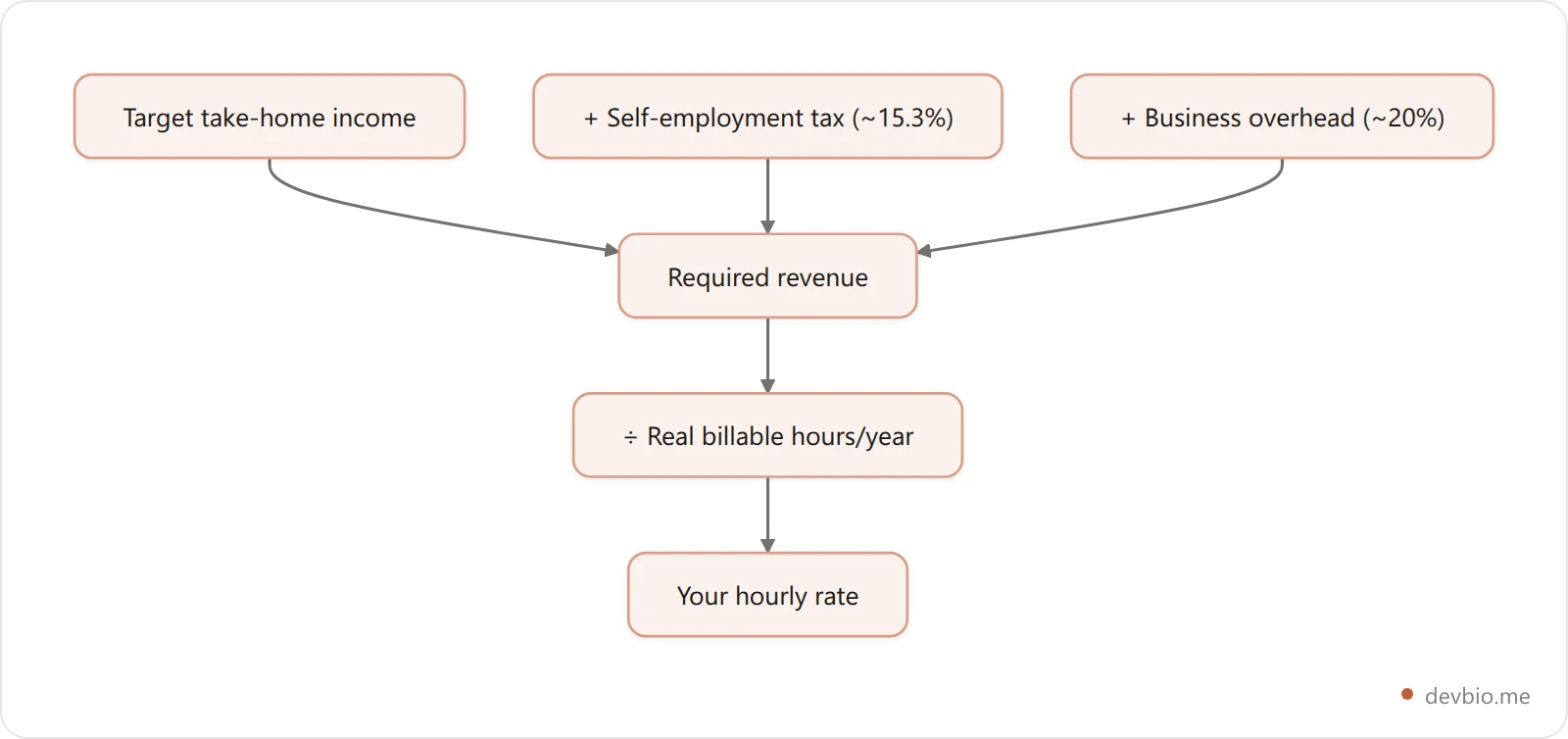
Call it the 4-Factor Rate Formula: Income, Tax, Overhead, Billable Hours. Skip any one of the four and you undercharge — usually the billable-hours factor, which is the one most calculators (and most developers) get wrong.
Step 1: Set Your Target Take-Home Income#
Start with the number you'd need to feel like freelancing was worth it — not your old salary, your target. If you want $75,000 in actual take-home pay this year, that's your baseline before anything else gets added.
Step 2: Add Self-Employment Tax#
As a freelancer, you're both the employee and the employer, so you owe the full 15.3% self-employment tax the IRS would otherwise split with an employer — on top of ordinary income tax. Most freelance pricing guides recommend setting aside 25–35% of gross revenue for taxes overall, depending on your bracket and state.
Step 3: Account for Overhead and Non-Billable Time#
Software, a coworking desk, an accountant, health insurance you're no longer getting from an employer — freelancers typically add another 20% for overhead on top of taxes. Then comes the part almost everyone underestimates:
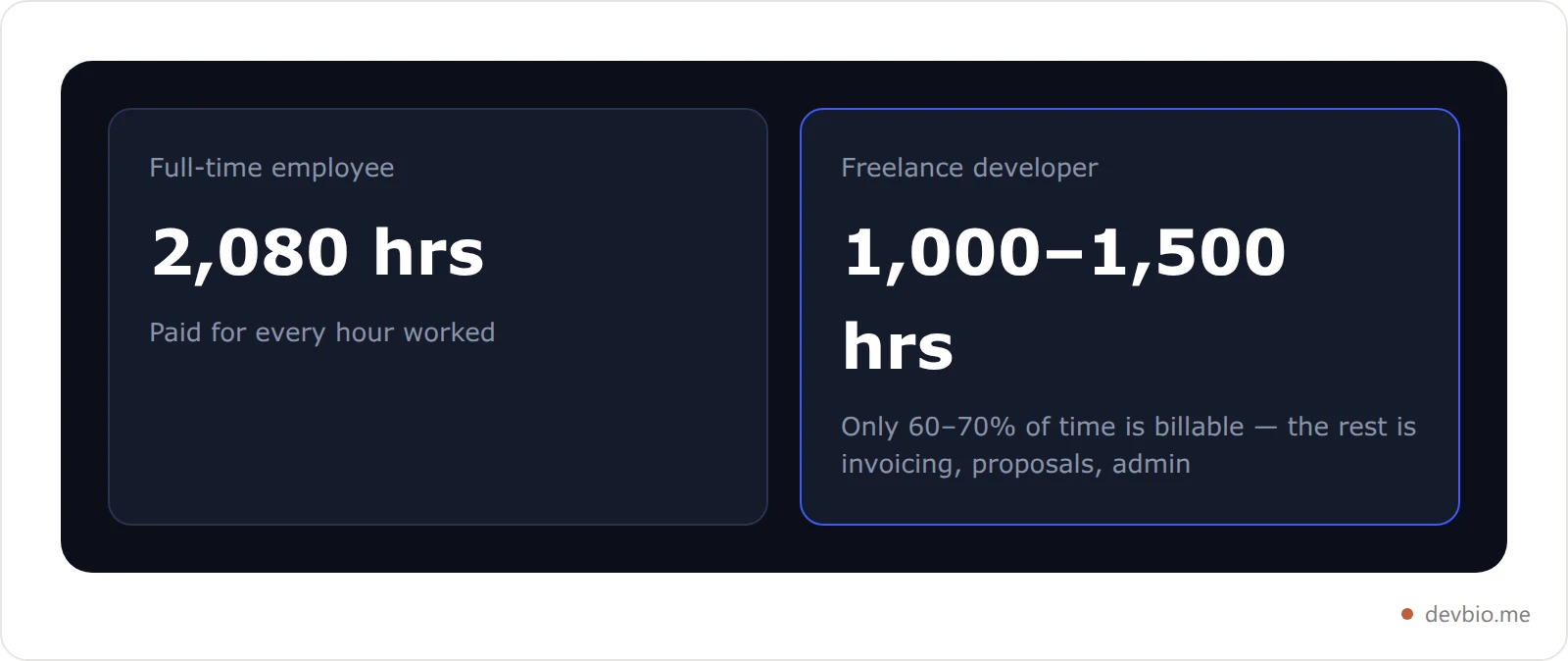
Dividing your income goal by 2,080 hours — a standard work year — is the single most common freelance pricing mistake. It assumes you bill every hour of every week, which no freelancer actually does.
Worked Example: From a $75K Goal to an Hourly Rate#
Here's the math with real numbers, using a freelancer working 30 billable hours a week and taking 4 weeks off:
Factor | Value |
|---|---|
Target take-home income | $75,000 |
Tax set-aside (25%) | +$25,000 |
Required gross revenue | $100,000 |
Working weeks/year (52 − 4 off) | 48 |
Billable hours/week | 30 |
Billable hours/year | 1,440 |
Break-even hourly rate | $69.44/hr |
Recommended rate (+20% buffer) | ~$83/hr |
That 20% buffer isn't padding — it covers slow months, scope creep, and the client who pays net-60.
What Developers Actually Charge in 2026#

Rates vary more by specialty than by seniority alone. Web developers average $45–75/hr, general software engineers $60–120/hr, and AI/ML specialists $100–250/hr — with AI agent development emerging as a $180–300/hr niche in 2026, according to Jobbers.io's rate index. Senior developers consistently earn 2–3x what juniors charge, across every region.
Mistakes That Quietly Undercut Your Rate#
Using a generic contract developer rate calculator without adjusting for your niche. A calculator only outputs what you put in — AI/ML or security specialties need a higher target income baseline than general web work.
Pricing off your old salary. Salaries include benefits, paid time off, and employer-paid taxes your rate now has to cover itself.
Counting calendar hours as billable hours. If you work 40 hours a week but only bill 25 of them, your effective rate is 37.5% lower than your quoted rate.
Forgetting to re-run the numbers. Rent, insurance, and tax brackets change. A rate you set two years ago is quietly losing to inflation.
Quoting a rate that ignores the client's real budget. Deep-dive research on the person or company you're pitching still matters — a well-calculated rate on a cold pitch converts worse than the same rate on a warm, informed one.
Treating a resume PDF as proof of your rate. An ATS-ready resume built from your GitHub profile helps for job applications, but clients evaluating a freelance rate want to see shipped, live work — not a static document.
Never revisiting billable-hours assumptions. Landing a bigger retainer client can shift your billable ratio dramatically; recalculate rather than assume last quarter's math still holds.
Try the Free Freelance Developer Rate Calculator#
You don't need a spreadsheet to run this math — a good freelance developer rate calculator does it in seconds. DevBio's free rate calculator works backward the same way this guide does — target income, expenses, tax set-aside, weeks off, and a billable-hours slider — and gives you an hourly, day, and weekly rate instantly, with presets for a part-time side gig, a full-time freelancer, or a senior consultant. No signup required.
Your rate means more with proof behind it
A number on an invoice is a guess to a client who's never worked with you. A DevBio profile shows the GitHub commits and shipped projects that justify it — live, not claimed.
Build your profile freeOnce you know your number, the harder problem is getting clients to believe it's justified. That's less about the math and more about proof — see our guide to building a freelance developer portfolio that wins clients with live GitHub and revenue data instead of claims.
Frequently Asked Questions#
How much should I charge as a freelance developer in 2026?#
It depends on specialty and region more than a single "market rate." US freelance developers average $47.71/hour, general software engineers charge $60–120/hr, and AI/ML specialists charge $100–250/hr. Run your own numbers through the 4-factor formula rather than copying an average.
What's a fair rate for a beginner freelance developer?#
Junior freelance web developers in emerging markets typically start around $18–45/hour, rising quickly with a portfolio of shipped, verifiable work. Underpricing to win your first client is common — just revisit the math every few months instead of staying there.
Should I charge by the hour or by the project?#
Either works once you know your real hourly rate — project quotes should still be built by estimating hours at that rate, plus a buffer for scope creep. Charging by the project without doing the hourly math first is how developers most often underprice.
How do taxes affect my freelance rate?#
As a freelancer, you owe the 15.3% self-employment tax an employer would otherwise share, on top of income tax — most guides recommend setting aside 25–35% of gross revenue for taxes overall. That amount needs to be added to your target income before you divide by billable hours. If job-search math matters more to you right now than freelancing, see how hiring managers actually evaluate a developer profile for comparison.
How many hours a year can I actually bill?#
Most freelancers bill 1,000–1,500 hours a year, since only 60–70% of working time ends up billable — the rest goes to invoicing, proposals, and admin. Using the full 2,080-hour work year in your math is the most common rate-setting mistake.
Is DevBio's rate calculator actually free?#
Yes — the calculator runs entirely in your browser with no signup and no email required. It's a standalone tool separate from building a DevBio profile.
The Bottom Line#
Your freelance rate isn't your old salary divided by a work year — it's your target income, plus taxes, plus overhead, divided by the hours you'll genuinely bill. Run those four factors and most developers find their "reasonable-sounding" rate was actually 20–40% too low. The free calculator does the math in under a minute; the harder part is showing a client the rate is earned. Put your shipped work, real GitHub activity, and proof on one link — a number lands differently next to receipts.


