You already have a resume. It has your job titles, your dates, your skills, maybe a project or two. Turning that into a developer portfolio used to mean a weekend rebuilding everything by hand, or paying a freelancer to do it. As of July 2026, a handful of AI tools will parse that PDF and spit out a portfolio page in under a minute.
Here's what nobody selling a resume to developer portfolio tool mentions: most of them just move your claims to a nicer template. It still says you "led a team of 5" or "grew revenue 40%" with nothing behind it. A developer portfolio that imports your resume and pulls live GitHub activity and real payment data onto the same page is a different thing entirely — it's the difference between a claim and a citation.
Call this the static resume trap: the same trap covered in proof over claims — a portfolio that looks more modern than a PDF but carries the exact same weakness — every number on it stopped updating the day you hit export. Fixing the design doesn't fix that. Only a data source that keeps reporting after publish day does.
Resume to Developer Portfolio: What These Tools Actually Do (and Where They Stop)#
Most resume-to-portfolio tools do one job well: they read unstructured text and turn it into a structured page. Upload a PDF, get a name, a title, a work history section, and a skills list dropped into a template. Tools like Artfolio, Resume2Portfolio, and QuickCV all follow this pattern — parse resume text, apply a design, publish a link.
That's useful. It's also where the value ends. None of these tools connect to anything that changes after publish day. The portfolio they generate is a snapshot of what your resume said the day you uploaded it — a static page wearing a nicer outfit than your PDF.
For developers specifically, that's a missed opportunity. Your resume can't show a commit graph. It can't show which of your side projects still gets pushes. It can't show that your SaaS actually has paying customers. A parser that stops at "nice template" leaves all of that on the table.
Tool | What it imports | Stays live after import | GitHub activity | Revenue proof | ATS resume export |
|---|---|---|---|---|---|
DevBio | Resume PDF/DOCX → structured bio | Yes — GitHub + payment data refresh automatically | Stars, commits, last-pushed date | Live MRR via Stripe, Dodo, Lemon Squeezy, or Polar | Yes, LaTeX-generated PDF |
Artfolio | Resume PDF/DOCX → static site | No, one-time snapshot | Not part of the product | Not part of the product | No |
Resume2Portfolio | Resume PDF → static site | No, one-time snapshot | Not part of the product | Not part of the product | No |
QuickCV | Resume → portfolio page | No, one-time snapshot | Not part of the product | Not part of the product | Own resume builder only |
GitHub Profile README | Manual markdown | Only via third-party badge widgets, which rate-limit and go stale | Via unofficial stat cards | Not supported | No |
The Parse-and-Prove Pipeline#
Call it the Parse-and-Prove pipeline: parsing gets your resume data into a usable shape, proving keeps that data honest by tying it to sources that update on their own. Most tools stop at parse. A developer profile that's actually worth linking in a job application needs both layers.
Here's roughly how DevBio's resume import runs through both layers:
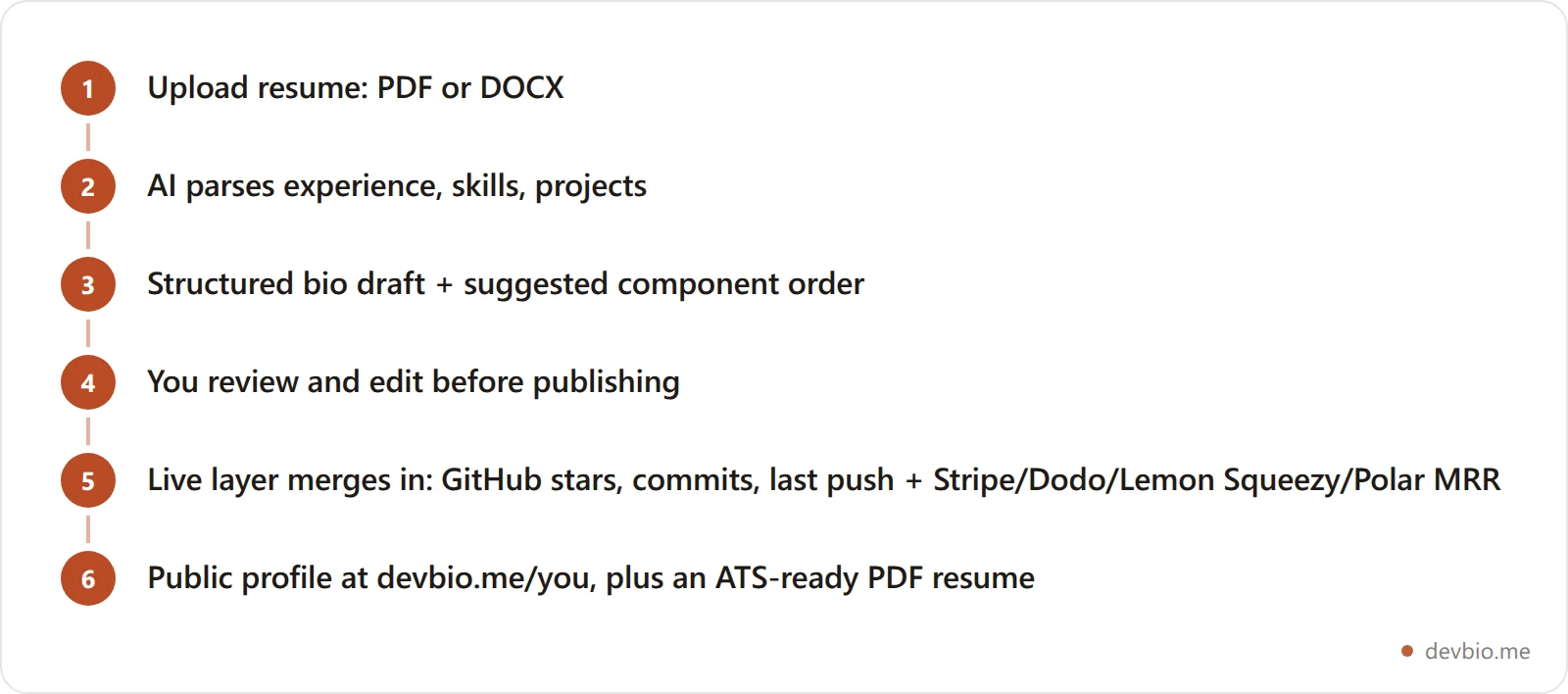
The parse step is a one-time LLM read of your resume file. It extracts your name, titles, employers, date ranges, skills, and any projects you listed, then suggests which bio components to turn on. You still review and edit before anything goes live — the AI drafts, you approve.
The prove step is where it stops being a snapshot. Once you connect a project's GitHub repo, its star count, commit activity, and last-pushed date pull in at read time, not at import time. Connect a payment provider — Stripe, Dodo, Lemon Squeezy, or Polar are the four currently supported — and the same project card shows live MRR next to the code. Nothing about your resume upload gets stale, because none of the proof lives in the resume anymore.
What Actually Gets Extracted From Your Resume#
A resume parser is only as good as what it can reliably pull out of a real-world PDF. Here's what transfers cleanly in most imports:
Identity fields: your name, current title, and a short summary line
Work history: employer, role, start/end dates, and bullet points per role
Skills: language and tool names, usually recognized as a flat, taggable list
Projects: any named project with a description, which becomes a starting point for a project card
Links: GitHub, LinkedIn, or personal site URLs already in your header or footer
What doesn't transfer automatically: your GitHub stats, your revenue, and your actual commit history. Those aren't in a resume to begin with — no parser can extract data that was never there. That's exactly the gap the live layer is built to close, and it's also why what you put on a developer bio matters more than what a parser alone can generate.
There's a second thing that doesn't transfer well either: nuance. A resume bullet like "improved API latency" compresses months of work into four words. The parser will keep that compression, because it can only work with what's on the page. This is where the review step earns its keep — once the draft exists, you can split one vague bullet into a real project entry, attach the actual repo, and let the live layer supply the detail the original bullet point couldn't fit.
From Static Text to a Live Project Card#
Say your resume lists "Built an internal analytics tool used by 12 engineers." A resume-to-portfolio converter renders that sentence in a bigger font. A live profile replaces the claim with a project card that shows the repo's real star count, how many commits landed this month, and — if you've connected a payment gateway — actual subscriber revenue if the tool ever became a product.
This is the same mechanism covered in more detail in the guide to setting up a live MRR developer profile: a background job resolves GitHub and payment snapshots and merges them onto your stored project data at fetch time, in a single batched read regardless of how many projects you have. Your bio's underlying data never gets overwritten with someone else's numbers — the live values sit alongside it and refresh on their own schedule.
The practical effect: a hiring manager who clicks through from your resume PDF to your profile link sees live GitHub stats that match what's actually happening in your account right now, not a claim frozen on the day you last edited a Word document.

A Before-and-After Example#
Consider a backend engineer with six years of experience — call her Maria. Her resume has the usual bullets: "Migrated a monolith to microservices," "Maintained a side project with 40+ stars," "Built a small SaaS tool for freelancers."
Before import, that's three unverifiable sentences. A recruiter has no way to check any of them without asking her to share screens in an interview.
After a resume import with the live layer connected, her profile shows the actual repo for the migration work with its real commit history, the side project's current star count instead of a number typed from memory two months ago, and — because she connected Lemon Squeezy — the SaaS tool's live subscriber count and MRR, even if it's a modest $340/month. That last part matters more than it looks: a small, real, live number reads as more credible than a vague, large, static claim, because it's the kind of detail nobody bothers to fake.
None of this required Maria to write more content. It required connecting two accounts she already had.
The interview conversation shifts too. Instead of opening with "tell me about this migration project," a reviewer who's already seen the commit history opens with a specific question about a decision they noticed in the repo. That's a better five minutes for both sides than re-explaining a bullet point from scratch.
Why This Matters for ATS Screening and Human Reviewers#
The resume itself still matters. Most companies run applications through an applicant tracking system before a human ever opens the file, and that system has its own failure modes that a portfolio link can't fix on its own.

Over 80% of resumes don't make it past the first automated screening, and only about 1 in 10 reach an actual hiring manager, according to Indeed's career advice research. A 2026 analysis found 43% of rejections are preventable formatting or extraction errors rather than real qualification gaps, and a separate test of eight ATS platforms found two-column resume layouts failed to parse correctly in seven of them, per ResumeAdapter's ATS statistics and QuickCV's own ATS test. Separately, 88% of employers believe they're losing qualified candidates to ATS filtering they can't fully control.
None of that goes away because you have a portfolio. What changes is what happens after your resume clears that first filter. Gergely Orosz, author of The Tech Resume Inside Out and The Pragmatic Engineer, has written extensively about how little time a recruiter spends on any single resume — often single-digit seconds — before deciding whether to keep reading. A link at the top of your resume that leads to a page with live, verifiable detail gives that scan something concrete to land on instead of another bullet list.

This is why a portfolio link earns its place on the resume even in an ATS-first hiring process. 73% of hiring managers say a strong portfolio matters more than a flawless resume for developer roles, and 76% say self-taught skills or real project work can outweigh formal credentials, according to research summarized around the Stack Overflow Developer Survey. A separate 2024 survey of 1,200 hiring managers found 54% now evaluate demonstrated skills before they even read resume content in depth. The resume gets you past the filter. The profile is what gets read once a human is actually looking.
The Bio Import Readiness Checklist#
A resume parser is only as accurate as the file you feed it. Before you upload, run through this:
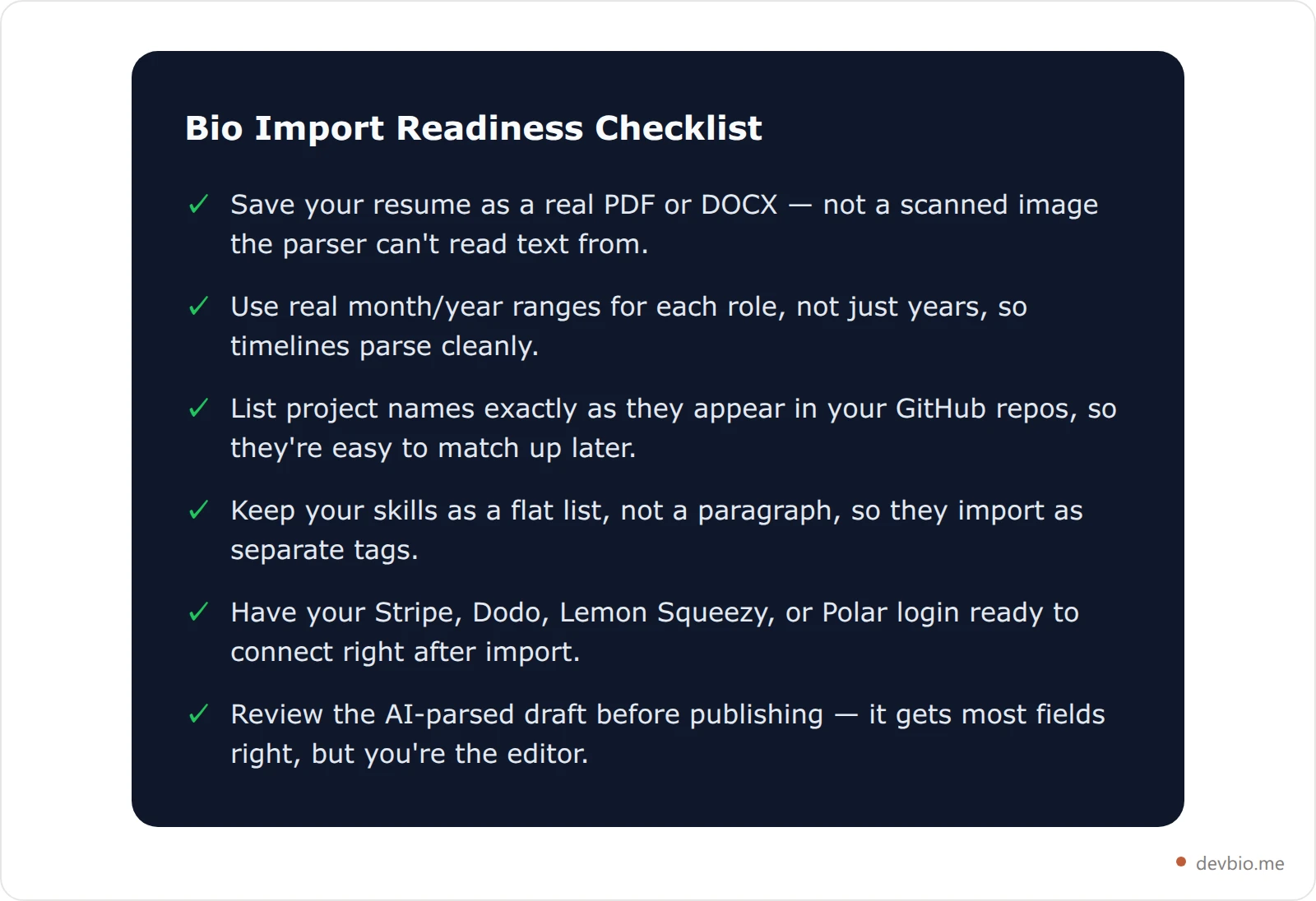
Save that list. Most import failures trace back to one of the first two items — a scanned PDF with no extractable text, or a resume that lists "2021–2023" instead of a role-by-role breakdown.
Setting It Up: Resume to Live Profile in Five Minutes#
The actual steps for going from resume to developer portfolio, in order:
Upload your resume file. PDF or plain text both work; a real text layer matters more than the format.
Let the parser draft your bio. It extracts your work history, skills, and projects, and suggests which components — about, skills, projects, work experience — to enable. Try DevBio's resume import free, no credit card required to start.
Review and edit. Fix any dates or titles the parser guessed wrong. This is a two-minute pass, not a rewrite.
Connect your project sources. Link each project's GitHub repo for live stars and commits, and connect a payment provider if any project earns revenue.
Publish and export. Your profile goes live at your devbio.me URL, and the same data compiles into an ATS-ready PDF resume at
/yourname/resumewhenever you need a traditional file.
If you'd rather build the bio manually and skip the import, the developer resume formats guide walks through the same output without needing an existing resume to start from. And if you'd rather fork something and own the code, we compared seven free developer portfolio templates — including which sections every one of them still leaves blank. Either path lands on the same live profile — the import just skips the blank-page problem.
Stop copying your resume by hand
Import it once, then let GitHub and your payment provider keep the proof current.
Import your resumeFrequently Asked Questions#
Can I turn my resume into a portfolio website for free?#
Yes. Most resume-to-portfolio tools, including DevBio's import, offer a free tier to parse a resume and publish a basic profile. Live GitHub and revenue data typically require connecting your own free developer and payment accounts, which cost nothing beyond what you already pay those providers.
Do I need to know how to code to convert my resume into a developer portfolio?#
No. The parsing and page generation are automatic — you upload a file and review the draft. Connecting GitHub or a payment provider for live data is a one-time authorization click, not a coding task.
What file formats can I upload to convert a resume into a portfolio?#
PDF and DOCX are the most reliably parsed formats, since they preserve a real text layer. Scanned images of a resume, even saved as PDF, often fail to parse because there's no extractable text underneath the image.
Is a developer portfolio better than a resume for getting hired?#
They serve different jobs. Your resume gets you past automated screening; your portfolio is what a human actually evaluates once they're looking closely. Around 73% of hiring managers say a strong portfolio matters more than a flawless resume, but almost none of them skip the resume stage entirely.
Will an ATS still need my resume if I have a live developer profile?#
Yes. Most companies still require a resume upload in their applicant tracking system regardless of what portfolio link you include. A live profile supplements that resume — it doesn't replace the file the ATS expects to ingest.
How accurate is AI resume parsing?#
Parsing accuracy depends heavily on file quality. Resumes with clear section headers, real dates, and simple single-column layouts parse close to completely. Complex two-column designs or scanned images cause the most extraction errors, which is why reviewing the draft before publishing matters.
Can I edit the profile after AI generates it from my resume?#
Yes. The import produces a draft, not a final page. Every field — titles, dates, skill tags, project descriptions — stays fully editable, and nothing publishes until you approve it.
Does importing my resume also pull in my live GitHub stats automatically?#
Not automatically from the resume itself — your resume doesn't contain that data. After import, you connect each project's GitHub repo separately, and stars, commits, and last-push dates start refreshing on their own from that point forward.
The Takeaway#
A resume-to-portfolio converter solves a real problem: turning unstructured text into a structured page without a weekend of manual work. That's the parse layer, and most tools stop there. What makes the result worth linking in a job application is the second layer — GitHub activity and revenue data that keep refreshing after publish day, so the page never goes stale the way a resume does the moment you save it.
Three numbers worth remembering: 80% of resumes never reach a human reviewer, 73% of the ones who do say a portfolio matters more than a perfect resume, and 43% of ATS rejections are preventable formatting errors that have nothing to do with your actual qualifications. A live profile doesn't fix the ATS problem. It makes the human-review stage count for more once you're through it.
Your resume already has everything a parser needs to draft your profile. Put your code on one link — devbio.me, and let the proof stay current on its own.