

You sign up for the 14-day trial, build the store, connect Stripe, and only then do the numbers start landing: $29 a month, or $99 if you want the upsells. Neither figure is the one that hits your bank account.
Stan Store pricing has two tiers: Creator at $29/month or $300/year, and Creator Pro at $99/month or $948/year, both after a 14-day free trial. Stan charges no transaction fee on your sales, but Stripe or PayPal still takes its cut on every order — so your real platform cost is the subscription plus roughly 3-9% of revenue.
That gap between the sticker price and the effective rate is where most Stan Store pricing comparisons stop. This one doesn't: below you'll find the per-order math, the revenue level where Creator Pro starts paying for itself, and the case where a $348-a-year storefront is the wrong tool entirely.
Stan Store Pricing at a Glance#
The Stan Store plans are simple: two public tiers, two billing intervals, one trial. Stan publishes both prices on its own pricing breakdown and splits the features in a Creator vs. Creator Pro help article.
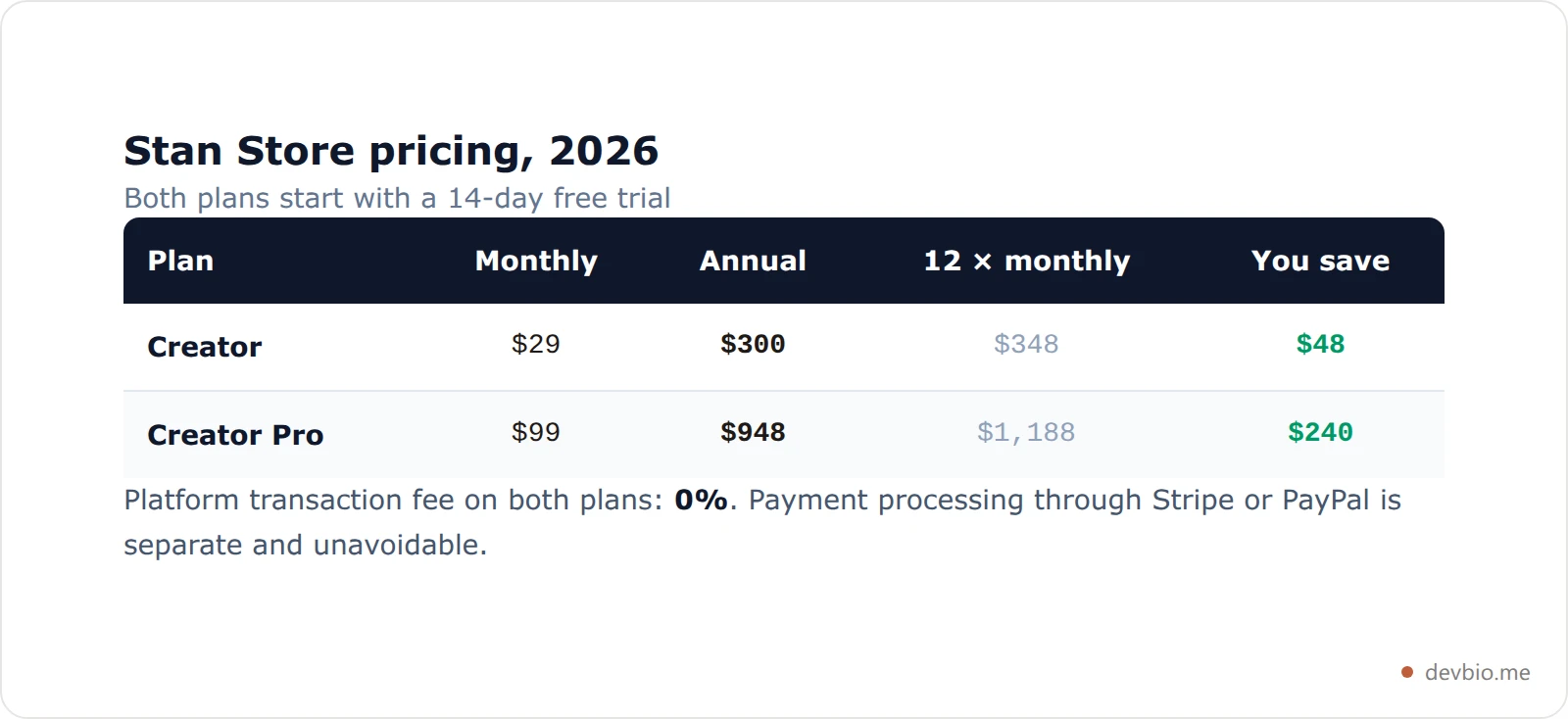
Three things to pull out of that table before you go further. The annual discount is real but modest — 14% on Creator, 20% on Pro. The jump between tiers is $70 a month, which is more than the entry plan costs. And the 0% platform fee is the headline Stan leads with, which makes it the number worth checking hardest.
What the $29 Creator Plan Includes#
Creator is a complete storefront, not a stripped trial tier. Per Stan's own documentation it covers a mobile- and desktop-friendly store page, calendar and booking tools, store and product analytics, an unlimited course builder, recurring subscriptions, lead magnets, community features, and Stan AutoDM for automated Instagram replies.
For a solo seller with one or two digital products, that list is already more than most people use. The Stan Store cost question at this tier is really a question about whether you need a storefront at all — you're paying $29 a month for checkout, delivery, and a product catalog. If you're only pointing people at a few links, you're renting a cash register you never open.
The plan has no listed cap on products, orders, or revenue. What you don't get is the conversion machinery: no discount codes, no order bumps, no email automation, no pixels.
Skip the storefront and just claim your page if links and proof are all you actually need.
What Creator Pro Adds for $70 More#
Stan Store Creator Pro keeps everything in Creator and layers on the tools that exist to raise revenue per visitor:
Dynamic pricing — discount codes and limited-quantity offers
Upsells and order bumps — the extra offer at checkout
More payment options — Stan Payments, Afterpay, and Klarna
Funnels — multi-step paths rather than a single product page
Affiliate management — other people selling for you
Email marketing — contact import, broadcasts, automated flows
Pixel tracking — Meta, Google, Pinterest, and TikTok
Read that list as one thing: Creator sells what you already have, Pro tries to sell more of it. That framing matters, because it turns the tier decision into arithmetic instead of taste. $70 a month is $840 a year, and it either generates more than that in extra margin or it doesn't.
"Zero Transaction Fees" Still Costs You 3-9%#
Stan's claim is accurate and worth understanding precisely: Stan doesn't take a percentage of your sales. Your customers still pay by card, though, and the processor charges for that. Stripe's published US rate is 2.9% + 30¢ per successful domestic transaction, plus 1.5% for international cards and another 1% when currency conversion is involved.
The percentage part is predictable. The 30¢ is the part that quietly reshapes your economics, because it's charged per order, not per dollar. Two sellers doing identical $1,000 months pay very different effective rates depending on how many transactions that $1,000 arrives in.

Run the numbers yourself and they hold up. At $1,000 a month sold as ten $100 orders, Stripe takes $29 in percentage and $3 in fixed fees; add the $29 subscription and you're at $61, or 6.1% of revenue. Sell the same $1,000 as two hundred $5 orders and Stripe's fixed fees alone hit $60 — total cost $118, or 11.8%.
The lesson isn't "Stan is expensive." It's that cheap products are the expensive ones to sell, on any platform with per-transaction pricing. If your catalog is $5 and $7 items, raising your average order value does more for your margin than any plan change. We went deeper on this in our breakdown of the best payment processor for indie hackers, where the same 30¢ shows up in every comparison.
When Creator Pro Pays for Itself#
Creator Pro costs $70 a month more than Creator. Digital products are close to 100% margin, so the break-even is simple: Pro has to lift your revenue by $70 a month to be free, and by more than that to be worth it.
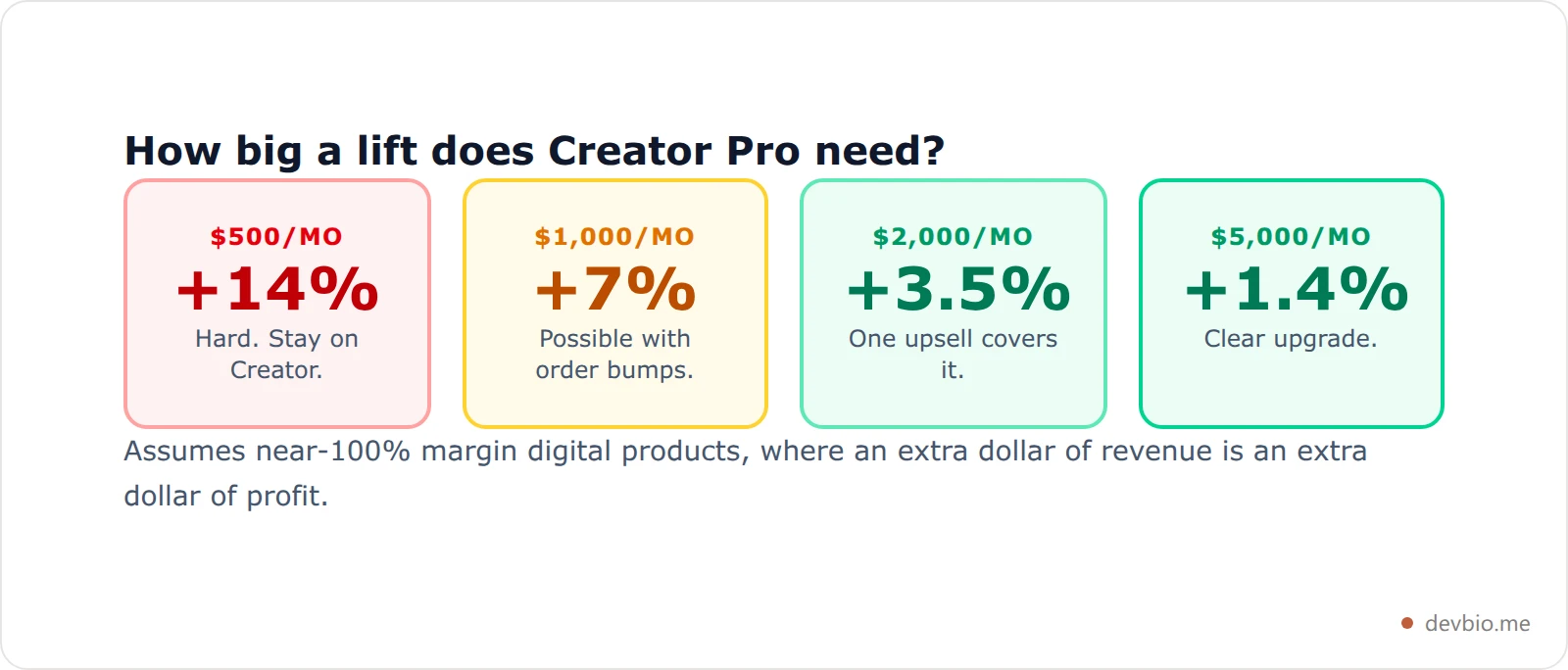
Below roughly $1,000 a month, the honest answer is that Pro is a bet on features you haven't proven you can use. Order bumps only convert if you have a second product worth bumping; affiliate management only matters if someone wants to promote you; pixel tracking only pays off if you're actually running paid traffic.
Above $2,000 a month, a single working upsell usually clears the bar and the question flips: staying on Creator is the thing that costs you money.
Monthly vs Annual: You're Buying Ten Months#
The annual plans are the clearest discount on the page, and they're easy to read wrong. Divide the annual price by the monthly price and the discount stops being a percentage and becomes a number of months:
Creator: $300 ÷ $29 = 10.3 months paid, 12 received
Creator Pro: $948 ÷ $99 = 9.6 months paid, 12 received
So annual billing on Creator is worth taking if — and only if — you're confident you'll still be selling in month eleven. That's not a given. Creator economy tools have high churn, and $300 committed up front is $300 you can't redirect when the product you launched doesn't land.
The safer sequence for a first store: run the 14-day trial, take monthly for the first quarter, and switch to annual once you have three months of orders proving the store earns more than it costs. Two-thirds of the annual discount is still there in month four.
Stan Store vs the Link-in-Bio Tools You're Comparing#
Most people searching Stan Store pricing are really deciding between a storefront and a link page, which are different products at very different prices.
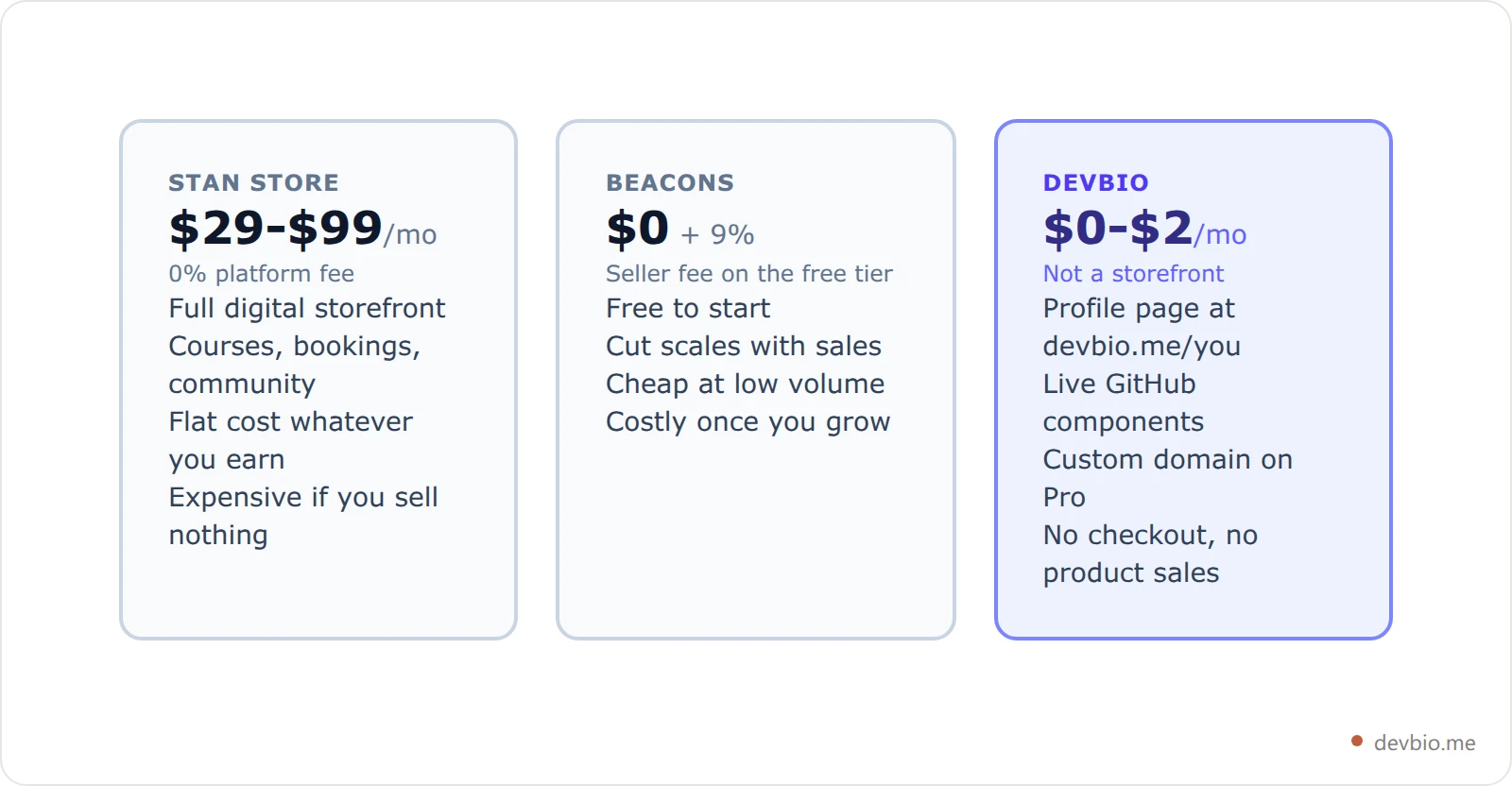
The fee-model difference is the whole comparison. A flat $29 beats a 9% cut the moment your monthly sales pass about $322 — below that, the percentage platform is cheaper. We worked that threshold out in detail for Linktree vs Beacons, and the Beacons pricing breakdown shows exactly what the 9% seller fee takes at each revenue level.
If you're comparing subscription link pages rather than storefronts, Linktree's tiers and Carrd's pricing sit far below Stan's — an order of magnitude, because they aren't handling checkout, delivery, or course hosting.
When You're Paying $348 for a Store You Don't Use#
Here's the case nobody selling you a storefront will make. If you're a developer, a freelancer, or an indie hacker whose "products" are a GitHub profile, a resume, a consulting inquiry, and three project links, a Stan Store subscription buys you a checkout flow you will never open — at $348 a year on the annual Creator plan.
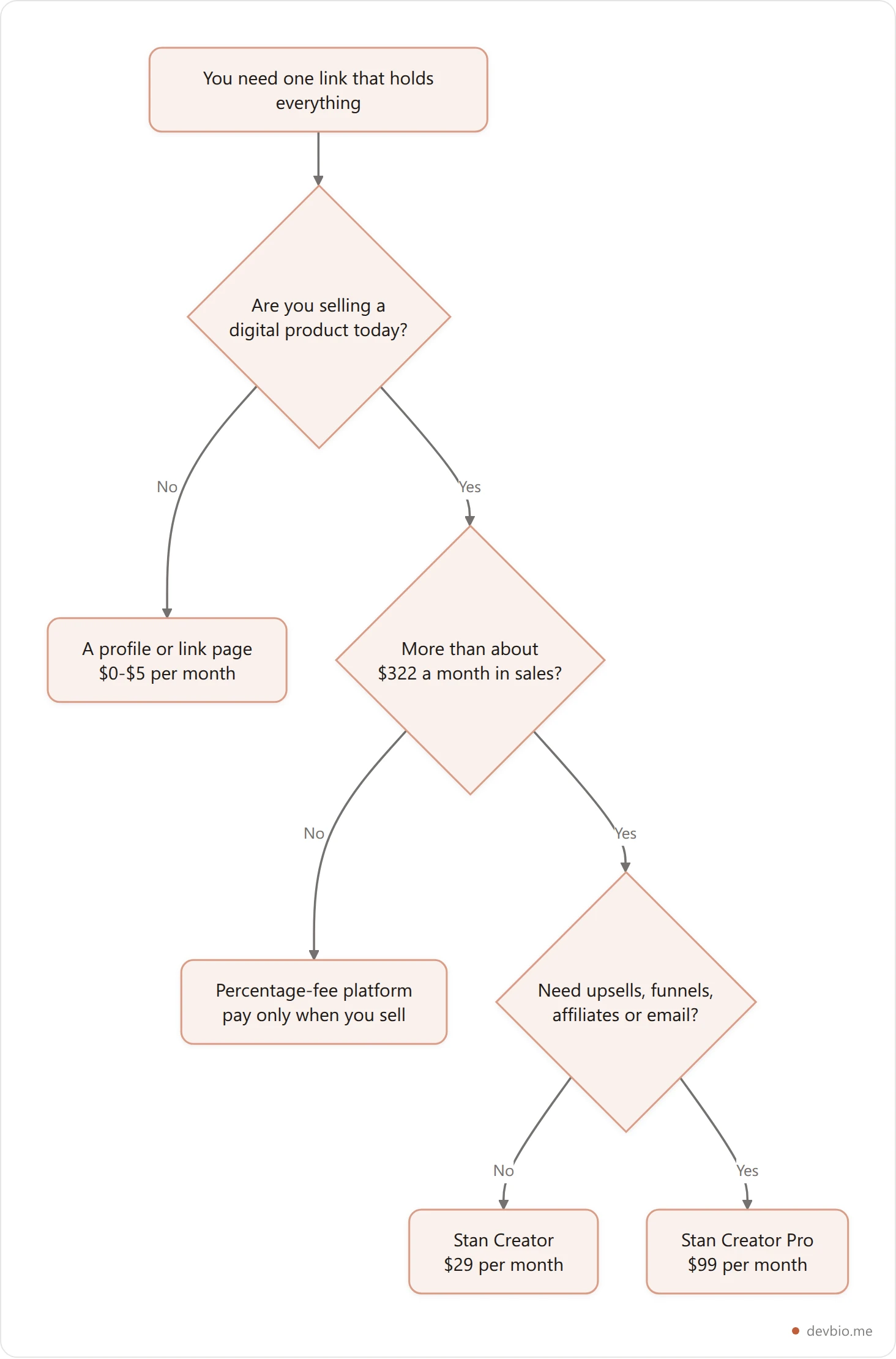
The honest split: storefronts earn their subscription when you have something to sell and volume to sell it at. A profile page earns its keep when what you're really distributing is credibility — the work you've shipped, the stack you use, the way to reach you.
That's what DevBio does. Your page lives at devbio.me/{you} and is free forever: every bio component, GitHub public-repo metadata, a LaTeX-generated PDF resume, a marketplace listing, and custom theming with dark mode. Pro is $2 a month or $12 a year at early-adopter pricing, and adds a custom domain, removal of the "Powered by devbio" line, full analytics with 30-day history, and GitHub private repos plus the contribution heatmap. It isn't a storefront — there's no checkout and no product delivery — which is exactly why it doesn't cost $29 a month.
For the wider field, our link-in-bio comparison for developers and the eight-tool Linktree alternatives roundup cover what each option actually does with your page.
Paying storefront prices for a link page?
DevBio gives you a developer profile at devbio.me/yourname with live GitHub components, a PDF resume, and one link that works everywhere — free forever, $2/mo for a custom domain.
Claim your handleFrequently Asked Questions#
How much does Stan Store cost per month?#
Stan Store costs $29 a month on the Creator plan and $99 a month on Creator Pro. Annual billing drops those to $300 and $948 a year respectively — roughly ten months' worth of the monthly price for twelve months of service. Both tiers begin with a 14-day free trial.
Does Stan Store take a percentage of your sales?#
No. Stan charges no platform transaction fee, so the subscription is the only money Stan takes. Your payment processor still charges you, though: Stripe's standard US rate is 2.9% plus 30¢ per transaction, which is why effective Stan Store transaction fees land nearer 3-9% of revenue.
Is Creator Pro worth $99 a month?#
Only above roughly $1,000-$2,000 in monthly sales. Pro costs $70 more than Creator, so on near-100% margin products it needs to lift revenue by $70 a month just to break even — about 7% at $1,000 a month, but only 3.5% at $2,000, where one working order bump usually covers it.
What's the difference between Stan Creator and Creator Pro?#
Creator gives you the storefront: product pages, courses, bookings, subscriptions, community, and analytics. Creator Pro adds revenue tooling on top — discount codes, upsells and order bumps, funnels, affiliate management, email broadcasts and automations, Afterpay and Klarna, and pixel tracking for Meta, Google, Pinterest and TikTok.
Is there a free plan on Stan Store?#
There's no permanent free tier — only the 14-day free trial, after which a paid plan is required to keep your store live. If you want a page that stays free indefinitely, a link-in-bio or profile tool is the category to look at rather than a storefront platform.
How does Stan Store pricing compare to Linktree?#
They're different products. Stan Store is a storefront at $29-$99 a month with no platform cut; Linktree is a link page whose paid tiers sit far lower because it isn't hosting courses or processing product delivery. Compare on what you're selling, not on the monthly figure alone.
Key Takeaways#
Stan Store's pricing is honest about the thing most platforms hide — there's genuinely no cut of your sales — but the sticker price is not the full cost, and the entry tier is only cheap relative to what it replaces.
$29 or $99 a month, or $300 and $948 annually, after a 14-day trial.
0% platform fee is real, but Stripe's 2.9% + 30¢ makes your effective rate 6-12% at $1,000 a month.
Low-priced products cost the most to sell. Two hundred $5 orders pay $60 in fixed fees alone.
Creator Pro needs a 7% lift at $1,000 a month to break even, versus 3.5% at $2,000.
Annual billing is ten months for twelve — take it after you have three months of proven orders, not on day one.
No product to sell means no storefront needed. A profile page does the credibility job for a tenth of the price.
If your link needs to show what you've built rather than sell it, start a free DevBio page and keep the $348.


