

Carrd's pricing page makes the decision look simple: Free, $9, $19, $49. It stops looking simple the moment you actually need something specific — because the $9 tier removes the "Made with Carrd" badge but still won't let you connect your own domain. That takes the $19 tier.
The short answer: Carrd Free gives you 3 sites with Carrd branding and no custom domain. Pro Lite ($9/year) removes the badge but keeps you on a carrd.co subdomain. Pro Standard ($19/year) is the cheapest tier with a custom domain, forms, and embeds. Pro Plus ($49/year) adds advanced forms and automation. Every tier caps your site count, and paying for more sites gets expensive fast.
Carrd Pricing at a Glance#
I checked every base tier directly against Carrd's own plan documentation — here's Carrd plans compared side by side, including where Carrd Pro pricing actually starts:
Plan | Price | Sites | Custom Domain | Branding Removed | Forms & Embeds |
|---|---|---|---|---|---|
Free | $0 | 3 | No | No | No |
Pro Lite | $9/year | 3 | No | Yes | No |
Pro Standard | $19/year | 10 | Yes (with SSL) | Yes | Yes |
Pro Plus | $49/year | 25 | Yes (with SSL) | Yes | Yes, advanced |
If you're weighing Carrd free vs Pro, the table answers most of it: Free and Pro Lite both cap you at 3 sites, and neither lets you use your own domain. Notice the gap between Pro Lite and Pro Standard. That $10 jump isn't a small upsell — it's the entire reason most people end up paying more than they planned.
The $9 Tier's Catch: No Branding, Still No Domain#
Pro Lite is the plan most people assume covers "a real site." It doesn't, and the confusion is common enough that it's a recurring question on Carrd's own subreddit.
For $9 a year, Pro Lite gets you:
The "Made with Carrd" badge removed
Premium, unbranded URLs (a cleaner carrd.co link, not your own domain)
Larger image uploads (up to 16MB) and video uploads (up to 64MB)
Unlimited page elements instead of the free tier's cap
Premium and custom templates
What it doesn't get you: your own domain. Your site still lives at a carrd.co address. If the entire reason you're paying is to point yourname.com at your Carrd site, Pro Lite won't do it — you need Pro Standard.
What You Actually Unlock at $19: Pro Standard#
Pro Standard is the first tier built for a site you'd actually put on a business card. On top of everything in Pro Lite, Carrd's Pro page lists these additions:
Custom domain URLs with SSL — the feature most people are actually paying for
Forms — contact and signup forms that submit somewhere real
Widgets — Stripe, PayPal, Gumroad, Typeform, and Facebook embeds
Code embeds — drop in custom HTML, CSS, or JS blocks
Analytics integration and custom meta tags for SEO
Local fonts, beyond Carrd's built-in font list
At $19/year for 10 sites, this is the tier that makes sense for a single landing page, waitlist, or link hub you want on your own domain. It's also where Carrd pricing stops being a rounding error and starts being a real decision.
Pro Plus at $49: Who Actually Needs It#
Pro Plus adds automation, not more design freedom. Past Pro Standard, Carrd's documentation lists:
Advanced forms that connect to Zapier, Make, n8n, or Airtable
Stripe Checkout support built into forms, not just a payment widget
Downloadable source — unminified HTML, CSS, JS, and images
Redirects, password protection, and dynamic variables
Custom site files (
robots.txt,ads.txt) and canonical URL controls
Most single-page sites never touch any of this. Pro Plus earns its $49 if you're running a real funnel — a form that needs to hit a CRM automatically, or a page that needs password-gating for a client preview. For a portfolio, waitlist, or bio page, it's paying for automation you won't use.
The Hidden Cost: Scaling Past Your Site Cap#
The $9/$19/$49 numbers only cover the base site count. Need more sites on the same tier, and the price jumps in steps that aren't obvious from the homepage pricing table:

Per Carrd's plan documentation, Pro Standard alone runs from $19/year at 10 sites up to $599/year at 1,000 sites, and Pro Plus tops out at $999/year for the same count. If you're building one site, none of this matters. If you're an agency spinning up dozens of client pages, it matters a lot, and it's worth checking the exact tier table before you commit rather than assuming the $19 or $49 number is your ceiling.
Which Carrd Plan Should You Actually Buy?#
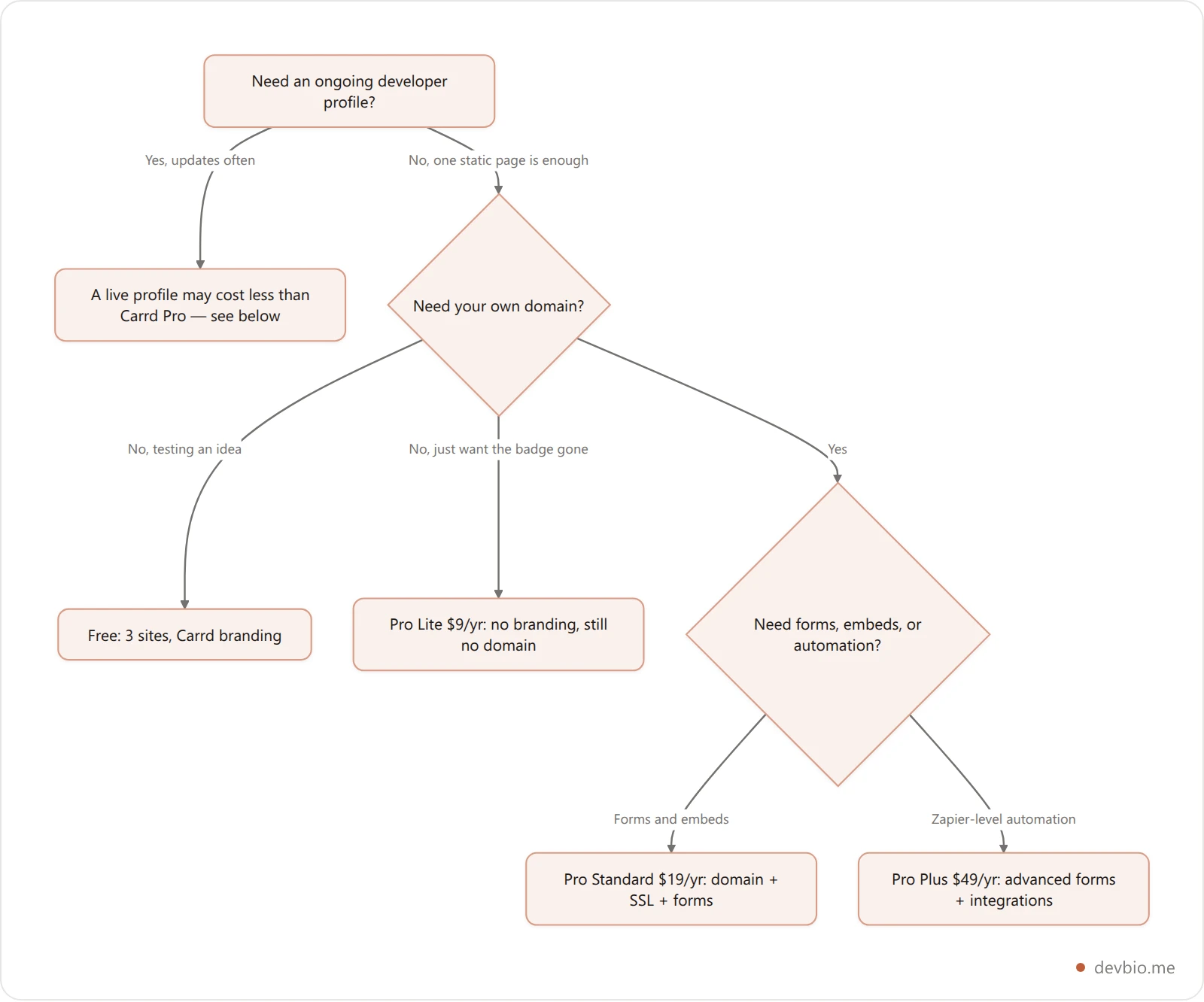
Strip away the feature lists and the decision comes down to two questions: do you need your own domain, and do you need forms or automation?
Just testing an idea, no domain needed: Free covers it. Three sites, Carrd branding, zero cost.
Want the badge gone, still don't need your own domain: Pro Lite at $9/year. Common for portfolio pages shared as a carrd.co link rather than a branded domain.
Need
**yourname.com**pointed at the page: Pro Standard at $19/year is the floor, not Pro Lite. This is the plan most people actually need and the one most people underestimate when they see "$9" on the pricing page.Need automated form handling or a client-facing page with password protection: Pro Plus at $49/year.
Still not sure which tier fits? Compare what a single live profile costs instead before you commit to a year of any Carrd plan.
Carrd Pricing vs a Live Developer Profile#
Carrd charges by the site. A developer-bio platform charges for one profile, which changes the comparison if what you actually need is a single page that represents you, not a landing page for a product.
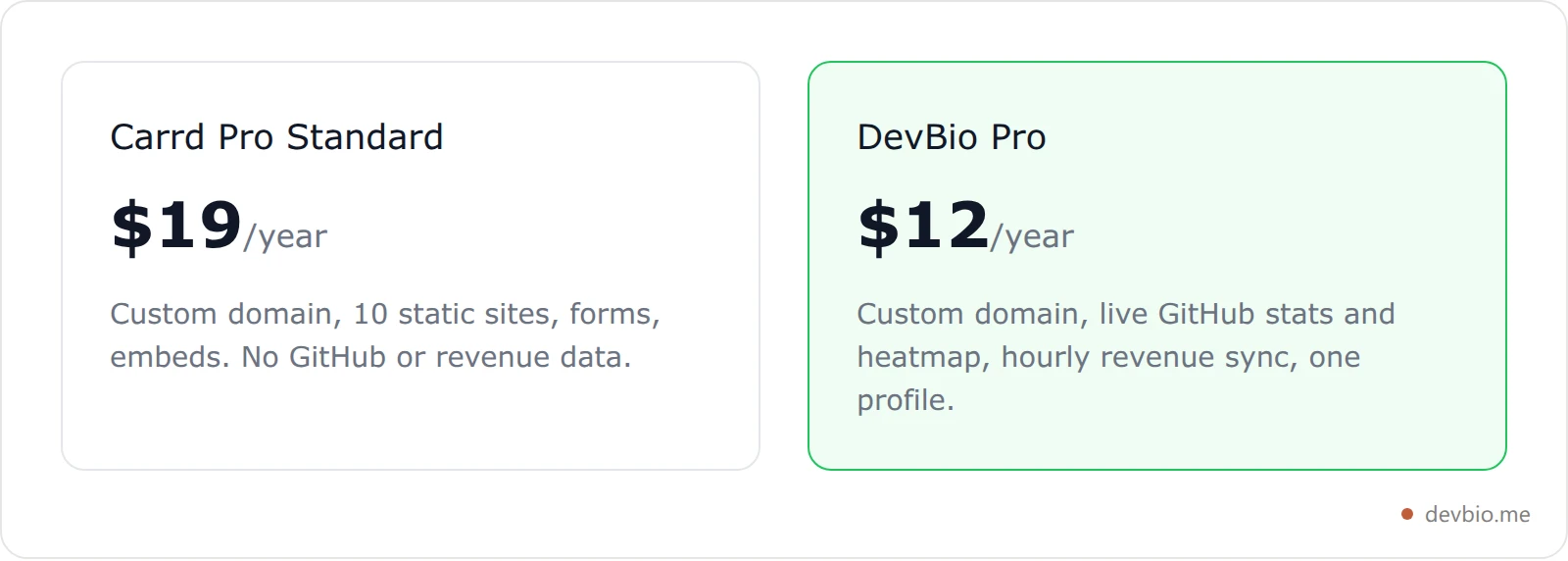
DevBio's free plan already includes a public bio, every bio component, GitHub public-repo metadata, a LaTeX-generated PDF resume, and a marketplace listing — no domain, same as Carrd's free tier. Pro runs $2/month, or $12/year billed annually, and adds a custom domain, badge removal, 30 days of analytics history, private-repo GitHub sync, and hourly revenue updates. There's also a $39-once "Pro forever" founding offer for the first 100 signups.
Skip the site-count math
DevBio doesn't charge by number of sites. One profile, live GitHub and revenue data, $12 a year.
See DevBio ProThat's a narrower comparison than Carrd's, because DevBio builds one live profile, not a general-purpose site builder — you're trading Carrd's design freedom (custom CSS/JS, 250+ templates) for components that update themselves. If that tradeoff is the one you actually care about, the full Carrd alternative breakdown covers the feature-by-feature case in more depth than pricing alone.
When Carrd's Price Is Worth Paying#
None of this makes Carrd overpriced. For what it's built to do, $19/year for a custom-domain landing page is genuinely inexpensive next to most website builders. I priced it against every other tool in this category while writing our comparisons, and nothing beats it on design freedom per dollar. Carrd earns its price when:
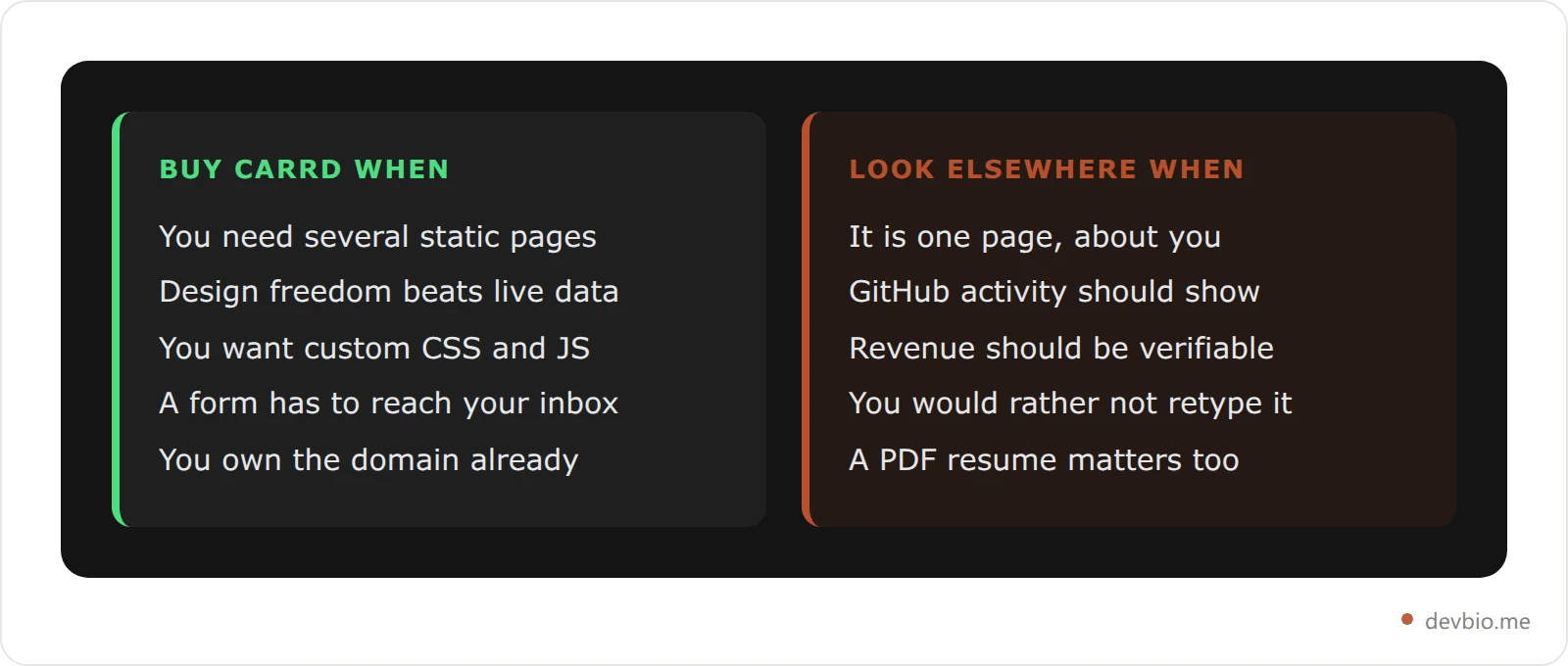
You need more than one static page (an event, a waitlist, a link hub, a product teaser)
Design flexibility — custom CSS, JS, and 250+ templates — matters more than live data
You want full control over exported source (Pro Plus) for a client project
You're shopping across several static-site and link-in-bio tools rather than picking one built for a developer profile specifically — see how Beacons compares if that's the search you're actually running, or how Linktree prices the same job across its four tiers, where the gated feature is branding removal rather than a custom domain — and the head-to-head on Linktree vs Carrd, which turns on the one row Linktree's own paid-features docs never mention
Where it stops making sense is when the thing you're building is a single profile meant to represent your work over time. That's a different job than a static site builder was designed for, and it's worth reading what actually belongs on a developer bio before you decide which kind of page — and which kind of pricing — fits what you're building.
Carrd's flat annual price looks even better next to a platform that takes a percentage. For that contrast, see how Beacons pricing and its 9% seller fee stack up tier by tier.
It looks better still against a creator storefront. Stan Store's entry plan costs $29 a month — more than Carrd Pro Standard costs for an entire year — because you're renting a checkout, course hosting, and product delivery rather than a page. The Stan Store pricing breakdown covers what that actually buys and the sales volume where it starts earning its keep.
Frequently Asked Questions#
Is Carrd Free?#
Yes. Carrd's free plan lets you build up to 3 sites with full access to the core editor and templates. Sites carry a "Made with Carrd" badge and can't use a custom domain until you upgrade to a paid plan.
What does Carrd Pro Lite actually add for $9 a year?#
Pro Lite removes the Carrd badge and unlocks premium URLs, larger image and video uploads, unlimited elements, and premium templates. It does not add a custom domain, forms, or embeds — those start at Pro Standard.
Does Carrd's $9 Pro Lite plan include a custom domain?#
No. Pro Lite only removes branding; your site stays on a carrd.co subdomain. Connecting your own domain with SSL requires Pro Standard at $19 a year, which is the cheapest tier that includes it.
How much does Carrd cost if I need more than 10 sites?#
Carrd's paid tiers scale by site count, not just features. Pro Standard jumps from $19/year at 10 sites to $119/year at 100 sites, and Pro Plus runs from $49/year at 25 sites up to $999/year at 1,000 sites.
How many Carrd sites can you make on each plan?#
Carrd's plan docs list 3 sites on Free and Pro Lite, 10 on Pro Standard, and 25 on Pro Plus at the base price. Every paid tier can scale up past that for a higher annual fee, so the site count, not just the feature list, sets what you actually pay.
Are there cheaper Carrd alternatives for a developer profile?#
If you only need one profile rather than multiple static sites, a developer-bio platform can cost less than Carrd's domain-enabled tier while adding live GitHub and revenue data Carrd doesn't support natively. See the full comparison for the complete feature breakdown.
Key Takeaways#
Carrd pricing is straightforward until you need one specific thing — usually a custom domain — and discover it's gated a tier higher than the homepage pricing implied. Free covers testing an idea. Pro Lite ($9/year) is a badge removal, not a real upgrade. Pro Standard ($19/year) is where most people actually land. Pro Plus ($49/year) is for automation most single-page sites don't need.
If what you're pricing out is a static landing page, that $19/year tier is a fair deal. If what you actually need is a profile that keeps itself current — your GitHub activity, your project revenue — without you manually editing it every time something changes, it's worth pricing against a platform built for that instead of a general-purpose site builder.


