

Choosing a payment processor is one of the few infrastructure decisions an indie hacker makes that's expensive to reverse. Get it wrong and you're either overpaying in fees for years or discovering a tax registration debt you didn't know you owed. This guide compares what Stripe, Lemon Squeezy, Polar, and Dodo Payments actually cost and handle in 2026, so you pick once and move on.
In this guide:
Payment processor vs. merchant of record — why the difference changes your legal liability
What each processor really costs — headline rate versus real effective rate
The 3-question test for picking the right category before comparing fees
A real before/after cost example, and how to prove your revenue once you've picked
The Best Payment Processor for Indie Hackers Depends on One Question#
This space moved fast this year. Polar raised its fees, Lemon Squeezy confirmed a migration path off its own platform, and Stripe's own merchant-of-record product turned out to cost more than the incumbents it was supposed to compete with.
The best payment processor for indie hackers comes down to one question: are you selling to more than one country? If yes, a merchant of record — Dodo Payments, Polar, or Lemon Squeezy — takes tax registration off your plate for roughly 2-4 extra points of fee. If no, plain Stripe at 2.9% + $0.30 is still the cheapest option, and you can add Stripe Tax later.
Everything past that first question is about trade-offs: headline rate versus real effective rate, vendor stability versus lowest cost, and how much of your Saturday you want to spend on VAT filings instead of shipping. This guide breaks down what each of the four processors developers actually use in 2026 — Stripe, Lemon Squeezy, Polar, and Dodo Payments — really costs, who they're built for, and how to decide without reading eleven pricing pages.
Payment Processor vs. Merchant of Record: The Distinction That Decides Everything#
A payment processor moves money. A merchant of record moves money and becomes the legal seller of your product.
With a plain payment processor — Stripe in its default configuration — you are the seller on every invoice. You register for sales tax in every US state where you cross an economic nexus threshold, register for VAT in the EU if you sell to EU consumers, and file returns in each jurisdiction, quarterly or monthly, for as long as you have customers there. For a solo founder selling into 20+ countries, that's not a side task. It's a part-time compliance job with real penalties for getting it wrong.
A merchant of record (MoR) — Lemon Squeezy, Polar, Dodo Payments, or Paddle — steps in as the legal seller. A merchant of record for SaaS calculates, collects, and remits sales tax and VAT on every transaction, absorbs the chargeback risk, and pays you a net payout. You never register anywhere. The trade-off is the fee: MoRs charge 4-11% instead of a processor's 2.9%, because that fee is buying you out of a genuine legal obligation, not just card processing.
The math on when that trade is worth it generally favors the MoR earlier than founders expect: once you're doing meaningful revenue across a handful of countries, the accountant hours, registration filings, and audit risk of self-managed compliance tend to exceed what an MoR charges in fees. For a true one-country, one-currency product, that math doesn't apply, and plain Stripe wins on cost every time.
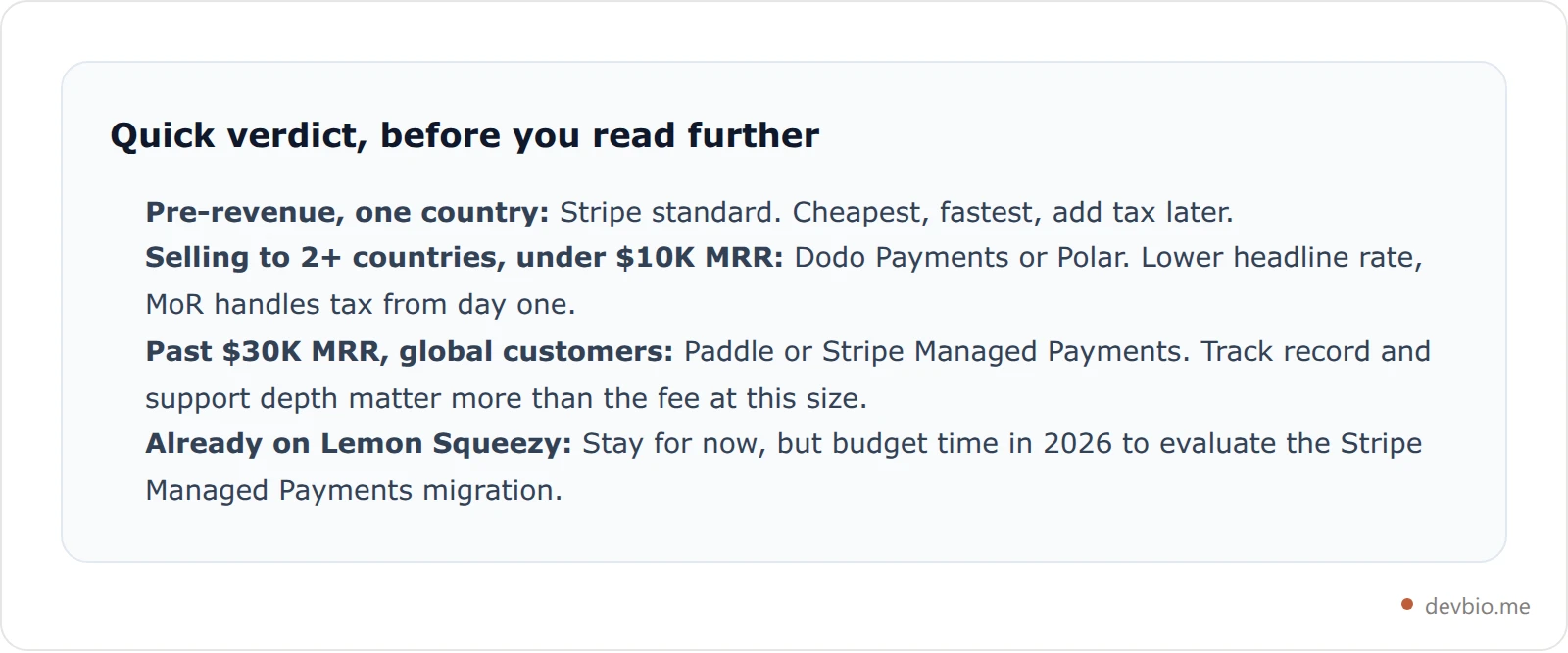
Once you've matched yourself to one of those rows, the setup afterward is quick — most of these processors take under 15 minutes to connect and start collecting. See how the connection works on a live profile, then come back for the fee breakdown below.
Stripe and Stripe Managed Payments: The Default, and Its Real Cost#
Stripe in its standard configuration is a payment processor, not a merchant of record. Domestic US card payments run 2.9% + $0.30, with you responsible for sales tax and VAT registration everywhere you sell. It's the cheapest option on this list and the one every developer already has an account with.
In April 2025, Stripe launched Stripe Managed Payments, its own merchant-of-record product, built in large part from the Lemon Squeezy acquisition. It doesn't replace the standard rate — it stacks on top of it. Managed Payments adds 3.5% on top of the standard 2.9% + $0.30, landing at an effective 6.4% + $0.30 domestic, and climbing past 8%, often above 10%, on international cards with currency conversion. That makes it the most expensive MoR option on the market — more than Paddle, more than Lemon Squeezy, more than either newer entrant below.
What you get for it: Stripe registers, collects, and remits tax in 75+ countries, plus the infrastructure Stripe is known for — the highest card authorization rates in the industry and support for effectively every payment method that matters. If uptime and authorization rate are your top priority and fee percentage is secondary, Managed Payments is a legitimate choice. If you're fee-sensitive, it's the most expensive way to get MoR coverage.
Lemon Squeezy: The Acquired Incumbent, Mid-Migration#
Lemon Squeezy has been the default MoR recommendation for indie hackers since before Stripe acquired it in July 2024. The pricing is simple: 5% + $0.50 base, with surcharges for international cards (+1.5%), PayPal (+1.5%), and subscription billing (+0.5%). For a founder doing $10K/month with a normal mix of domestic and international subscribers, the effective rate lands between 5.5% and 11% depending on how many of those surcharges stack.
The bigger issue in 2026 isn't the fee, it's direction. Stripe's own CEO Patrick Collison set the tone at acquisition, writing publicly: "Welcome @lmsqueezy! We're going to scale merchant of record selling in a big way." That scaling has turned out to mean building Stripe Managed Payments as the long-term product, not growing Lemon Squeezy as a standalone brand. In a January 2026 update, Lemon Squeezy co-founder JR Farr confirmed the team is actively building migration paths from Lemon Squeezy to Stripe Managed Payments, noting that authorization rates are "much better when you're directly on Stripe" with "100's of engineers focused on core features."
Lemon Squeezy isn't shutting down today and there's no announced end date. But storefront builders, affiliate tooling, and digital-download delivery that Lemon Squeezy merchants rely on aren't part of Stripe Managed Payments today, so a forced migration would mean rebuilding parts of your checkout flow. If you're already on Lemon Squeezy, that's not an emergency. If you're choosing a processor from scratch in 2026, it's a real factor to weigh against the newer, purpose-built alternatives below.
Polar: The Developer-Native Merchant of Record#
Polar started in 2023 as a GitHub sponsorship tool and grew into a full MoR: subscriptions, one-time sales, usage-based billing, and tax compliance in 60+ countries, with an API-first design and GitHub integration that feels native to how developers already work. It crossed 10,000 registered developers in early 2026, pulled in largely by founders tired of Paddle's enterprise sales friction and Lemon Squeezy's post-acquisition uncertainty.
The catch: Polar's pricing isn't what it was when most of those developers signed up. It launched at a flat 4% + $0.40. On May 27, 2026, Polar restructured to a tiered model where the free Starter tier now costs 5% + $0.50 — a 25% increase on both the percentage and the fixed fee. It's still competitive, and still meaningfully cheaper than Stripe Managed Payments, but the "cheap because it's small and open source" pitch has softened. Budget for the new rate, not the one you might remember from a launch post.
Where Polar still wins clearly: developer experience. If you want an MoR that feels like a well-documented API rather than a hosted checkout you bolt on, and you value the open-source, GitHub-native ecosystem, Polar remains the most developer-shaped option on this list.
Dodo Payments: The Newest, and the Cheapest Headline Rate#
Dodo Payments launched in 2023, founded by Rishabh Goel and Ayush Agarwal, targeting SaaS, AI, and digital-product businesses specifically — it explicitly doesn't support service businesses like agencies, due to MoR compliance requirements. It processes across 190+ countries and has picked up traction fast with early-stage founders who want the lowest sticker price on the market: 4% + $0.40.
Read the fee schedule past the headline, though. Dodo adds +1.5% for international transactions and +0.5% for subscription billing, and for a typical global SaaS subscriber the real effective rate lands around 6.5% — closer to Stripe Managed Payments than the 4% headline suggests, though still meaningfully cheaper on the fixed fee and for domestic-heavy revenue mixes. As of mid-2026 Dodo has around 121 Trustpilot reviews with generally positive early-adopter sentiment, but it's the youngest company on this list, which is its own kind of risk to weigh.
Real Effective Fees, Side by Side#
Headline rates are marketing. Effective rates — what actually leaves your payout — are what matter. Here's both, based on the sourced figures above:

Provider | Type | Headline rate | Real effective rate | Tax/VAT handled | Best for |
|---|---|---|---|---|---|
Stripe (standard) | Payment processor | 2.9% + $0.30 | 2.9% + $0.30 (domestic) | No — you register | Single-country, cost-sensitive |
Stripe Managed Payments | Merchant of record | +3.5% stacked | 6.4% + $0.30 domestic; 8-10%+ intl | Yes, 75+ countries | Founders who want Stripe's rails, will pay for it |
Paddle | Merchant of record | 5% + $0.50 | 7-8.5% all-in | Yes, global | Scaled SaaS, $500K+ ARR |
Lemon Squeezy | Merchant of record | 5% + $0.50 | 5.5-11% with surcharges | Yes, 130+ countries | Existing users; new signups should weigh migration risk |
Polar | Merchant of record | 5% + $0.50 (since May 2026) | ~5.5-6% typical | Yes, 60+ countries | Developer-first teams, open-source-adjacent products |
Dodo Payments | Merchant of record | 4% + $0.40 | ~6.5% typical global | Yes, 190+ countries | Early-stage SaaS wanting the lowest sticker price |
For a deeper look at what to do with the revenue number once you're collecting it — including how to calculate and prove MRR accurately — see the SaaS MRR calculator guide. Whichever number you land on, DevBio pulls it live from any of these four processors straight onto your profile.
The 3-Question Payment Stack Test#
Every payment-stack decision indie hackers agonize over collapses into three questions, in this order. Answer them top to bottom and you'll land on the right processor faster than reading another comparison post.
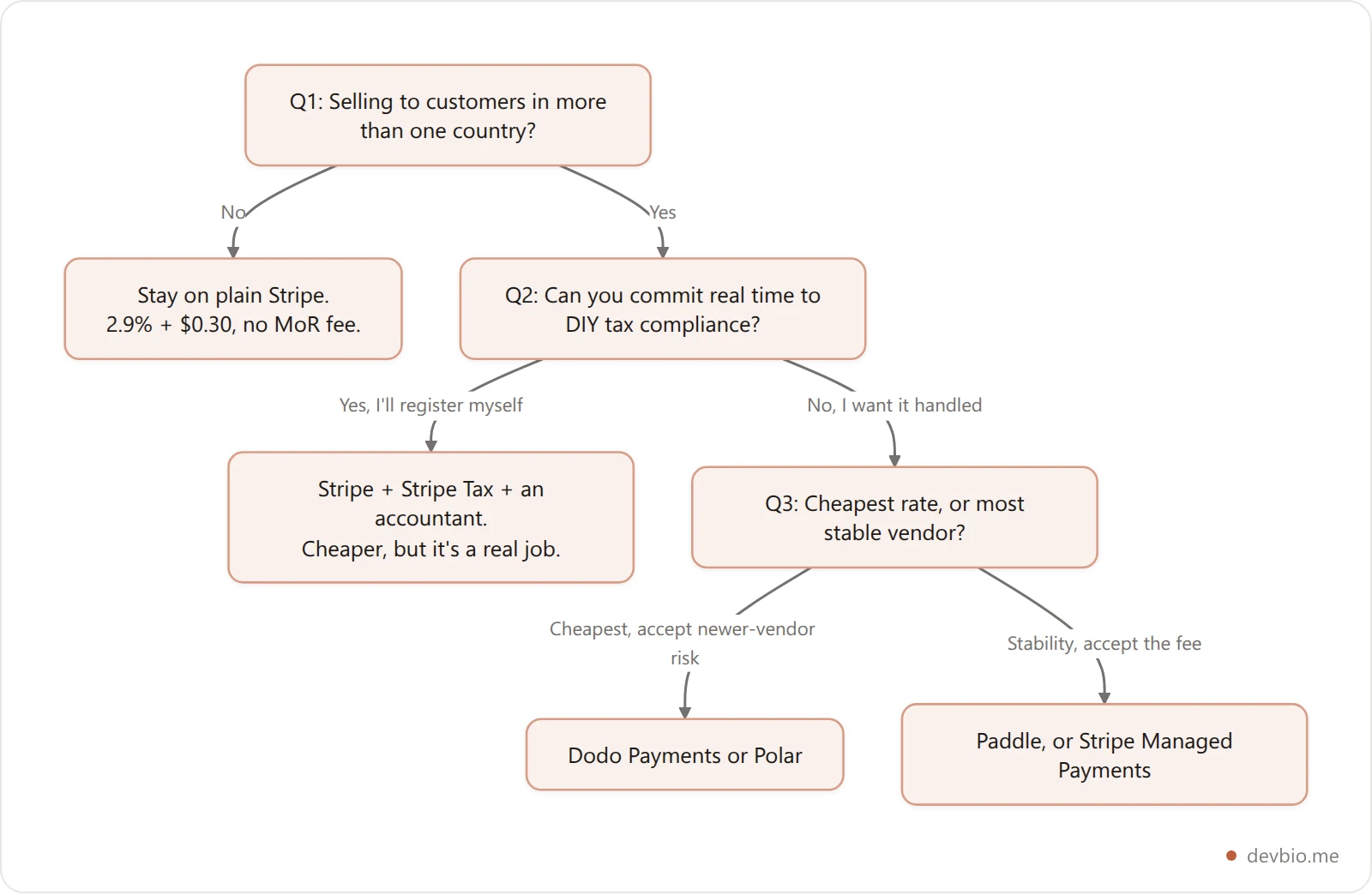
Call this the 3-Question Payment Stack Test — three answers and your indie hacker payment stack is settled. The reason it works is that it forces the fee comparison to happen last, not first. Most founders start by comparing percentages and end up picking a processor that's wrong for their actual tax exposure. The country question and the compliance-time question determine the category of processor you need. The fee only decides which processor within that category.
For context on why this decision matters beyond the accounting — a stable payment stack is also part of what makes your revenue numbers trustworthy to a hiring manager, a community, or a future acquirer — see the indie hacker profile guide on what to show before you hit $10K MRR.
Before and After: What Getting the Stack Wrong Actually Costs#
Maya builds a small dev-tools SaaS. She launches on plain Stripe because it's the account she already has, and picks up customers in the US, UK, Germany, and Canada within four months.
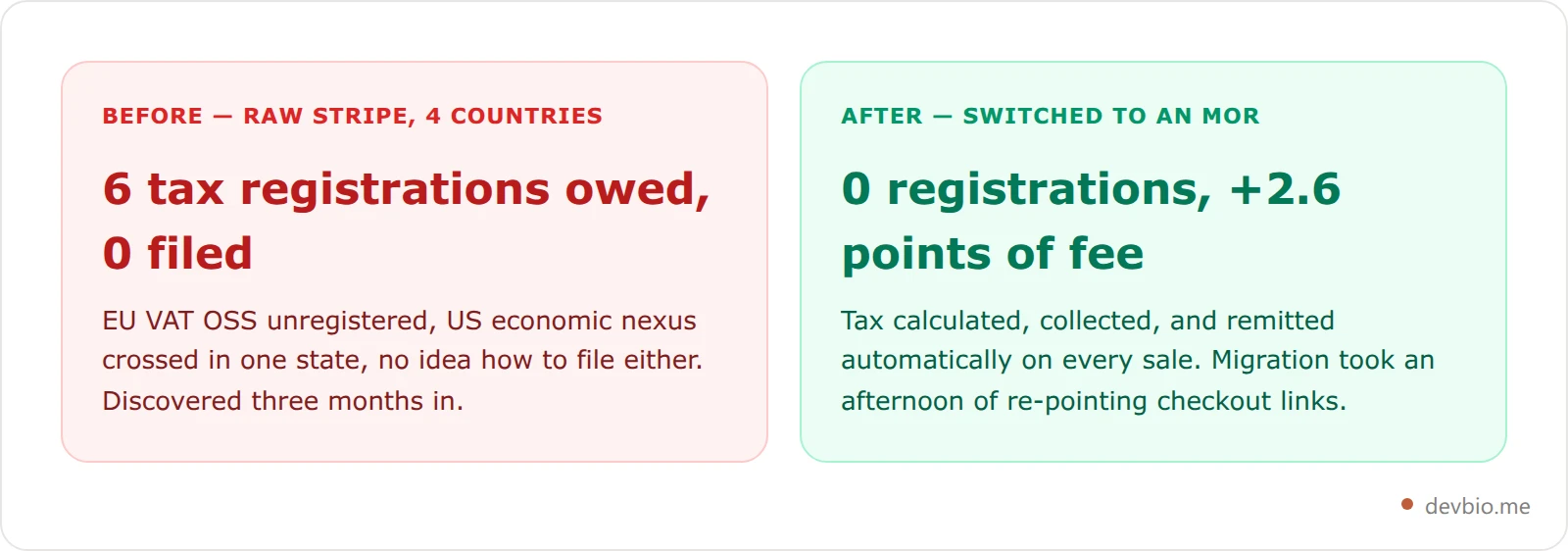
Maya's mistake wasn't picking Stripe — it was not asking the first question in the 3-Question Test before she had customers outside one country. She migrated to an MoR in month four, which meant re-pointing checkout links and re-issuing a handful of active subscriptions, a half-day of work that would have taken ten minutes if decided before launch. The fee she pays now is real. So was the registration debt she was accumulating for free before she switched. Selling to customers across 40 US states without an MoR can mean 40 separate state tax registrations, each with its own filing cadence — a full-time job hiding inside what looked like a free choice.
Once You've Picked, Prove the Revenue Is Real#
Whichever processor you land on, the number it produces is only useful to other people if they can see it's real. A dollar figure typed into a bio is a claim. The same figure pulled live from your payment account via a read-only API key is proof — because nobody can fake an API response your processor didn't send.
This is the part most payment-stack comparisons skip: the processor you choose also determines what you can show. A project card that pulls live subscriber counts and MRR straight from Stripe, Dodo Payments, Lemon Squeezy, or Polar reads completely differently to a recruiter or a potential acquirer than a static "$4K MRR" line in a bio description — the live MRR developer profile guide walks through the five-minute setup for connecting any of the four. Start with your bio and add the integration once it's live.
If you're further along and the current conversation isn't "which processor" but "should I sell the whole thing," a stable, well-documented payment history is also one of the first things a buyer's due diligence will check — see how to sell your SaaS side project for what that process actually looks for. Evaluating the other side of that trade — see how to buy micro SaaS for what a verified-MRR listing should actually show before you wire money.
Frequently Asked Questions#
What's the difference between a payment processor and a merchant of record?#
A payment processor moves money but leaves you as the legal seller, responsible for sales tax, VAT registration, and chargeback liability everywhere you sell. A merchant of record becomes the legal seller itself, collecting and remitting tax and absorbing chargeback risk, for a higher fee — typically 4-11% versus a processor's 2.9%.
Is Stripe a merchant of record?#
Not by default. Standard Stripe is a payment processor — you own tax compliance. Stripe Managed Payments, launched in 2025, is Stripe's separate MoR product, and it stacks a 3.5% fee on top of standard processing, landing around 6.4% + $0.30 domestically and 8-10%+ internationally.
Why did Polar get more expensive in 2026?#
Polar launched at a flat 4% + $0.40 and restructured its pricing on May 27, 2026, moving the free Starter tier to 5% + $0.50 — a 25% increase on both components. It's still cheaper than Stripe Managed Payments and Paddle, but no longer the cheapest option on the market outright.
Should I worry about Lemon Squeezy shutting down?#
Not urgently. Lemon Squeezy is still operating and there's no announced shutdown date. But Stripe has confirmed it's building migration paths from Lemon Squeezy to Stripe Managed Payments, and some Lemon Squeezy-only features like the storefront builder and affiliate tools aren't part of the Stripe product yet. Existing users should watch this; new signups should factor it into the decision.
What's the real cost of Dodo Payments beyond the 4% headline rate?#
Dodo's advertised rate is 4% + $0.40, but international transactions add 1.5% and subscription billing adds 0.5%. For a typical global SaaS subscriber, the real effective rate lands around 6.5% — still competitive, but noticeably higher than the number in Dodo's own marketing.
At what revenue level should I switch from Stripe to a merchant of record?#
There's no universal number, but once you're selling to multiple countries and the hours spent on manual tax registration and filing start competing with time spent building, the crossover has usually already happened. Many founders find the MoR's all-in fee becomes cheaper than DIY compliance somewhere in the $10K-$30K MRR range, though country mix matters more than revenue alone.
Can I show live revenue from any of these processors on a public profile?#
Yes. Stripe, Dodo Payments, Lemon Squeezy, and Polar can all connect via a read-only API key to display live, verified MRR on a public developer profile — the number comes from the payment account itself rather than text someone typed, which is a meaningfully different signal to a recruiter, a community, or a buyer evaluating your work.
Key Takeaways#
One country, cost-sensitive: plain Stripe at 2.9% + $0.30 beats every merchant of record on price.
Multiple countries, don't want to manage tax: Dodo Payments or Polar offer the lowest effective MoR rates in 2026, around 5.5-6.5%.
Scaled and global: Paddle or Stripe Managed Payments trade a higher fee (7-10%+) for the deepest track record and support.
Already on Lemon Squeezy: stay for now, but plan around Stripe's confirmed migration path to Stripe Managed Payments.
Plain Stripe is still the cheapest option if you sell to one country. Past that, the 3-Question Payment Stack Test — country count, compliance time budget, cheapest-versus-stable — gets you to the right category faster than comparing percentages first. And once you've picked, the processor you choose also decides what you can prove: a live, API-verified MRR number reads as fact, where a typed-in figure reads as a claim.
Your revenue is already real. Put it on one link, verified — devbio.me


