Carrd is the fastest way to ship a one-page site. It is also the reason a lot of developer "portfolios" quietly go stale: a project ships, the Carrd page doesn't get touched, and six months later it's showing a screenshot of an app that pivoted twice since. Carrd was never built to know that.
The short answer: the best Carrd alternative for developers is a profile that pulls its own proof instead of asking you to paste it in. Carrd builds static one-page sites with drag-and-drop blocks and paid custom domains. DevBio builds a developer bio where the project cards, GitHub stats, and revenue numbers update themselves, because they're read live from GitHub and your payment provider instead of typed once and left to rot.
That distinction matters more in 2026 than it did in 2023. Developers created more than 230 new repositories every minute last year, and the platform crossed 630 million repositories total, per GitHub's 2025 Octoverse report. A static screenshot of your GitHub activity is out of date before the page finishes loading.
What Carrd Actually Gets Right#
Carrd deserves the credit it gets. It's cheap, it's fast, and it doesn't try to be everything.
250+ templates and a genuinely simple block editor. You can have a page live in under an hour with zero code.
Custom CSS and JavaScript on paid plans, which is why a lot of developers use it for landing pages and link-in-bio pages instead of no-code tools aimed at non-technical users.
Third-party embeds. You can drop in Stripe, PayPal, Typeform, or Gumroad widgets to collect payments or leads directly on the page.
Real pricing, not a bait-and-switch. Plans with a custom domain and no Carrd branding start at $19/year, which is genuinely cheap next to Wix or Squarespace, per Tech.co's review.
If you need a single static landing page for an event, a waitlist, or a link hub with a custom domain, Carrd is a legitimate, low-cost answer. The problems start when you try to use it as a developer profile that's supposed to prove you can build and ship software.
More Developers, More Noise: Why a Static Page Stops Working#
Carrd's simplicity was a real advantage when fewer people were competing for the same roles and clients. That's not the market anymore.
More than one new developer joins GitHub every second, and the platform added over 36 million new developers in the past year alone, bringing the total past 180 million, per GitHub Octoverse 2025. Every one of them can spin up a Carrd page with the same templates you're using in under an hour.
That's not an argument against Carrd's design quality. It's an argument that a well-designed static page is no longer a differentiator by itself, because so many other developers have one. What's left to differentiate on is whether the claims on the page can be checked. The 2025 Stack Overflow Developer Survey lists practical skills, portfolio projects, and real-world problem-solving as the top hiring priorities, with 67% of developers naming GitHub itself as a primary community and collaboration platform. Hiring managers are already looking at GitHub directly. A profile that surfaces that same data live, instead of asking them to go dig for it, is doing work a static page can't.
This is also why maintenance cost is a real, if unglamorous, factor. A Carrd page doesn't fall behind all at once. It falls behind in small increments: a project gets renamed, a client wraps up, a new repo ships, and each of those is a manual edit that competes with actual paid work for your attention. Most developers, understandably, let the page slip. The result is a portfolio that's quietly describing you as you were 8 to 14 months ago.
The Static Trust Gap: Why a One-Page Site Can't Prove Anything#
Here's the direct answer: a static page can claim anything. It can't verify anything. That gap between what a page says and what it can back up is what we'll call the Static Trust Gap, and in 2026 it's a bigger liability than it used to be.
Hiring is going through a trust crisis right now, and it's not about developers lying. It's about AI making it trivially easy for anyone to sound qualified. 67% of hiring managers say AI-generated resumes are actively hurting the hiring process, largely because polished claims are now cheap to produce and hard to verify at a glance, according to Forbes.

A Carrd page sits on the wrong side of that gap by default. Every bullet point on it, "built a SaaS to $10K MRR," "500+ GitHub stars," "shipped 12 production apps," is a claim you typed in yourself. Nothing on the page checks it against a live source. A recruiter has no way to tell your Carrd page apart from one built by someone who used an AI tool to write convincing copy about projects that don't exist.
This is the same argument we made in more depth in Developer Portfolio vs Resume: Proof over Claims: the format that wins in an AI-saturated hiring market is the one where the reader can verify a number without asking you to. For how a static one-pager stacks up against a personal site or a plain link-in-bio too, see developer portfolio vs personal site vs link in bio.
DevBio vs Carrd: Feature-by-Feature#
Here's the comparison stripped down to what actually differs.
Carrd | DevBio | |
|---|---|---|
Page type | Static one-page site | Composable developer bio, live-rendered |
GitHub stats | Manual text or embedded badge images | Live stars, commits, and contribution heatmap, pulled per visit |
Revenue / MRR | Not supported natively | Live MRR from Stripe, Dodo Payments, Lemon Squeezy, or Polar |
Resume export | None built in | ATS-readable PDF, compiled from your bio at |
Custom domain | Yes, from $19/year plan | Yes, on the Pro plan |
Sell a project | Not supported | Built-in marketplace with live-MRR listings |
QR code / vCard | Not built in | Both generated automatically per profile |
Design freedom | High (custom CSS/JS, 250+ templates) | Structured components, less freedom, zero upkeep |
Best for | Landing pages, waitlists, static link hubs | A developer profile that has to prove, not just claim |
The tradeoff is honest: Carrd wins on raw design flexibility. DevBio wins on every axis that involves proving something is real and current, because those things are components with a live data source, not text you edited once. If you're weighing other link-in-bio options too, see how the same tradeoff plays out in the Bento.me alternative and the read.cv alternative comparisons.
Live GitHub Stats and Real Revenue: What Carrd Can't Show#
This is the part of the Static Trust Gap that's easiest to see in practice. On Carrd, showing your GitHub activity means embedding a third-party badge image or manually listing repos. Both go stale the moment you stop maintaining the page.

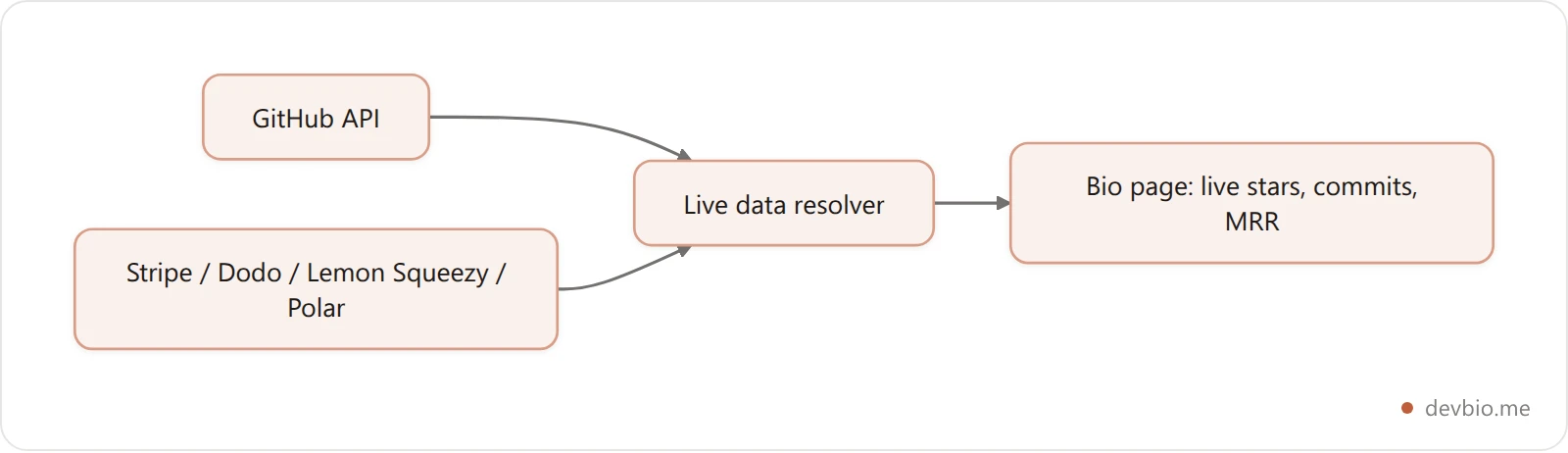
DevBio resolves this at read time instead of write time. Every time your bio page is fetched, it batch-queries your connected GitHub repos and any connected payment provider, then merges live stars, commit counts, and MRR or subscriber counts onto your project cards and revenue component. Your bio content itself never gets mutated with those numbers; they're layered on live, so there's no "last synced 3 months ago" problem.
This matters because of scale, not just aesthetics. Developers pushed nearly a billion commits in 2025, up 25.1% year over year, and 81.5% of all contributions now happen in private repositories, per GitHub Octoverse 2025. Most of your actual output is invisible unless something surfaces it deliberately. A static Carrd bullet ("active open-source contributor") can't reach into that private activity and prove it. A live contribution heatmap and commit count can.
If you want the deeper mechanics of what a heatmap communicates and how to read one, see the GitHub contribution heatmap guide.
Resume Export: A PDF vs a Page You Have to Screenshot#
Recruiters still ask for a PDF. Carrd doesn't generate one. Your options are exporting the page as a screenshot (which no applicant tracking system can parse) or maintaining a completely separate resume document by hand.

DevBio compiles a real, text-based PDF at /{username}/resume by converting each bio component into LaTeX and rendering it server-side. It's not a screenshot and not an image export, it's actual selectable text that an ATS can parse the same way it parses a Word doc, generated from the same components already on your public bio. Update your bio once, and both the live page and the resume PDF stay in sync automatically.
Pricing and Total Cost#
Carrd's pricing is genuinely fair for what it is: a Free plan (3 sites), Pro Lite at $9/year, Pro Standard at $19/year (10 sites, custom domain, no ads), and Pro Plus at $49/year (25 sites), all billed annually, per Tech.co. But you're paying per number of static sites, not for anything that proves your work is current.

DevBio's Free plan covers up to 8 projects and 2 integrations. Pro runs $2/month or $12/year and adds custom domains, up to 30 projects, 10 integrations, hourly data sync, and private-repo GitHub support. There's also a $39 one-time founding-member offer for lifetime Pro access, capped at the first 100 seats. Full setup for a custom domain, on either platform, takes about 10 minutes; see the custom domain setup guide if you're moving your domain over.
Got a Side Project to Sell? Carrd Has No Marketplace#
If a side project ever reaches the point where you want to sell it, a Carrd page can describe it. It can't list it anywhere a buyer is actually looking, and it can't prove the MRR you're claiming.
DevBio's marketplace lists projects with live MRR snapshots pulled straight from the same integration data shown on your bio, plus optional "for sale" and asking-price fields for projects you want to shop to acquirers, alongside other places developers list a SaaS for sale. A buyer sees the same live revenue number a recruiter or a fellow developer would see on your profile, not a number you typed into a listing description. For the mechanics of proving MRR before you list anything, see the live MRR setup guide.
Before and After: Two Freelance Developers, Same Skill Set#
Picture two freelance backend developers with near-identical experience, both looking for contract work.
Developer A runs a Carrd page built 14 months ago. It lists three projects, two of which have since been sunset. The GitHub link goes to a profile that hasn't been updated with the newer private-repo work, because that work is under NDA and doesn't show up as public activity anyway. Updating the page means logging into Carrd's editor and manually re-typing project descriptions, something that reliably gets pushed to "later" every time a project ships.
Developer B runs a DevBio profile. The same NDA'd private work still shows up as commit volume and a contribution heatmap without exposing any code or client names. The two most recent shipped projects show live GitHub stars and, for the one that's a SaaS side project, live MRR pulled from Stripe. There's nothing to manually update: the page reflects this week's numbers by default, and the ATS resume PDF regenerates from the same data.
Same skill level, same experience. One profile requires ongoing manual upkeep to stay honest. The other can't fall behind, because it isn't describing your work from memory, it's reading it.
The 15-Minute Carrd-to-DevBio Migration Checklist#
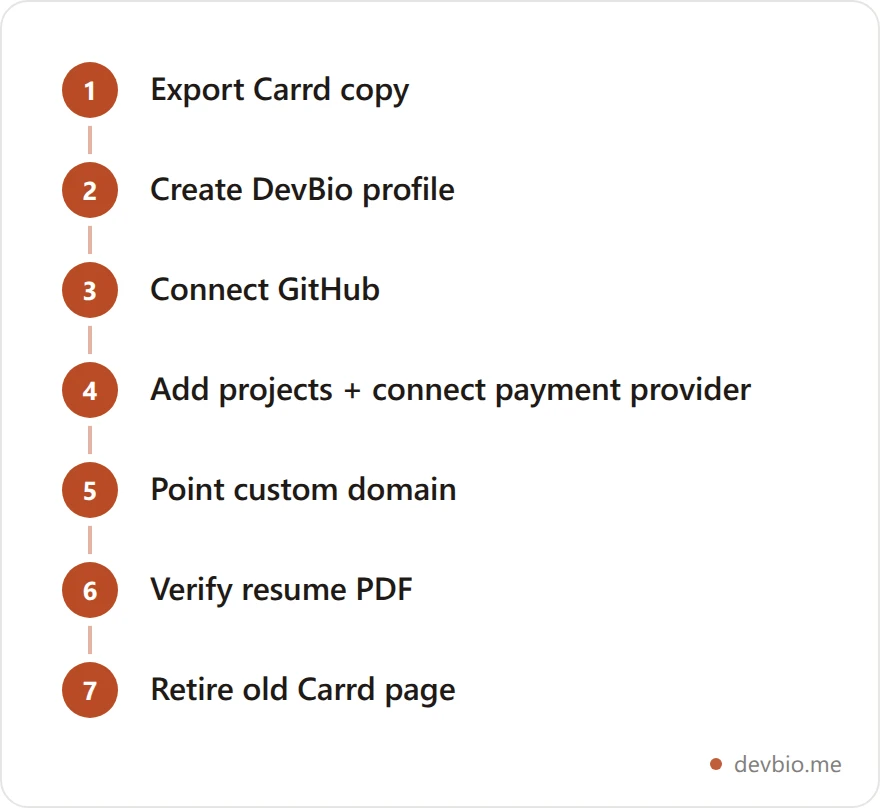
If you're moving off Carrd, here's the order that avoids rework:
Export or note down your current Carrd copy (about section, project descriptions, links) so you're not rewriting from scratch
Create your DevBio profile and add the basic-info, avatar, and about components first
Connect your GitHub account to enable live stats and the contribution heatmap
Add your projects as components, then connect Stripe, Dodo Payments, Lemon Squeezy, or Polar to any project that has real revenue
Add your links component (the same links your Carrd page had)
Point your custom domain at DevBio if you had one on Carrd (both platforms support this on paid plans)
Check
/{username}/resumeto confirm your ATS PDF renders correctlyRedirect or retire the old Carrd URL once the new profile is live
For a broader look at which components are worth including beyond what Carrd's templates nudge you toward, see what to put on a developer bio.
When Carrd Is Still the Right Call#
Don't switch everything just because this post is making the case for DevBio. Carrd is still the better tool if:
You need a single static landing page for an event, product launch, or waitlist with no ongoing data to show
Design flexibility (full custom CSS/JS, dozens of layout options) matters more than proof
You're not a developer and have no GitHub activity, revenue, or technical work to verify in the first place
If none of those apply and the page is meant to represent you as a developer, the Static Trust Gap is working against you every day the page sits unmaintained.
As developer educator devraj_singh7 put it in a widely read 2026 DEV Community post: "Your portfolio is not a gallery of what you've built. It's proof that you can solve real problems." A static page can hold the gallery. It can't hold the proof.
FAQ#
Is Carrd good for developers?#
Carrd is good for developers who need a fast, cheap static landing page, waitlist, or link hub. It's a weaker fit as a professional developer profile, since it can't verify GitHub activity, revenue, or project status without manual upkeep.
What is the best Carrd alternative for developers?#
The best Carrd alternative for developers is a platform that pulls GitHub stats and revenue data live instead of relying on typed-in claims. DevBio does this by resolving live GitHub and payment-provider data onto your bio at read time.
Can Carrd show GitHub stats or live revenue?#
Not natively. You can embed a third-party GitHub badge image on Carrd, but it isn't connected to your account and won't update reliably. Carrd has no built-in way to show live MRR or subscriber counts.
Is Carrd free?#
Carrd has a free plan limited to 3 sites with Carrd branding. Removing branding and adding a custom domain requires a paid plan starting around $9 to $19 per year, billed annually.
Can I sell a side project through Carrd?#
No. Carrd can describe a project on a page, but it has no marketplace, no buyer discovery, and no way to verify the revenue you list. A platform with a built-in marketplace and live MRR data gives buyers something to actually verify.
Does Carrd support custom domains?#
Yes, on paid plans starting at Pro Standard ($19/year), which also removes Carrd branding. Most competing developer-bio platforms, including DevBio, support custom domains on their paid tier as well.
What's the difference between a static portfolio and a live developer profile?#
A static portfolio is content you typed once and have to manually update. A live developer profile pulls current data (GitHub stars, commits, revenue) from connected sources every time it's viewed, so it can't go stale the way a static page can.
Can Carrd generate an ATS-ready resume PDF?#
No, Carrd has no resume export feature. You'd need a separate tool or manual document. Some developer-bio platforms compile an ATS-readable PDF resume directly from the same profile data shown on the live page.
The Bottom Line#
Carrd is a good, cheap tool for exactly what it's built for: static one-page sites you design once and rarely touch. That's the wrong shape for a developer profile in a hiring market where 67% of hiring managers already distrust unverified claims and where your real output, mostly sitting in private repos, needs a live source to surface it at all.
The fix isn't a better template. It's a profile built from components that read live data instead of storing typed-in claims: GitHub stars and commits that update on their own, revenue pulled straight from Stripe or Polar, and a resume PDF that regenerates from the same source instead of drifting out of sync.
Your code and your revenue already prove what you can do. Put them on one link, live.