

The Read.cv shutdown took the site offline on May 16, 2025. If your professional profile lived there, that URL has led nowhere for over a year — and every "top 10 read.cv alternatives" roundup published since treats the gap it left as interchangeable with any other bio page. It isn't, especially if you're a developer, because the thing that made Read.cv useful for engineers was never the layout.
A read.cv alternative for developers needs to do more than host a clean, minimal profile page. It needs live GitHub activity, real product revenue if you ship a SaaS, and a resume an applicant-tracking system can actually parse — because that was the substance underneath Read.cv's design, not the design itself.
Updated July 2026. This covers exactly what happened to Read.cv, why most alternative roundups solve the wrong problem for developers, a full comparison of the realistic options, and a step-by-step migration path.
Read.cv Shutdown Timeline: The Official 2025 Dates#
The Read.cv shutdown took effect on May 16, 2025, after its founding team joined Perplexity AI in an acquihire announced that January. Unlike most shutdowns, Read.cv gave users real notice and a real export path.
The official Read.cv shutdown timeline, reconstructed from the acquisition announcement and community coverage:

January 2025 — Perplexity AI announces it has acquired Read.cv's team. The product itself is not folded into Perplexity; it's wound down. (Yahoo Finance)
January–May 2025 — Read.cv stays live in a maintenance window, giving users roughly four months to migrate before the shutdown date.
May 16, 2025 — Read.cv goes offline permanently. Profile pages, essays, and the "readers" following graph are gone.
The one thing Read.cv did that most shut-down platforms don't: it let users export a .zip of their content, and — for the technically inclined — download their entire profile as a working Next.js project to self-host. That's a genuinely rare move, and it's why the Hacker News thread on the acquisition reads less angry than most shutdown threads. One commenter summed up the more common complaint about this pattern across the industry: "Users help grow a product... and then it's yanked out from under them." (Hacker News) Read.cv avoided the worst version of that story, but the underlying lesson holds regardless: a profile that only exists because one company keeps paying to run it is a profile you don't fully control.
If you exported before the deadline, you have your content. If you didn't, your best options now are the Wayback Machine or whatever you can recover from browser cache — treat it as partial recovery, not restoration.
Why Most "Read.cv Alternative" Roundups Miss What Developers Need#
Most Read.cv alternative lists rank tools by how closely they match its minimal, essay-driven design. That's the wrong axis for developers, because Read.cv's actual value for a technical audience was never the typography — it was that a single clean page could sit next to a job application without looking like a marketing asset.
Look at how the current wave of roundups handles this:
Fueler, Polywork, FlowCV, about.me, Curvit are general-purpose professional profile or resume tools. None of them connect to a GitHub account or a payment processor. They replace the page Read.cv hosted, not the credibility signal underneath it.
Peerlist is the one name in most lists that's actually built for developers specifically — its entire pitch is "proof of work" over claims, and it supports GitHub integration. It's the closest philosophical match to what a developer lost.
Bento, which itself later shut down in February 2026 after Linktree acquired and then discontinued it, shows up on some lists too — a reminder that "which alternative looks nicest" is a worse filter than "which alternative has a business model that survives." Here's the fuller story on what happened when Bento went the same way. Bento's ending was harsher in one specific respect — where Read.cv simply went offline, every bento.me URL now redirects to Linktree's homepage, so those old links keep "working" while quietly delivering visitors to someone else.
None of the roundups ask the question that actually matters for an engineer choosing where to spend the next few years building a professional presence: does this page prove anything, or does it just say things?
The Proof-Over-Claims Test#
Before picking whatever's next, run it through four questions. This is the same Proof-Over-Claims framework worth applying to any developer portfolio decision — a resume claims, a live profile proves.
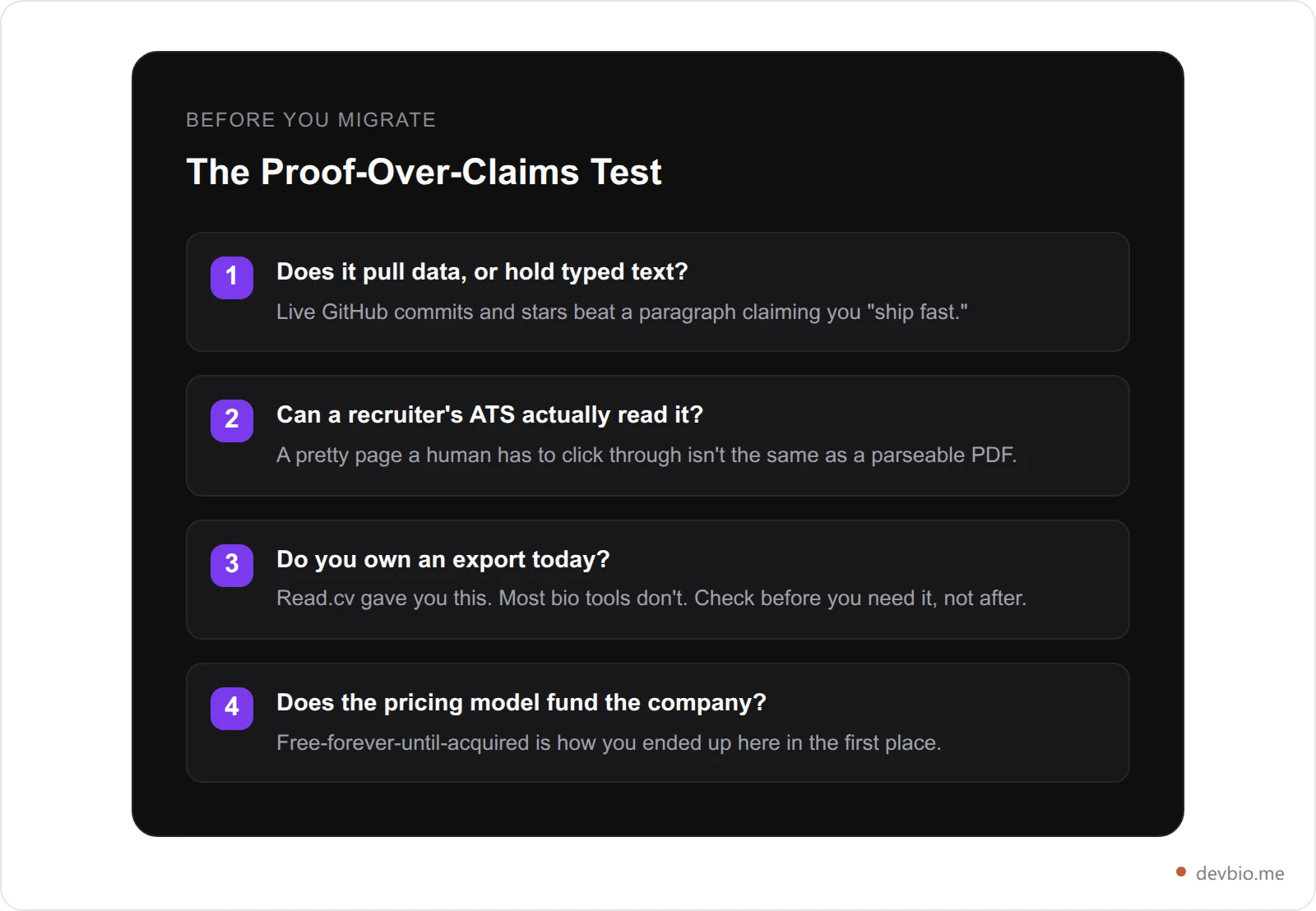
Score any replacement against those four before you spend an afternoon rebuilding on it.
Read.cv Alternatives for Developers: Full Comparison#
Here's how the realistic options actually compare against those four questions, not against how closely they clone Read.cv's minimalist layout.
Platform | Live GitHub data | Live revenue (MRR) | ATS PDF resume | Data export | Starting price |
|---|---|---|---|---|---|
DevBio | Yes (stars, commits, heatmap) | Yes (Stripe, Dodo, Lemon Squeezy, Polar) | Yes (LaTeX-typeset PDF) | Yes (JSON, vCard, llms.txt) | Free |
Peerlist | Yes (repo linking) | No | No | Limited | Free |
Fueler | Links to repos only | No | No | Limited | Free / paid tiers |
FlowCV | No | No | Yes (template-based) | Yes | Free / paid tiers |
Polywork | No | No | No | Limited | Free |
about.me | No | No | No | No | Free / paid tiers |
Claim your handle and rebuild in about 20 minutes — the migration steps are further down.
Two things worth pulling out of that table. First, "live GitHub data" on DevBio isn't a badge you update by hand — a sync job pulls stars, commits, and the contribution heatmap on a schedule, so what a visitor sees reflects what you actually shipped recently, not what you typed in months ago. Second, revenue only appears at all if you connect a payment integration yourself; nothing is estimated or fabricated for you. The same live-vs-typed distinction matters for GitHub profiles generally.
Peerlist vs. DevBio: Two Different Bets on "Proof of Work"#
Peerlist is the name that comes up most often as the developer-specific Read.cv replacement, and it deserves a closer look because its entire premise is proof over claims — the same philosophy this whole category is chasing. Peerlist has grown to 53,000+ designers and developers on the platform, built around letting people connect GitHub and other work sources into a single profile others can browse and follow. (Peerlist)
Where the two diverge is what "proof" is used for. Peerlist's proof of work feeds a social network — a feed, followers, and discovery by other builders and recruiters browsing the platform. DevBio's proof of work feeds a single static asset you control: a profile at your own handle that also compiles into an ATS-parseable resume, a vCard, a QR code, and — if you connect a payment integration — a verified founder badge that only appears once your connected Stripe, Dodo Payments, Lemon Squeezy, or Polar account shows real monthly revenue, not a number you typed into a bio field.
Neither approach is strictly better. If what you valued about Read.cv was the community and discovery angle — people finding your profile organically, following your updates — Peerlist is closer to that experience. If what you valued was having one link that works everywhere a resume would (a job application, an Upwork proposal, a bio in a conference speaker list) with revenue and code activity baked in automatically, that's a narrower, more utilitarian job a resume-generating profile is built to do.
Where DevBio Is Honest About Its Limits#
DevBio isn't a social network, and it isn't a freeform essay platform either. Bios are built from fixed, typed components — basic info, avatar, about, skills, projects, work experience, links, GitHub stats, contribution heatmap — not open-ended long-form writing the way Read.cv's essay format allowed.
If what you specifically miss about Read.cv is writing and publishing essays that build a personal audience over time, a component-based profile won't replace that; a blog or a Polywork-style feed will do that job better.
What you get in exchange for giving up open-ended long-form: every component renders real, synced data automatically, and the same profile compiles into a dozen other formats without extra work — a PDF resume at /resume, a vCard at /bio.vcf, a QR code, and an llms.txt file so AI tools can read your profile in a structured way. Here's the complete list of what to actually put on a developer bio.
Migrating From Read.cv to DevBio, Step by Step#
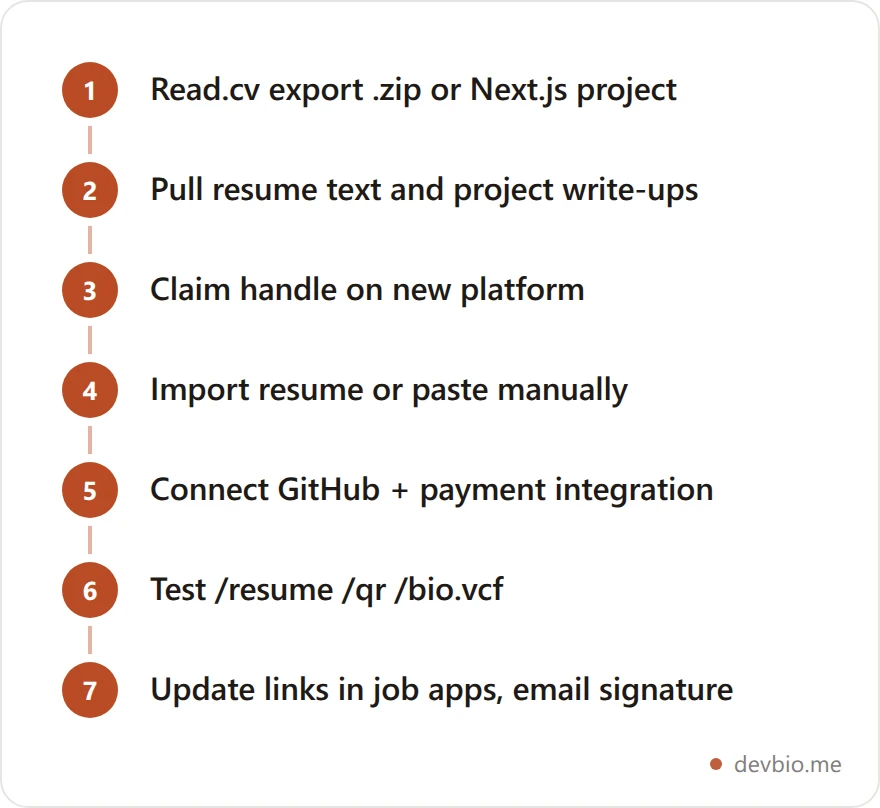
Find your export. If you migrated before May 16, 2025, locate the
.zipor Next.js project you downloaded. If you didn't, check the Wayback Machine for a cached snapshot of your old URL before assuming everything is lost.Claim your handle. Go to devbio.me and grab the same username you used elsewhere, if it's available.
Import what you can. If you have a resume file — even one reconstructed from your old export — DevBio's resume importer parses it directly into bio components, which is faster than retyping your work history from memory.
Connect GitHub. This turns on live commit activity, star counts, and the contribution heatmap — proof Read.cv never pulled automatically in the first place.
Connect a payment integration, if you run a SaaS or subscription product. Stripe, Dodo Payments, Lemon Squeezy, and Polar all sync automatically. Project cards start showing real MRR the moment the connection completes.
Rewrite your project descriptions, keeping them shorter than your old Read.cv essays. A bio component is scanned, not read start to finish.
Test your endpoints. Visit
/resume,/qr, and/bio.vcfbefore you put the new link anywhere public — confirm the PDF, QR code, and vCard all generate correctly.Update every place your old Read.cv link lived — job applications, Upwork or Contra profiles, email signatures, conference speaker bios.
For someone with an existing resume to import, the whole process runs 20–30 minutes. It takes longer if you're reconstructing project write-ups from memory because you missed the export window.
Before/After: A Backend Engineer's Read.cv Migration#

Before: Marcus is a backend engineer who used Read.cv as his link in every job application for two years — a short bio, three essays about infrastructure decisions he'd made, and a list of past roles. He exported his .zip in April 2025 but didn't do anything with it until a recruiter asked for "a portfolio link" eight months later and he realized the URL in his resume template still pointed at a dead domain.
After: He rebuilds on a profile that pulls from his actual GitHub account instead of retyping a static bio. His contribution heatmap shows consistent activity across three infrastructure repos. His /resume endpoint generates an ATS-clean PDF he now attaches directly to applications instead of a separately maintained résumé file — a shortcut that removes an entire category of formatting mistakes. His old essays get trimmed into two project write-ups under 100 words each, since a component gets scanned, not read start to finish.
The measurable difference: two recruiters in the first month specifically mention his GitHub activity graph in their outreach message — something a static essay page never gave a recruiter a concrete detail to reference.
Other Places Former Read.cv Users Are Landing#
Not every displaced Read.cv user wants the same replacement, and several other options are worth knowing even if they're not the best fit for a developer-first profile:
Fueler carries forward Read.cv's clean profile feel and adds direct hiring features on top, reporting 100,000+ users as of 2026 — a reasonable pick if hiring discovery matters more to you than live technical proof.
FlowCV is built for people who still need a perfectly ATS-formatted resume file for portals that demand one, with more resume-template flexibility than a component-based profile offers.
Curvit launched specifically in response to the Read.cv shutdown and turns an uploaded resume into a profile page automatically — a fast option if you want something running in minutes with minimal setup.
Reactive Resume, a self-hosted open-source tool, was recommended repeatedly in the Hacker News thread on the shutdown for developers who'd rather avoid depending on any single company's roadmap again.
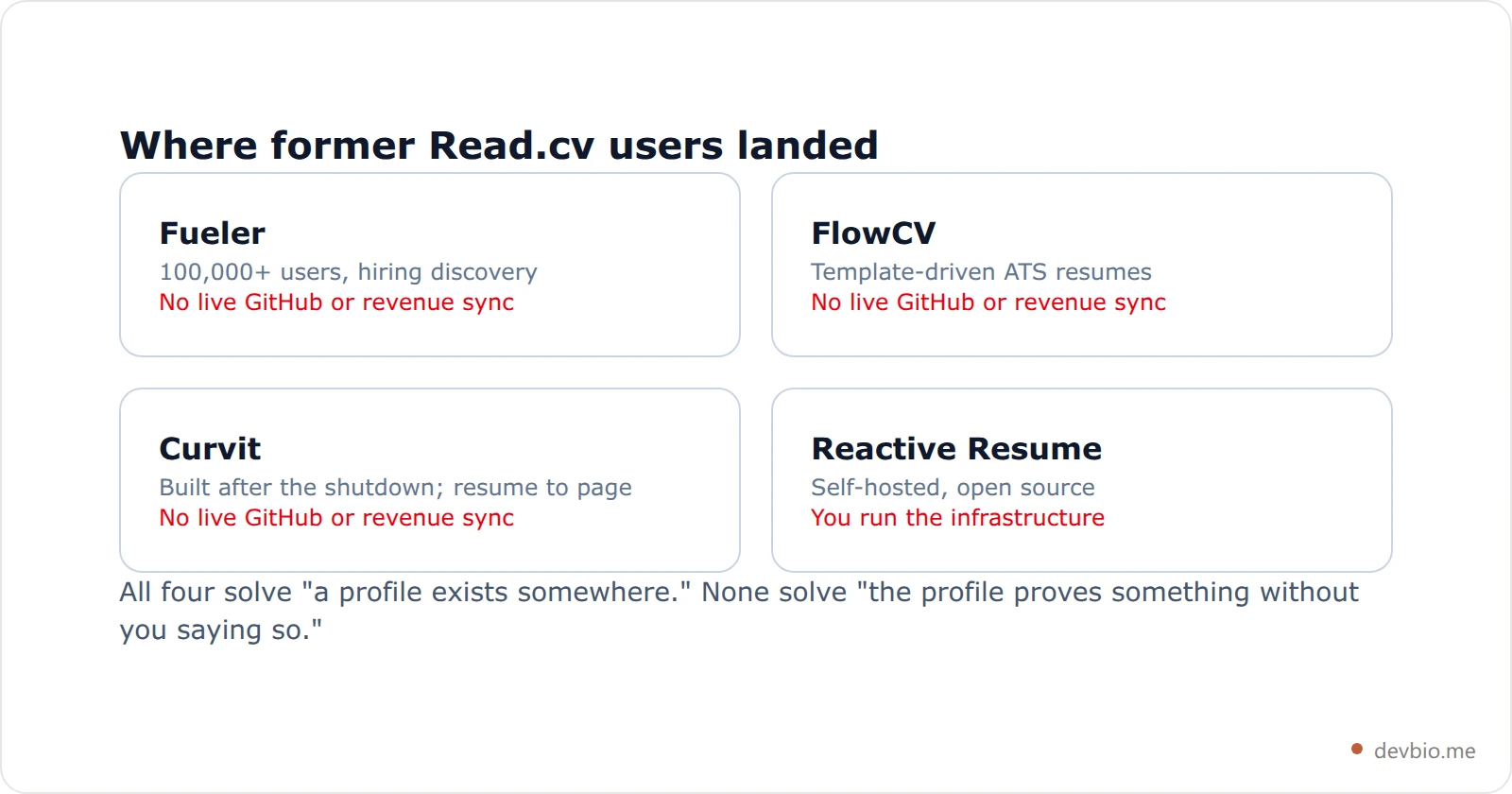
None of these four pull live GitHub or revenue data automatically, which is the gap this whole piece has been pointing at — they solve for "a profile exists somewhere," not for "the profile proves something without you saying so."
Free vs. Paid: What Actually Costs Money#
One more thing the Read.cv shutdown should make you check before committing to whatever's next: what's genuinely free, and what a company needs to charge to stay solvent without needing to be acquired.
Free | Pro ($2/mo or $12/yr) | |
|---|---|---|
Public profile + all components | Yes | Yes |
GitHub public-repo data | Yes | Private repos + heatmap |
ATS PDF resume | Yes | Yes |
Marketplace listing | Yes | Yes |
Custom domain | No | Yes |
Analytics history | — | 30 days |
Integration sync | Every 6 hours | Hourly |
Rebuild your profile on something that pulls live proof
Claim your handle, connect GitHub, and get an ATS-ready PDF resume at /resume — free to start, no card required.
Claim your handleA $2/month plan isn't a large business on its own, but it's a real, disclosed number attached to a specific set of features — not a "free forever" pitch that only makes financial sense if the company gets acquired for its user base, the way Read.cv's free tier ultimately did. Before you invest an afternoon rebuilding your professional profile, "how does this company make money without selling to someone bigger" is a fair question to ask.
What the Broader Hiring Shift Means for This Decision#
This isn't happening in a vacuum. Skills-based hiring adoption climbed to 70% of employers in NACE's 2026 Job Outlook survey, up from 65% the year before, with 87% of employers using it during interviewing and 65% during screening. (NACE) GitHub itself now hosts more than 180 million developers, with 36 million new accounts added in 2025 alone — more than one new developer joining every second. (GitHub Octoverse 2025)
Elon Musk made the sharpest public version of this shift when describing hiring for a technical team: instead of a resume, he asked applicants for three bullet points on the toughest technical problems they'd solved. Whatever you think of the source, the underlying signal matches what recruiters keep repeating in every 2026 hiring survey — evidence of what you actually built beats a claim about what you're capable of.
That's the environment any Read.cv replacement has to perform in. A page that only holds typed text is exactly as verifiable in 2026 as it was in 2022. A page that pulls from a GitHub account and, if relevant, a payment processor, isn't making a claim at all — it's just showing what's already true.
FAQ#
What happened to Read.cv?
Read.cv shut down on May 16, 2025, after its team joined Perplexity AI in an acquihire announced in January 2025. Users had a four-month window to export their profile data as a .zip file or download the entire page as a Next.js project before the shutdown.
Can I still recover my old Read.cv profile?
Only if you exported it before May 16, 2025. Read.cv offered a genuine export tool, so anyone who used it before the deadline has their content saved locally. If you missed the window, try the Wayback Machine at web.archive.org, but treat any recovery as partial.
When did the Read.cv shutdown happen?
The Read.cv shutdown was completed on May 16, 2025. Perplexity AI announced the acquihire of the founding team in January 2025, and the product stayed live in a maintenance window for roughly four months so users could export before the servers went dark.
What is the best read cv alternative for developers specifically?
For developers, a tool that pulls live GitHub activity and real product revenue rather than relying on typed-in claims fits the gap Read.cv left better than a general professional-networking clone. Peerlist is the closest developer-focused proof-of-work network; DevBio is the closest fit if you also want an ATS-ready resume and revenue proof generated from the same profile.
Is Peerlist a good Read.cv replacement?
Peerlist works well if what you want is a networking feed and community around proof-of-work posts. It doesn't generate an ATS-parseable PDF resume or show live product revenue, so if your primary use case was a resume replacement or revenue-backed credibility, it only covers part of what Read.cv did.
Does a Read.cv alternative need to show revenue?
No, revenue display should be optional. It matters most for indie hackers and freelancers who want a live MRR figure to back up a SaaS or client pitch. A developer with no product revenue gets full value from GitHub activity, shipped projects, and a resume alone.
What made Read.cv different from LinkedIn?
Read.cv was intentionally minimal and curated compared to LinkedIn's feed-driven, engagement-optimized design. It focused on a clean, single-page professional profile with essays and project write-ups rather than posts, likes, and algorithmic reach.
How long does it take to rebuild a profile after Read.cv?
For someone with an existing resume file to import and a GitHub account to connect, rebuilding a full profile takes about 20-30 minutes. It takes longer if you're rewriting project descriptions from memory because you missed the export window.
Will my next profile tool just shut down too?
No platform can guarantee it won't shut down or get acquired. What you can check before committing: does the company have a disclosed, real pricing model that funds the product independent of an acquisition, and can you export your data today. Those two answers predict platform survival better than a feature list does.
Key Takeaways#
The Read.cv shutdown completed on May 16, 2025 after an acquihire into Perplexity AI — but, unusually, it gave users a real export path first.
Most "alternative" roundups match Read.cv's minimal design, not the live-proof problem developers actually need solved.
Run any replacement through the Proof-Over-Claims test: live data, ATS-readable output, data ownership, and a pricing model that funds the company on its own.
Put Something No Acquisition Can Delete#
Three things worth doing this week if you were on Read.cv: locate your export if you made one before May 16, 2025, run whatever replacement you're considering through the four-question test above, and connect a data source — GitHub, a payment processor, or both — instead of retyping the same static essay into a new page.
A profile that only holds what you typed can vanish exactly the way Read.cv's did: one acquisition, one wind-down notice, gone. A profile that pulls from your actual GitHub activity and actual revenue survives any single platform's decision, because the proof underneath it was never the platform's to own.
Your code and your shipped work already exist independent of any bio tool. Put them on one link that proves it — devbio.me.


