Most "developer portfolio examples" roundups show you pretty websites. Nice typography, a hero animation, a grid of project cards with screenshots. Then you copy the layout, fill in your own projects, and nothing changes — no callbacks, no replies, no interviews.
The problem isn't your design. It's that a screenshot is a claim, and in 2026, hiring managers and clients don't act on claims anymore. They want to see the thing working, the commits behind it, and the number it's making — live, not typed in.
A developer portfolio works in 2026 when it replaces claims with live proof: real GitHub stars and commits instead of a project list, real revenue instead of "built a SaaS," and a resume that generates from the same data instead of a separate PDF you have to keep in sync. That's the shift this guide walks through, with nine real patterns, a checklist, and the mistakes that quietly kill otherwise-good portfolios.
What Actually Makes a Developer Portfolio Work in 2026#
The bar moved. GitHub now hosts more than 180 million developers, with 36 million joining in 2025 alone — the biggest single-year jump in the platform's history. Everyone applying for the same role has a GitHub profile. Having one is no longer a differentiator; what you show on it is.
The 2025 Stack Overflow Developer Survey found that practical skills, portfolio projects, and real-world problem-solving now rank above formal degrees as hiring priorities. That's a real shift from five years ago, when a degree and a clean resume did most of the work. The portfolio picked up the slack — which means the portfolio now carries more weight, and more scrutiny, than it ever has.
Part of that scrutiny comes from volume. Job seekers are submitting far more applications per offer than they were even a few years ago, and every recruiter reading a portfolio is doing it faster, across more candidates, with less patience for a page that makes them dig for proof. A portfolio that answers "is this real" in one glance wins that race before a competing candidate's page has finished loading its hero animation.
The 5 Developer Portfolio Archetypes#
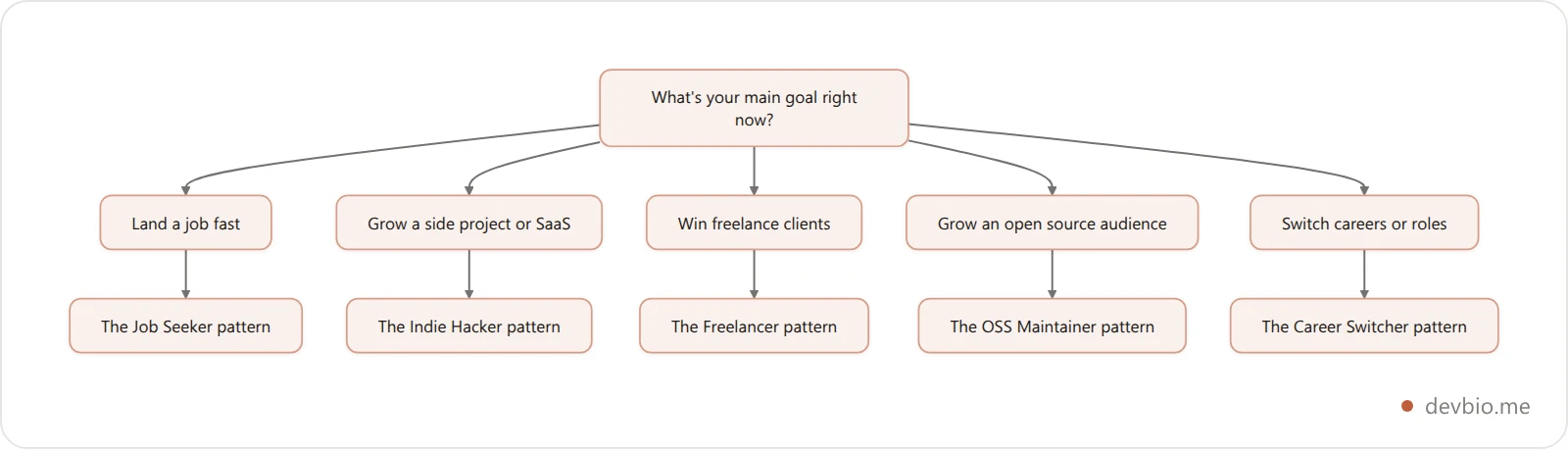
Not every developer portfolio should look the same, because not every developer is selling the same thing. The best developer portfolio examples and developer bio examples all commit to one specific goal instead of trying to impress everyone — before you copy a layout, figure out which of these five archetypes actually matches your situation. The goal changes what "good" looks like.
Archetype | Primary goal | What must be live, not static |
|---|---|---|
The Job Seeker | Pass recruiter screening fast | GitHub activity, an ATS-parseable resume |
The Indie Hacker | Prove traction to an audience or acquirer | Revenue / MRR |
The Freelancer | Convert a client inquiry into a contract | Past project outcomes, availability |
The OSS Maintainer | Convert GitHub traffic into a wider audience | Contribution history, project stars |
The Career Switcher | Prove practical skill without years of titles | Shipped, working projects |
1. The Job Seeker#
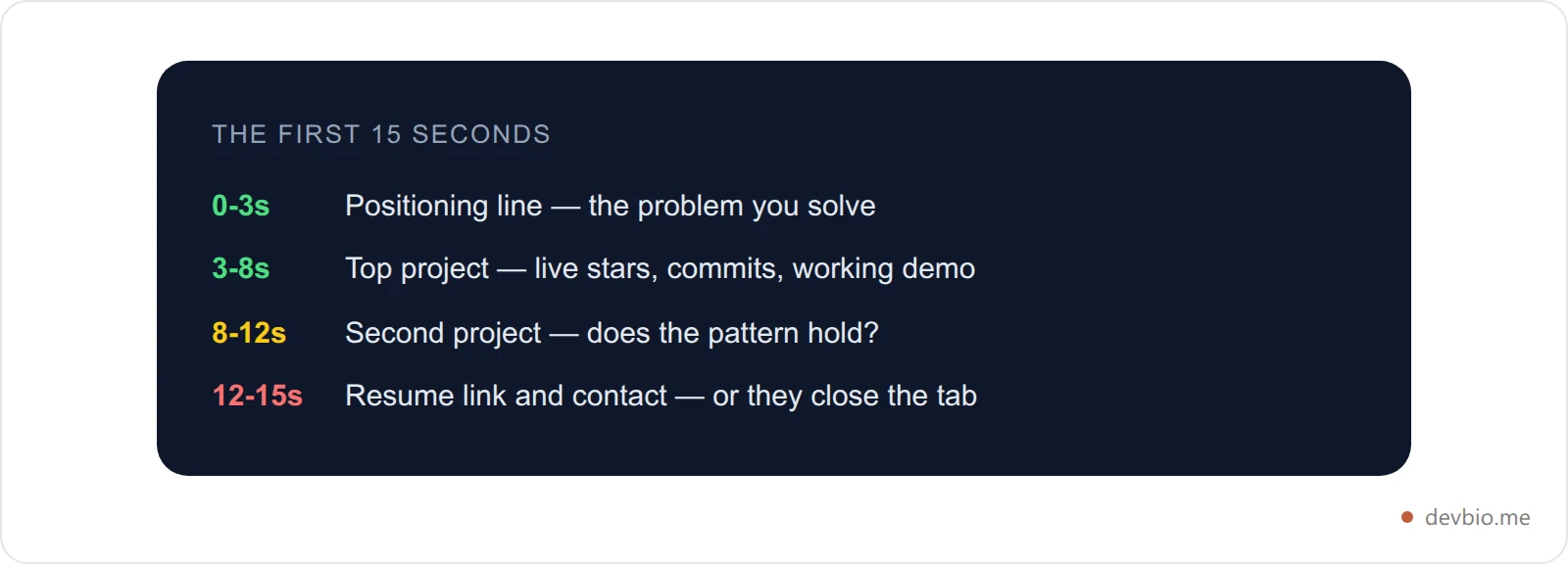
This is the most common portfolio, and the one recruiters scan fastest. Hiring managers spend roughly 15 seconds on an initial portfolio scan before deciding whether to keep reading — so the top third of the page has to answer "can this person do the job" without scrolling.
The pattern that works: a one-line positioning statement (not "full-stack developer," but the specific problem you solve), 3–5 projects with live GitHub stars and commit activity instead of a static screenshot, and a resume link that generates a real, parseable PDF instead of an unstyled Word doc. 87% of technical recruiters check a candidate's GitHub profile before an interview decision, and active profiles see roughly 40% more callbacks than stale ones. Developers with well-documented portfolio projects also tend to see meaningfully higher salary offers than candidates whose GitHub is a ghost town — the portfolio isn't just a gate to pass, it's a negotiating asset.
2. The Indie Hacker#
For a developer building a SaaS on the side, the portfolio's job isn't to prove you can code — it's to prove the thing is real and growing. A typed "$4K MRR" in an About section reads exactly like every other unverifiable claim on the internet.
The pattern that works: a revenue card connected directly to your payment processor. On DevBio, connecting Stripe, Dodo Payments, Lemon Squeezy, or Polar pulls live MRR onto the project card automatically — the number updates on its own sync cycle instead of you editing a text field every time a customer churns or converts. Pair it with a live GitHub star count on the same project, and you've shown both sides: people are using it, and it's making money. Connect a payment processor and show the number live rather than asking a reader to take it on trust.
3. The Freelancer#
A freelance portfolio has one job: turn a cold inquiry into a signed contract, fast. The pattern that fails here is a generic "services" list — every freelancer has one, and it tells a client nothing about outcomes.
The pattern that works: 3–4 past projects framed as case studies (the problem, your specific role, the result), a visible skills list matched to the work you actually want more of, and clear contact information above the fold. Our freelance developer portfolio guide breaks down the exact section order that converts inquiries into calls.
4. The OSS Maintainer#
An open source maintainer's audience often finds them through a repository first, not a portfolio link. The pattern that works here inverts the usual order: lead with contribution history and project impact, because that's what a visitor already trusts you for, then use the portfolio to extend that trust into the parts GitHub can't show — like a resume or a broader project list. A contribution heatmap does more work here than a paragraph of self-description ever could, since it shows years of consistency at a glance. See our open source portfolio guide for how to show GitHub impact beyond a single README.
5. The Career Switcher#
If you don't have five years of job titles to lean on, the portfolio has to do more work than for anyone else on this list. The pattern that works: fewer projects, more depth per project. Three shipped, working applications with a clear write-up of what you built and why beat ten tutorial clones every time. Verifiable code and commit history are doing the trust-building that a resume's work-history section usually does — which is exactly why a live profile beats a static resume for someone whose resume alone can't carry the case. A short "how I got here" note also helps — it turns a gap that a resume can't explain into context a portfolio can.
How Long Should Building One Actually Take?#
This is where a lot of good intentions stall. A hand-built portfolio with custom layout, responsive breakpoints, and a contact form typically takes a competent developer somewhere between one afternoon and a full weekend — longer if you're also designing from a blank canvas instead of a template. That's a reasonable investment once. The part that quietly costs more is maintenance: every new project, every star-count update, every resume revision is a manual edit on a static site, and manual edits are exactly the tasks that stop happening once you're busy.
The alternative is a component-based profile where the layout is already solved and the data updates on its own. On DevBio, the structured components (skills, projects, work history, GitHub stats, revenue) take roughly 15 minutes to fill in because the schema and design are already built — the time goes into what you write, not how the page is laid out. Neither path is wrong. The tradeoff is design control versus time spent on upkeep, and it's worth choosing deliberately instead of defaulting to whichever option you found first. Our breakdown of 7 developer personal website setups ranked by effort puts launch time, yearly cost, and maintenance load side by side if you want to make that call with numbers.
Real Developer Portfolio Examples Worth Studying#
Two names come up in almost every developer-portfolio discussion for good reason. Brittany Chiang's personal site is the most frequently cited example in developer communities — clean typography, a tight three-section structure, and project write-ups that explain the "why" behind each build, not just the tech stack. Bruno Simon's portfolio takes the opposite approach: an interactive 3D world you drive a virtual jeep through to find his projects, built specifically to prove his Three.js skills through the experience of using the site itself.
Neither approach is "correct" — they're both memorable because they commit fully to a specific goal. Chiang's site optimizes for a recruiter reading quickly. Simon's optimizes for a hiring manager remembering him specifically. A third pattern worth naming is the README-first maintainer: a bare-bones GitHub profile with a strong pinned-repo selection and a heatmap doing the talking, no separate site at all. It works precisely because the audience it's built for is already on GitHub.
For a broader, community-curated set, Emma Bostian's developer-portfolios list on GitHub collects dozens of real examples across styles, and remains one of the most-referenced starting points for portfolio inspiration.
As Bostian put it in her own guide to building a technical portfolio: "portfolios are a representation of you, and they're often one of the first impressions a recruiter will have of you and your work" — which is exactly why a portfolio that only shows static screenshots undersells work that's actually verifiable.

Static Portfolio vs. Proof-Driven Profile#
The difference between a portfolio that gets skimmed and one that gets remembered usually comes down to whether the data is typed or live.
Static portfolio | Proof-driven profile | |
|---|---|---|
Project stats | Typed once, goes stale | Live GitHub stars + commits |
Revenue claims | Screenshot or text ("$4K MRR") | Live figure from Stripe/Dodo/Lemon Squeezy/Polar |
Resume | Separate file, manually kept in sync | Generated from the same data, one click |
Update effort | Manual edit every change | Updates on its own sync cycle |
Trust signal | "Take my word for it" | "Check it yourself" |
This is the same distinction that separates a developer portfolio from a personal site or a link-in-bio page — the format matters less than whether the data behind it is verifiable.
Stop retyping your own stats
A profile that resolves stars, commits, and MRR on every page load stays accurate during the months you never open the editor.
See live developer profilesThe Anatomy Checklist: What Every Great Portfolio Includes#
Regardless of archetype, these are the components a strong developer portfolio should have. Use this as a copy-paste audit of your current page:
A specific positioning line. Not "full-stack developer" — the actual problem you solve and for whom.
3–6 projects, not 15. Fewer projects with real depth beat a long list of half-finished ones.
Live data over static claims. Stars, commits, MRR — whatever applies, pull it live instead of typing it.
A one-paragraph "why" per project. The problem, your role, and one decision you'd make differently now.
Skills tied to evidence. Don't just list a language — link the skill to the project that proves it.
A resume that matches the page. Same projects, same numbers, no separate document that drifts out of sync.
A clear way to reach you. Email, or a contact form — not buried three clicks deep.
A custom or clean URL.
yourname.devordevbio.me/yournamereads as intentional; a URL full of platform slugs and IDs doesn't.
See the full component breakdown for what belongs in each section and why, and the developer personal brand guide for how these pieces fit into a broader presence across GitHub, your portfolio, and your resume. If you want more developer profile examples broken down section by section, that component guide is the deepest resource on the site.
6 Mistakes That Kill an Otherwise-Good Portfolio#
Listing every technology you've ever touched. A wall of badges reads as "I don't know what I'm actually good at." Pick the 6–8 that define your work and drop the rest.
Tutorial clones as flagship projects. A todo app or a cloned e-commerce template signals "I followed instructions," not "I can solve a problem." Real work, not tutorial clones, is one of the three signals hiring managers actually look for.
A dead or unreachable demo link. A broken "Live Demo" button is worse than no demo at all — it actively erodes trust in the rest of the page.
No explanation, just screenshots. A gallery of images with no write-up forces a visitor to guess what they're looking at. Explain the problem and your role in two or three sentences.
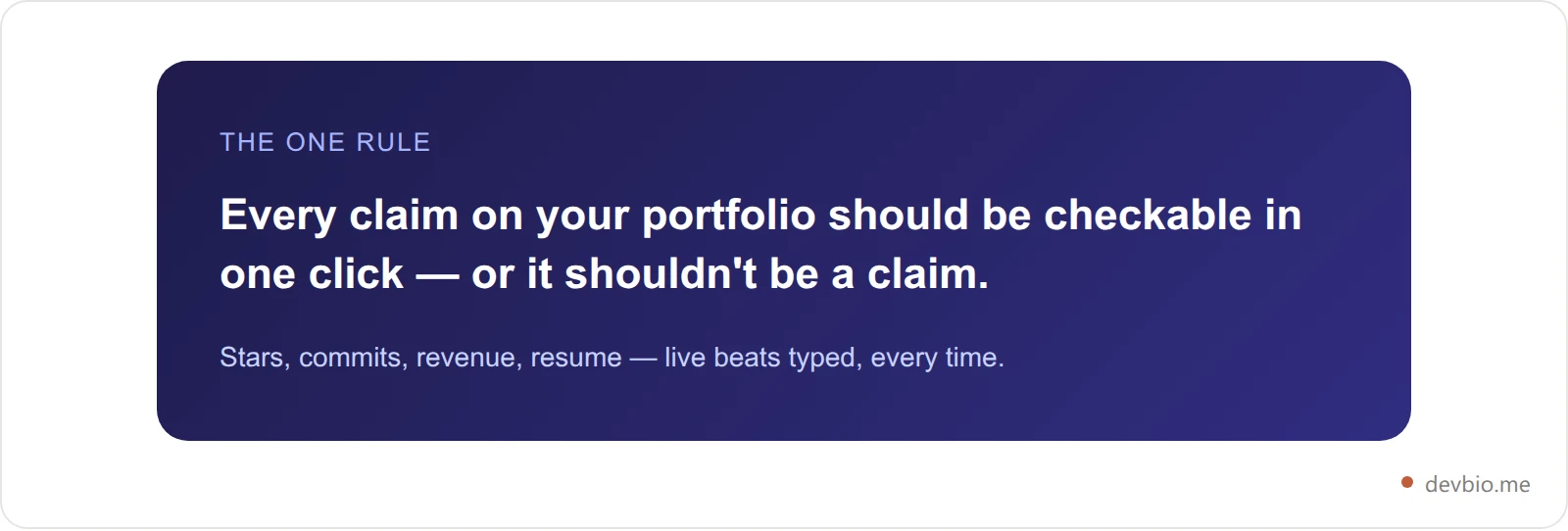
Stale numbers. A "50 GitHub stars" claim that's actually three years old and now sits at 400 undersells you. Typed numbers go stale the moment you stop updating them — which is exactly why live data has become the differentiator this guide keeps coming back to.
Burying contact information. If a hiring manager or a client has to hunt for how to reach you, most won't bother. The fastest fix on this whole list: put your contact method somewhere visible without scrolling, on every device size.
Frequently Asked Questions#
What should a developer portfolio include in 2026?
A specific positioning line, 3–6 projects with live data (GitHub stars, commits, or revenue where relevant), a short "why" for each project, skills tied to evidence, a resume that matches the page, and a clear way to reach you. Fewer, deeper projects consistently outperform a long list of shallow ones.
How many projects should be on a developer portfolio?
Three to six. Hiring managers and clients scan fast — roughly 15 seconds on an initial pass — so a shorter list with real depth per project reads better than fifteen entries with one screenshot each.
Is a GitHub profile enough, or do I need a separate portfolio?
A GitHub profile is a strong foundation but has real limits: no custom domain, no revenue display, and no generated resume. Most developers get the best result from a strong GitHub presence plus a linked profile that covers what GitHub can't — see our GitHub profile guide for how the two work together.
Should a developer portfolio show revenue from a side project?
Yes, if you have a live SaaS or product — live revenue is one of the strongest trust signals a founder-facing portfolio can carry, more convincing than a static "built a profitable SaaS" claim. Our live MRR setup guide covers connecting a payment processor so the number updates on its own.
What's the difference between a developer portfolio and a resume?
A resume is a static document optimized for ATS keyword parsing. A portfolio is a living page that can show real, checkable evidence — commit history, live stars, working demos. The strongest setups generate the resume from the same data as the portfolio, so the two never drift out of sync.
Do developer portfolio examples with 3D animation actually work?
They work when the animation itself proves a skill relevant to the jobs you want — Bruno Simon's 3D portfolio makes sense because his target roles need exactly that skill. For most developers, a clean, fast, minimal layout that loads instantly outperforms an elaborate build a recruiter has to wait to load.
How often should I update my developer portfolio?
As often as your projects change, ideally without manual work. A portfolio with live GitHub and revenue data updates itself on a sync cycle. A static one needs a deliberate edit every time a project ships, a star count moves, or a job description changes — which is why static portfolios go stale faster than anyone plans for.
What's the biggest mistake in developer portfolio examples people copy?
Copying the visual design without the substance behind it. A clean layout with stale, typed, or vague project descriptions performs worse than a plainer page backed by live, verifiable data. Design earns a second look; proof earns the callback.
The Takeaway#
The best developer portfolios in 2026 share one trait: nothing on them requires the visitor to take your word for it. Three things to carry forward from this guide:
Match the archetype to the goal. A job seeker, an indie hacker, and a freelancer need different sections doing different jobs — copying a layout built for someone else's goal is why so many portfolios underperform.
Live data beats typed claims, every time. Stars, commits, MRR, resume — whichever applies to you, the version that updates itself is the version that gets trusted.
Fewer projects, more depth. Three well-explained builds beat fifteen screenshots.
Your code already proves you can build. Put it on one link, live — devbio.me