A developer portfolio used to mean one thing: a personal website with a hero section, an about page, and a grid of project cards linking to GitHub. In 2026, that format is losing to something simpler and harder to fake — live proof.
Hiring managers don't have time to read your code. They skim. They click one or two links. What they're actually looking for is evidence: does this person ship, and can I verify it in under 30 seconds? A static "I built a task manager with React" line doesn't answer that. A project card showing 340 real GitHub stars, 1,200 commits this year, and $2,100 in live MRR does.
A developer portfolio in 2026 is a page that proves your work with live, verifiable data — GitHub activity, shipped products, and revenue if you have it — instead of describing it in prose. The format matters less than whether a stranger can check your claims without asking you a single follow-up question.
This guide (updated for July 2026) covers what to build, what to skip, how many projects is enough, and the exact framework hiring managers and acquirers use to judge a portfolio in the first ten seconds.
What a Developer Portfolio Actually Means in 2026#
A developer portfolio in 2026 is a claim-to-evidence ratio, not a website template. Every claim, "I ship fast," "profitable side project," gets live, verifiable data attached to it instead of asking a visitor to just trust the sentence.
Forget the old definition. Every portfolio makes claims: "I'm a backend engineer," "I ship fast," "I have a profitable side project." The old portfolio format asked visitors to trust those claims. The 2026 version attaches evidence to each one: a live commit graph next to "I ship fast," a synced revenue chart next to "profitable side project."
This shift tracks a broader change in hiring. GitHub's Octoverse 2025 report found more than 180 million developers now build on the platform, with a new developer joining roughly every second, and 121 million new repositories created in 2025 alone. When everyone has a GitHub profile, having one isn't a differentiator. What you show on top of it is.
Software Engineer Portfolio vs Developer Portfolio#
These are the same artifact, and the naming difference mostly tells you who's searching. "Software engineer portfolio" is the phrase job seekers use when they're targeting a formal engineering role at a company with a structured hiring loop. "Developer portfolio" skews toward freelancers, indie hackers, and people building in public.
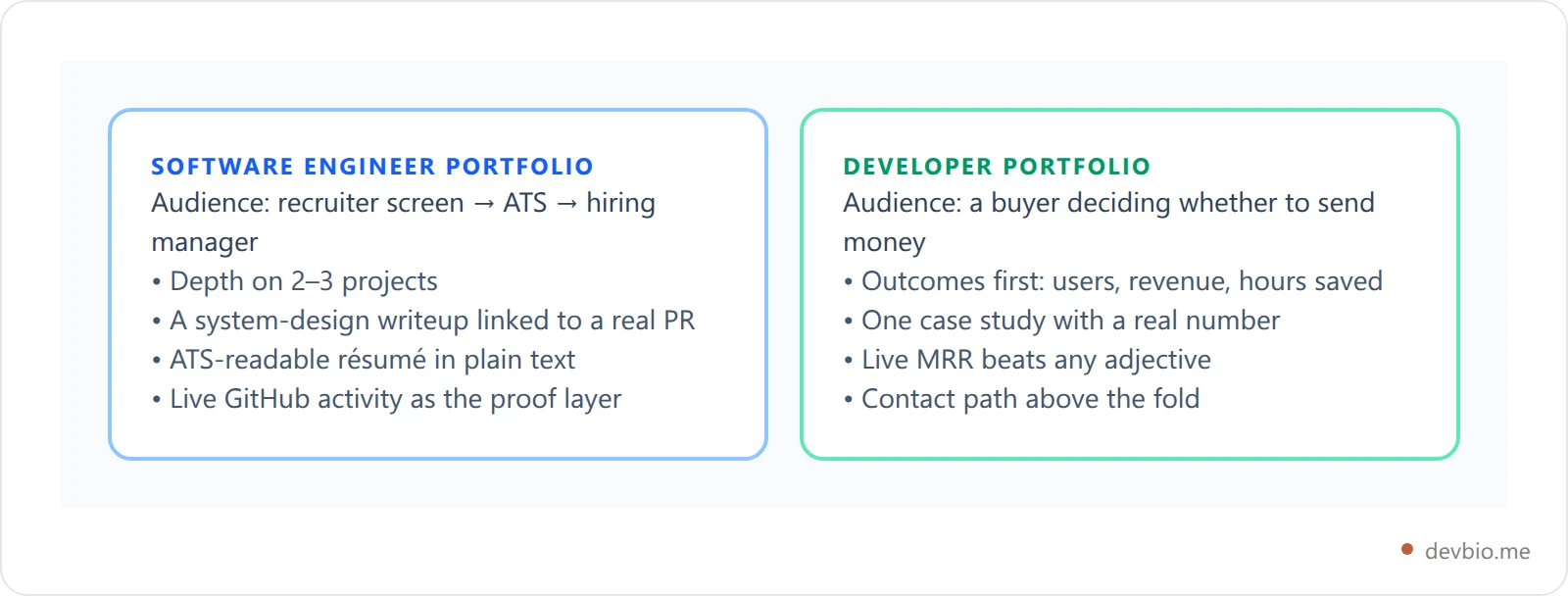
What works is identical — live proof over prose — but the emphasis shifts. A software engineer portfolio aimed at a company loop should lead with depth on two or three projects, a system-design writeup, and an ATS-readable résumé, because there's a recruiter screen and an applicant tracking system standing between you and the hiring manager. A freelance-facing portfolio leads with outcomes and revenue, because the buyer is deciding whether to send money, not whether to schedule a phone screen.
If you're building a software engineer portfolio specifically, the practical difference comes down to one thing: make sure a text-parseable version of your skills and experience exists somewhere. An ATS can't read a project card, a badge, or a screenshot.
Do You Even Need One? The Honest Answer#
Not every developer needs a dedicated portfolio, and pretending otherwise wastes people's time.
If you're a backend or infrastructure engineer with a stable job history, a clean LinkedIn and an active GitHub often do the job. Recruiters filling those roles lean on referrals, take-home projects, and system-design interviews more than a personal site. Building a polished portfolio for a role like that can cost a week of work for close to zero return.
The calculation flips hard in three cases: you're job hunting without much traditional experience, you're a frontend, product, or design-adjacent engineer where the portfolio itself is a work sample, or you're an indie hacker or freelancer who needs to prove revenue or client results to close a sale. In all three, a portfolio isn't optional — it's the fastest way to convert a stranger's five seconds of attention into a reply.
The honest rule: build a portfolio when it does work for you — an interview, a client, a sale. Skip it, or keep it minimal, when your GitHub and résumé already cover the same ground.
What Hiring Managers Actually Check#
Hiring managers check recency, whether projects are original work or forks, README clarity, and whether claims come with live proof instead of static text. Most only skim rather than read line by line.
Industry estimates put the depth of review at 60–80% of tech recruiters at least glancing at a linked GitHub profile for mid-to-senior roles, with a real deep dive happening in only 40–50% of cases, usually reserved for specialized positions.
What they check, in rough order:
Recency. Is there activity in the last few months, or does the profile look abandoned?
Shape of the work. Original projects versus forks and tutorial clones.
README and docs quality. Can a stranger tell what the project does in 10 seconds?
Live signal over static claims. A stars-and-commits count that updates itself beats a paragraph that says "actively maintained."
Revenue or usage, if claimed. If your bio says "profitable SaaS," they expect to see a number, not just the word.
Online presence checks are standard practice now, not an edge case. CodersRank's recruiter survey found 93% of recruiters use or plan to use some form of online screening, and 57% said they wouldn't move forward with a candidate who had no online presence at all. Separately, the 2025 Stack Overflow Developer Survey — nearly 50,000 responses across 177 countries — found GitHub has overtaken Jira as developers' most desired collaboration and documentation tool, which is exactly why a live GitHub signal now carries more weight in a portfolio than it did a few years ago.

The Show-Prove-Reach Framework#
Every developer portfolio that actually converts — into an interview, a client call, or an acquisition offer — does three things, in this order. Call it Show, Prove, Reach.

Show: What You Built#
This is the claim layer. A short, specific line per project: what it does, who it's for, what stack you used. Skip the padding. "A Chrome extension that syncs Figma comments to Linear, 2K weekly users" beats "A productivity tool I built to solve a problem I had."
Prove: Live Evidence#
This is the layer most portfolios skip, and it's the one that matters most. Attach real data to the claim: GitHub stars and commit history pulled live from the repo, not typed in by hand and left to rot. If the project makes money, show the number. A live MRR figure carries more weight than any adjective you could write.
Reach: How to Contact You#
The layer everyone forgets. A portfolio that proves you're good but buries the contact link, or worse, routes people through a contact form, loses the conversion it just earned. Email, a scheduling link, or a direct message option, visible without scrolling.
Miss the Prove layer and you have a résumé with extra steps. Miss Reach and you've done the work of earning trust and thrown it away at the finish line.
How Many Projects You Actually Need#
More projects don't make a stronger portfolio. They make a longer one, which is not the same thing.
Hiring-manager research consistently lands on the same number: three to five polished, complete projects outperform ten half-finished ones. Depth reads as competence; a long list of abandoned repos reads as scattered attention. It's also worth knowing that roughly 90% of senior engineers have fewer than 10 public repositories — a short, curated list is the norm at the senior level, not a red flag.
Pick your best 3-5 projects using one filter: would you be comfortable explaining every technical decision in it, live, in an interview? If not, it's not portfolio-ready yet. Cut it or fix it. Our developer portfolio examples roundup breaks down nine real patterns worth studying before you finalize your list.
GitHub Integration: Making Your Code Count as Proof#
A link to your GitHub profile is not the same as GitHub proof embedded in your portfolio. The difference is friction: a link asks the visitor to leave, dig, and interpret. Embedded data hands them the answer.
At minimum, a portfolio project entry should show, pulled live rather than typed by hand: star count, primary language, and recent commit activity, ideally a weekly commit chart, since a burst of activity two years ago reads very differently from steady weekly commits. DevBio's project component does this by resolving GitHub repo data live on every profile view, so the stars and commit graph next to a project are never stale screenshots.
This matters more than it used to. Our complete GitHub profile guide covers how to optimize the profile itself, and the GitHub contribution heatmap breakdown explains what that graph does and doesn't prove on its own, worth reading before you lean on it too hard as a portfolio signal. If a chunk of your credibility comes from open-source work rather than shipped products, see our open-source portfolio guide for how to surface contributions that don't live in your own repos.
Rather not wire the GitHub API up yourself? See what a live project card renders.

Showing Revenue as Proof#
If you've built something people pay for, that's the strongest proof a portfolio can carry, and most developers still hide it behind a vague line like "generates revenue."
The clearest public example of revenue-as-proof at scale is Pieter Levels, who has spent over a decade publishing real launch numbers instead of describing them. His AI photo tool did roughly $5,400 in its first week and reached about $132,000 in monthly recurring revenue by month 18, both numbers posted publicly as they happened, not summarized after the fact. That "post the number first" habit is a large part of why strangers trust his next launch before it even ships.
You don't need six-figure MRR for this to work. A live $340 MRR chart on a side project says "I can ship something people pay for" more convincingly than any bullet point, because it can't be exaggerated. The number updates itself. Our live MRR profile setup guide walks through connecting Stripe, Dodo Payments, Lemon Squeezy, or Polar so the figure on your profile is always current. Once it's wired up, put the number somewhere buyers can check it. If you're building toward a freelance or client-facing portfolio specifically, the freelance developer portfolio guide covers how to present revenue and results to close deals rather than just impress recruiters.
Portfolio vs Resume vs Link-in-Bio vs GitHub README#
These four formats get compared constantly, and the honest answer is that they solve different problems. Here's how they actually stack up.
Portfolio (live proof) | Static Resume/PDF | Generic Link-in-Bio | GitHub README | |
|---|---|---|---|---|
Updates itself | Yes, if data-backed | No, manual | No, manual | Partially (commits only) |
Shows revenue | Yes, if connected | Rarely | No | No |
ATS-compatible | Via generated PDF export | Yes | No | No |
Built for developers | Depends on the tool | No | No | Yes, but code-only |
Best for | Job search + sales + credibility | Formal applications | Social reach | Open-source credibility |
None of these replace each other entirely. The strongest setup uses a portfolio as the hub — it can generate the résumé, hold the links, and show the proof — with the résumé PDF and GitHub profile as supporting artifacts it points to. We compared portfolios against personal sites in more depth in portfolio vs personal site, and against traditional résumés in portfolio vs resume, if you want the longer breakdown of either matchup. For the résumé itself, our developer resume formats guide covers the ATS formatting rules parsers expect.
Before/After: A Realistic Case Study#
Take a hypothetical backend engineer, call her Maya, three years into her career, applying for senior roles.
Before: Her portfolio was a single static page. Bullet points: "Built a real-time chat app," "Contributed to open source," "Freelance projects available on request." No links to live code, no numbers, no way to verify any of it without emailing her. Recruiters spent a few seconds on the page based on her own analytics plugin, then bounced.
After: She rebuilt around three projects only, each with a live GitHub star and commit chart, and one with a connected payment integration showing $180 MRR from a niche API wrapper she sold access to. She added a one-line contact section at the top with her email and a scheduling link. Same three projects, same three years of experience, but every claim now had a number attached.
The result wasn't magic. It was fewer, better-supported claims replacing more, weaker ones. That's the entire mechanism behind why live-proof portfolios outperform descriptive ones: verification takes the recruiter seconds instead of requiring trust.
Build vs Buy: What It Actually Costs#
Building a custom portfolio from scratch is a real option, and for some developers, particularly frontend and design engineers where the site itself is a work sample, it's the right one. For everyone else, the time cost is worth being honest about.
Custom-built site | Generic link-in-bio | Purpose-built dev profile | |
|---|---|---|---|
Setup time | Days to weeks | ~10 minutes | ~10 minutes |
Live GitHub stats | Build it yourself | No | Built in |
Live revenue (MRR) | Build it yourself | No | Built in |
ATS PDF resume | Separate tool | No | Generated from the same data |
Custom domain | Yes, but you manage hosting | Rarely | Yes, on paid plans |
Ongoing maintenance | You own all of it | Low | Low |
A hand-built site wins on total control and is genuinely the better call for a frontend engineer whose portfolio is the interview. For everyone whose portfolio is a supporting artifact rather than the product itself, most backend, full-stack, and indie-hacker cases, a tool built specifically for developer proof gets you the same credibility signal without a week of frontend work you'll redo again in a year. DevBio was built around exactly that trade-off: connect GitHub and a payment provider once, and the project cards, résumé PDF, and revenue numbers all stay in sync on their own.
Stop retyping your own numbers
Connect GitHub and Stripe, Dodo Payments, Lemon Squeezy or Polar once. Stars, commits and MRR stay current on their own — and the ATS-readable résumé generates from the same data.
Build your DevBio
9 Portfolio Mistakes That Kill Your Chances#

Typed-in stats instead of live data. "500+ commits" as text is a claim. The same number pulled live from GitHub is proof. Visitors can tell the difference.
Too many projects. Ten mediocre entries dilute the three or four that are actually good. Cut ruthlessly.
Dead links. A broken demo link is worse than no demo at all. It actively signals neglect.
No contact path. Making someone hunt for how to reach you loses the conversion right when you've earned it.
Vague revenue claims. "Profitable" with no number reads as marketing copy, not proof.
Stale "last updated" dates. A portfolio that hasn't moved in a year looks abandoned even if you're actively working elsewhere.
No mobile layout. A large share of recruiter clicks happen on mobile between meetings. A portfolio that breaks there doesn't get a second look.
Burying the résumé. If you need an ATS-compatible PDF for applications, don't make people ask for one separately from your live profile.
Copying someone else's structure verbatim. The specific projects and numbers are what make a portfolio credible. A template with the serial numbers filed off reads as generic, even when the underlying work is good.
The 15-Minute Portfolio Setup Checklist#
Copy this and work through it in order:
Pick 3-5 projects you can defend in a live technical conversation
Write one specific sentence per project (what, who for, stack) — no filler adjectives
Connect GitHub so stars and commits update automatically, not typed by hand
If a project makes money, connect the payment provider instead of writing "profitable"
Add a visible contact method above the fold — email or scheduling link
Generate or link an ATS-compatible resume from the same data
Set a custom domain if you have one available
Check the mobile layout before you share the link anywhere
Frequently Asked Questions#
Do I need a developer portfolio if I already have a strong GitHub profile?#
Not always. If your GitHub is active, well-documented, and easy to navigate, it can function as your portfolio for backend and infrastructure roles. A separate portfolio adds the most value when you need to show revenue, client work, or projects that don't live entirely in public repos.
How many projects should be on a developer portfolio?#
Three to five, fully finished and ready to discuss in detail. Research on senior engineers backs this up: most have fewer than 10 public repos, and hiring managers consistently rate a short, strong list above a long, uneven one.
Should a developer portfolio include a resume?#
Yes, ideally as an ATS-compatible PDF generated from the same data as your live profile, so the two never drift out of sync. Our developer resume formats guide covers the exact formatting rules ATS parsers expect.
Is a static portfolio website still worth building in 2026?#
It depends on your role. For frontend, design, or product engineers, a hand-built site is often the work sample itself. For most other roles, a static site with typed-in claims is outperformed by a profile with live, verifiable data, at a fraction of the setup time.
What should a developer portfolio show for a non-technical hiring manager?#
Lead with outcomes over implementation: what the project does, who uses it, and any number that proves impact, such as users, revenue, or stars. Save deep technical detail for a linked README or GitHub repo, since a non-technical reviewer won't parse it on the main page.
Does showing revenue on a portfolio actually help freelancers?#
Yes. Live revenue or client-result numbers are the single strongest trust signal for freelance and contract work, because they answer the buyer's real question, has this person actually delivered, without requiring a reference call.
How do I keep a developer portfolio from looking abandoned?#
Connect data sources like GitHub and payment providers so the numbers move on their own instead of relying on you to manually refresh the page. A profile with a live commit graph never looks stale, even if you haven't logged in for a month.
What's the biggest difference between a 2020-era portfolio and a 2026 one?#
Verification. The old format asked visitors to trust written claims. The current one attaches live, checkable data to each claim, so a recruiter or client can confirm it themselves in seconds instead of taking your word for it.
Niche Portfolio Considerations by Role#
The Show-Prove-Reach framework holds across roles, but what counts as strong proof shifts depending on what you do.
Frontend and Design Engineers#
Here the portfolio site itself is a work sample. Load speed, layout choices, and animation restraint get judged as directly as the code. A cluttered, over-animated site actively undercuts the "I have good taste" claim it's trying to make. Fewer, sharper projects beat a long scroll every time.
Backend, Infrastructure, and Platform Engineers#
GitHub activity and system-design writeups carry more weight than visual polish. A short writeup of a hard scaling or reliability decision, linked to the actual pull request, does more work than a project screenshot ever could.
Data and ML Engineers#
Static screenshots of a model's output age badly. Where possible, show a live demo or a metric that updates, not a chart frozen from six months ago.
Freelancers and Contractors#
Client results and revenue matter more than raw commit volume. A single case study with a real number, hours saved, revenue generated, users onboarded, outperforms ten generic "available for hire" projects.
The AI Hiring Filter: Why Live Data Survives Screening Tools#
More of the hiring funnel now runs through automated screening before a human ever opens your portfolio. GitHub's Octoverse 2025 data shows 80% of new developers on the platform use Copilot in their first week, and AI-assisted workflows are now the default rather than the exception. The 2025 Stack Overflow Developer Survey found developers fluent with AI tools command a 12-56% pay premium, which means the bar for what counts as credible technical output keeps rising.
That shift cuts in favor of live data. A typed-in list of skills is trivial for a screening tool, or a human skimming fast, to skip past unverified. A GitHub commit graph or a synced revenue number is harder to fake and easier to weight as a real signal, whether the first pass is automated or not. Our deeper look at AI hiring and developer profiles covers what specifically to show as this shift continues.
If You're Building Toward an Exit#
If your side project is more than a portfolio piece, if it's actually generating revenue, your portfolio doubles as the first draft of a sales pitch. A project card with a live MRR chart, a subscriber count, and a clear revenue history is close to what a buyer expects to see in the early stages of evaluating an acquisition, before you ever open a data room.
The same live-proof principle applies to selling a SaaS side project. Buyers discount unverified numbers heavily, and a public track record of live revenue removes the biggest source of that discount before negotiations start. If you're weighing whether your project is ready to list, our guides on how to sell a SaaS side project, where to list it, and how to value it cover the process end to end.
Key Takeaways: Conclusion#
A developer portfolio in 2026 isn't a design project. It's a claim-to-evidence ratio, and most portfolios fail because they're all claims. Fix that with three moves: cut your project list to the 3-5 you can actually defend, attach live proof to every one of them (GitHub activity at minimum, revenue if you have it), and put your contact info where nobody has to hunt for it.
Get that right and the format underneath, custom site, link-in-bio, or a purpose-built tool, matters far less than whether a stranger can verify what you claim without asking you a single question.
Your code already proves you can build. Put it on one link, live — devbio.me