Beacons is built to help a creator sell a course, book a brand deal, and run a digital storefront from one link. None of that is what a developer needs from a bio link, and updated 2026 pricing makes the mismatch worse: free accounts and $10/month Creator accounts both pay a flat 9% commission on every sale, and removing it costs $30/month. This guide covers the best Beacons alternative for developers, and why another generic link-in-bio tool isn't the fix.
A Beacons alternative for developers is a profile that proves your work instead of selling products. For an engineer, that means a bio that pulls live GitHub stars and commits, shows real MRR from Stripe or Dodo, and compiles straight into an ATS-ready resume, none of which a creator monetization tool like Beacons was built to do.
This isn't a knock on Beacons. It's a genuinely good product for the audience it was built for: creators selling digital products, coaching calls, and affiliate links. Developers are a different audience with a different asset. You don't have a media kit. You have a commit history, a shipped product, and maybe some real revenue. The rest of this guide covers exactly where Beacons falls short for that use case, what it actually costs, and what a developer-native alternative looks like instead.
What Beacons Actually Does (and Who It's Built For)#
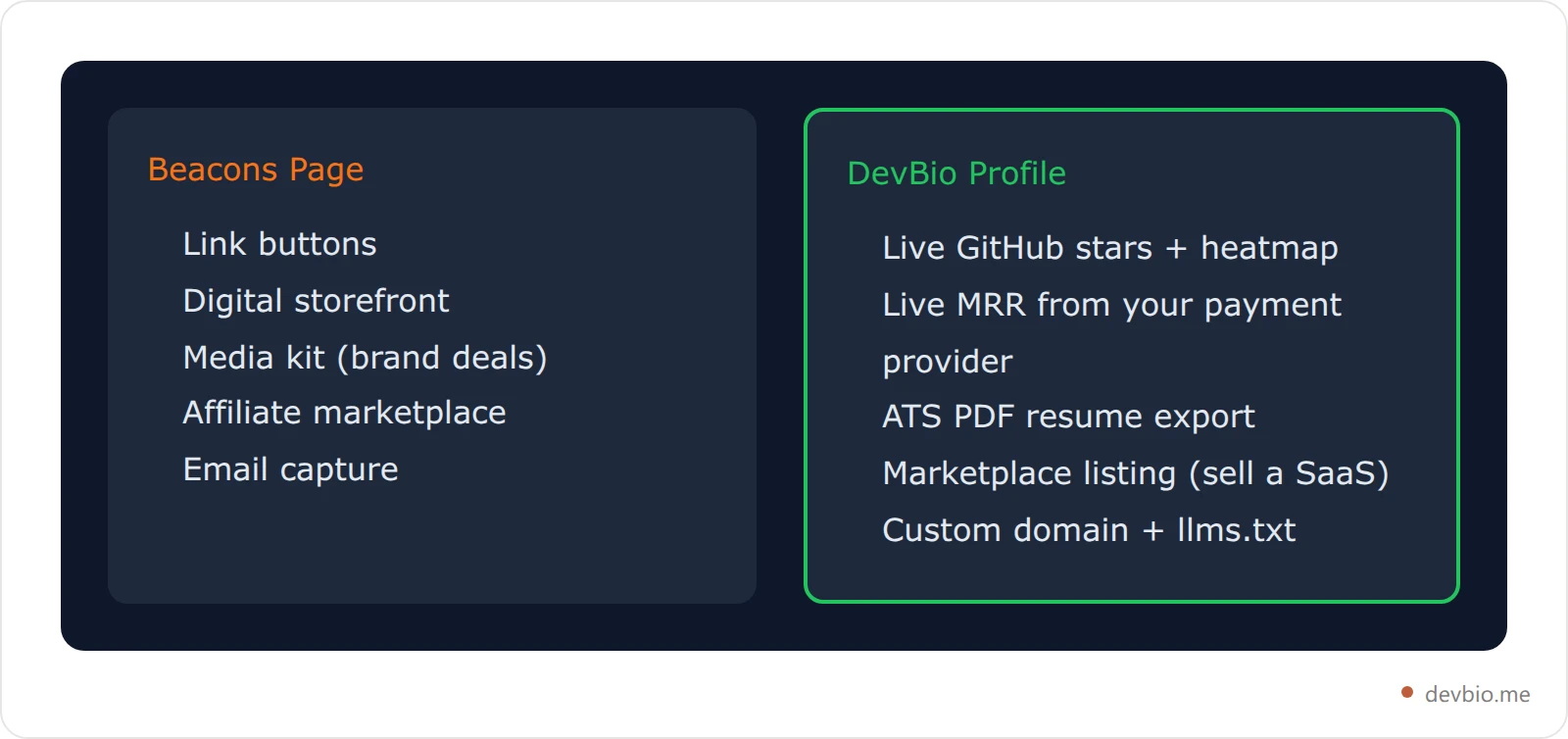
Beacons is an all-in-one creator monetization platform built for influencers and content creators, not developers. It bundles a link-in-bio page, a digital storefront, a media kit, and affiliate tools, with nothing for code, revenue proof, or a resume.
Beacons is an all-in-one creator platform: a link-in-bio page, a digital storefront, an auto-updating media kit for brand deals, an affiliate marketplace, email marketing, and an AI assistant called Beam that suggests growth moves. It's aimed squarely at influencers and content creators who need to monetize an audience across Instagram, TikTok, and YouTube.
That focus shows up in what the product prioritizes. The media kit exists to help you pitch brand sponsorships, auto-refreshing follower counts and engagement rates across platforms. The storefront exists to sell templates, presets, and courses, with Beam, Beacons' built-in AI assistant, nudging you toward product ideas and pricing. The affiliate marketplace exists to match creators with products to promote in exchange for a cut. If your income comes from sponsorships and digital products, that's a genuinely strong feature set, and plenty of creators use it well.
If your income (or your job search) depends on people trusting that you can ship software, none of those four pillars apply. There's no field for a GitHub username, no way to surface a contribution graph, and no concept of "live MRR pulled from your Stripe account" versus a screenshot you uploaded yourself.
Who Beacons Is Actually Right For#
To be fair to the product: if you're a content creator, a coach, or you sell courses and templates as your main source of income, Beacons is a reasonable choice. The media kit and affiliate marketplace solve real problems for that audience. The mismatch only shows up when a developer picks it because it's popular, not because it fits. A tool built to help you pitch a brand deal has nothing to say about whether you can actually write code.
Where Beacons Breaks Down for Developers#
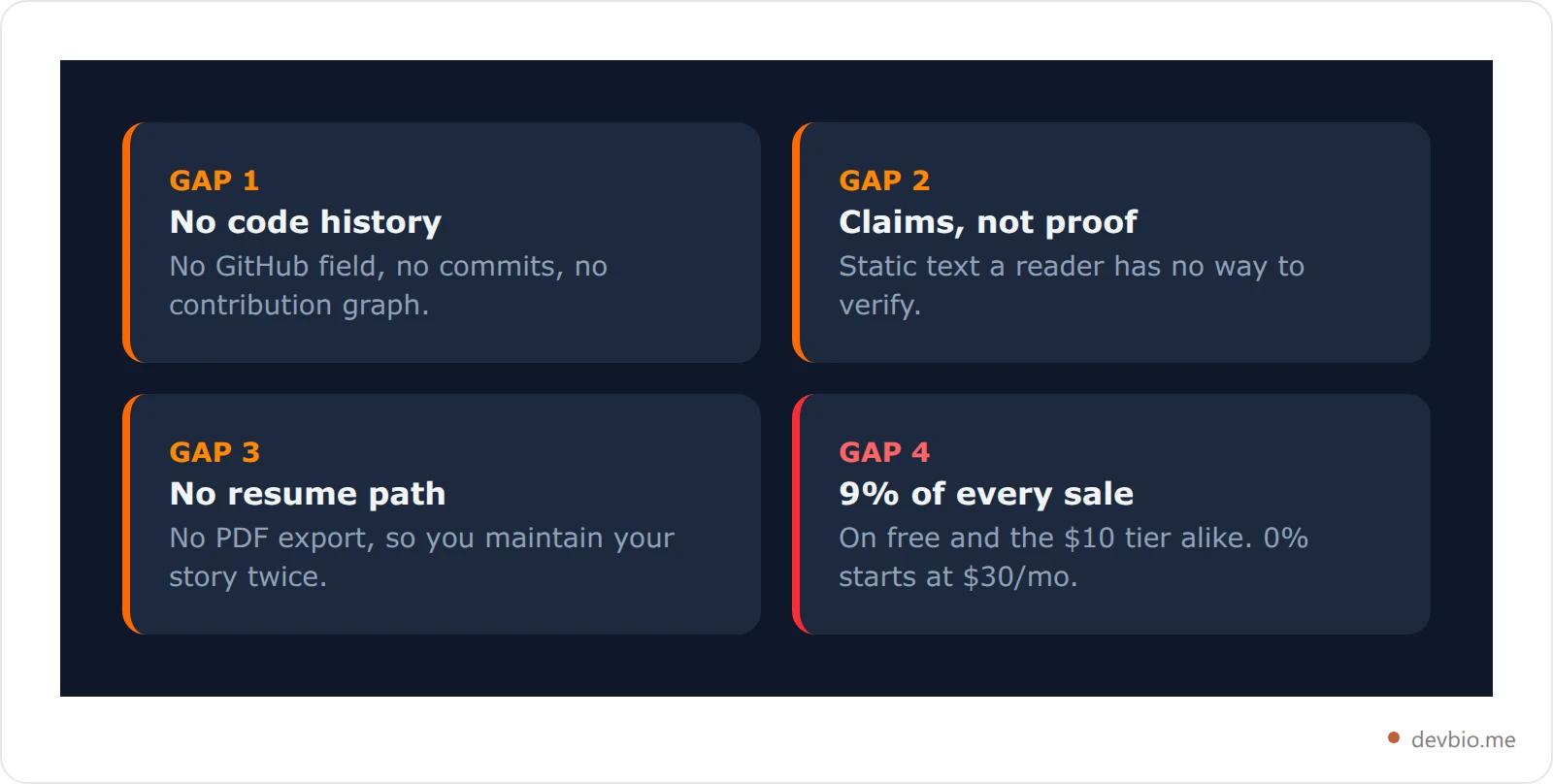
Beacons breaks down for developers because it has no GitHub integration, no live revenue proof, no resume export, and charges up to 9% commission on sales. Each gap maps to something a developer actually needs to prove.
The gap isn't a missing feature here or there. It's a structural mismatch between what the tool proves and what a developer needs to prove.
No code, no commits, no contribution history. A recruiter or a client sizing you up wants to see that you actually build things. GitHub now hosts over 180 million developers, adding more than one new account every second, and developers pushed nearly a billion commits in 2025 alone, a 25.1% jump year over year, according to GitHub's 2025 Octoverse report. That activity is the single strongest credibility signal a developer has, and Beacons has no way to surface it.
Claims instead of proof. Beacons lets you write "10K+ students taught" or "$50K in brand deals" as static text or a manually built media kit. None of it updates on its own, and none of it is verifiable by the person reading your page. A developer bio that pulls live GitHub stars or live MRR from a connected payment provider closes that gap by design: the number on the page is the number in the account, not a screenshot from three months ago. See what to actually put on a developer bio if you're deciding which components matter most.
No resume path. Beacons has no concept of exporting a PDF resume. If you're job hunting, you're maintaining a Beacons page and a separate resume in a separate format, with no connection between the two, which means every time your work history changes you're updating it twice. A developer profile built around proof over claims treats the resume as one output of the same data, not a second job.
Commission on every sale. This is the one that surprises people. Beacons' free plan takes a 9% cut of anything you sell through its storefront. Removing that fee means upgrading to Creator Plus at $30/month, or $300 billed annually. The $10 Creator tier in between does not reduce the fee at all — it carries the same 9%. If you're selling a SaaS product or a side project rather than a course, that commission structure doesn't even make sense as a fit.
Beacons Pricing vs. What Developers Actually Pay#
Here's the actual 2026 pricing breakdown, since most "alternative" roundups skip the fine print. For the tier-by-tier version with break-even math, see our full breakdown of Beacons pricing and the 9% seller fee.
Plan | Monthly Cost | Commission on Sales | Custom Domain | GitHub / Code Proof |
|---|---|---|---|---|
Beacons Free | $0 | 9% | No | No |
Beacons Creator | $10/mo ($100/yr) | 9% (unchanged) | Yes, free year one | No |
Beacons Creator Plus | $30/mo ($300/yr) | 0% | Yes | No |
Beacons Creator Max | $90/mo ($900/yr) | 0% | Yes | No |

Worth noting: DevBio isn't a storefront, so it was never positioned to take a cut in the first place. It's a profile that displays the MRR your own Stripe, Dodo Payments, Lemon Squeezy, or Polar account is already collecting. There's no checkout to route through and no percentage to negotiate away, because the money never touches the platform.
See your own GitHub data on a free profile before deciding whether a storefront is worth 9% of what you sell.
The Proof-over-Claims Framework: What a Developer Bio Needs Instead#
Call it the Proof-over-Claims profile, one layer of a broader developer personal brand: every claim on the page is backed by a data source the reader can trust, not a sentence you typed once and forgot to update.
For a developer, that breaks into four layers:
Code proof. Live GitHub stars, commit counts, and a contribution heatmap pulled directly from the API, not a manually updated badge. If your account has been quiet for six months, the heatmap says so, which is exactly why it's more convincing than a paragraph claiming otherwise.
Revenue proof. Real MRR and subscriber counts synced from Stripe, Dodo, Lemon Squeezy, or Polar, refreshed on a schedule instead of hand-typed once. A live MRR setup turns "I built a profitable side project" from a claim into a number someone can watch update. Not sure your numbers are even worth showing yet? Run them through a free MRR calculator first.
Resume proof. A single source of truth that compiles into an ATS-readable PDF, so the online profile and the document a recruiter downloads never drift apart.
Reach proof. One link, a custom domain if you want it, and export formats like a vCard or
llms.txtso both humans and AI tools can find and parse your work.
A Stack Overflow-style analysis of hiring trends found that developers with an active, well-maintained portfolio or profile report meaningfully higher interview callback rates than those relying on a resume alone, according to Hakia's 2026 developer portfolio guide. The mechanism is simple: proof is faster to trust than a claim, and hiring managers are scanning dozens of candidates in the time it takes to skim one page.
Can AI Tools and Recruiter Screeners Even Read a Beacons Page?#
Not well. A Beacons page is a stack of unstructured link buttons with no machine-readable data, while a profile that exports llms.txt gives AI tools and recruiting screeners a structured answer instead.
Worth asking in 2026: a growing share of the traffic hitting a developer's bio link isn't a human clicking from Twitter. It's a recruiting tool summarizing your online presence, or a hiring manager asking ChatGPT to pull together a quick read on a candidate before a call.
A page built as a stack of link buttons and a media kit gives those tools almost nothing structured to work with. There's no clean way to expose "here are my repos, here is my stack, here is my resume" in a format a language model can parse cleanly. A profile that exports an llms.txt file and structures its data by component (bio, skills, projects, work history) gives AI tools an actual answer instead of a page full of buttons to guess at. If that sounds like a narrow edge case, it's the same shift that's already reshaping how developers get discovered by AI hiring tools, and it only grows from here.
DevBio vs. Beacons vs. Linktree vs. Stan Store#
Beacons isn't the only creator-first tool developers get funneled toward, and it's worth seeing where it lands next to the other names that show up in every "best link in bio" listicle, including our own breakdowns of the Linktree, Bento, Carrd, and Read.cv alternatives. Here's how the four most common options stack up on what actually matters for a technical profile. For how these link-in-bio tools stack up against a full personal site or a live developer bio as your primary professional link, see developer portfolio vs personal site vs link in bio.
Feature | DevBio | Beacons | Linktree | Stan Store |
|---|---|---|---|---|
Built for developers | Yes | No | No | No |
Live GitHub stats + heatmap | Yes | No | No | No |
Live MRR from Stripe/Dodo/LS/Polar | Yes | No | No | No |
ATS-ready PDF resume | Yes | No | No | No |
Commission on sales | None (no storefront) | Up to 9% | N/A | Up to 5-10% |
Custom domain | Pro plan ($2/mo) | Creator ($10/mo, free year one) | Paid tier | Paid tier |
Sell a SaaS project | Marketplace listing | No | No | Digital products only |
Migrating From Beacons to a Developer-Native Bio in 10 Minutes#
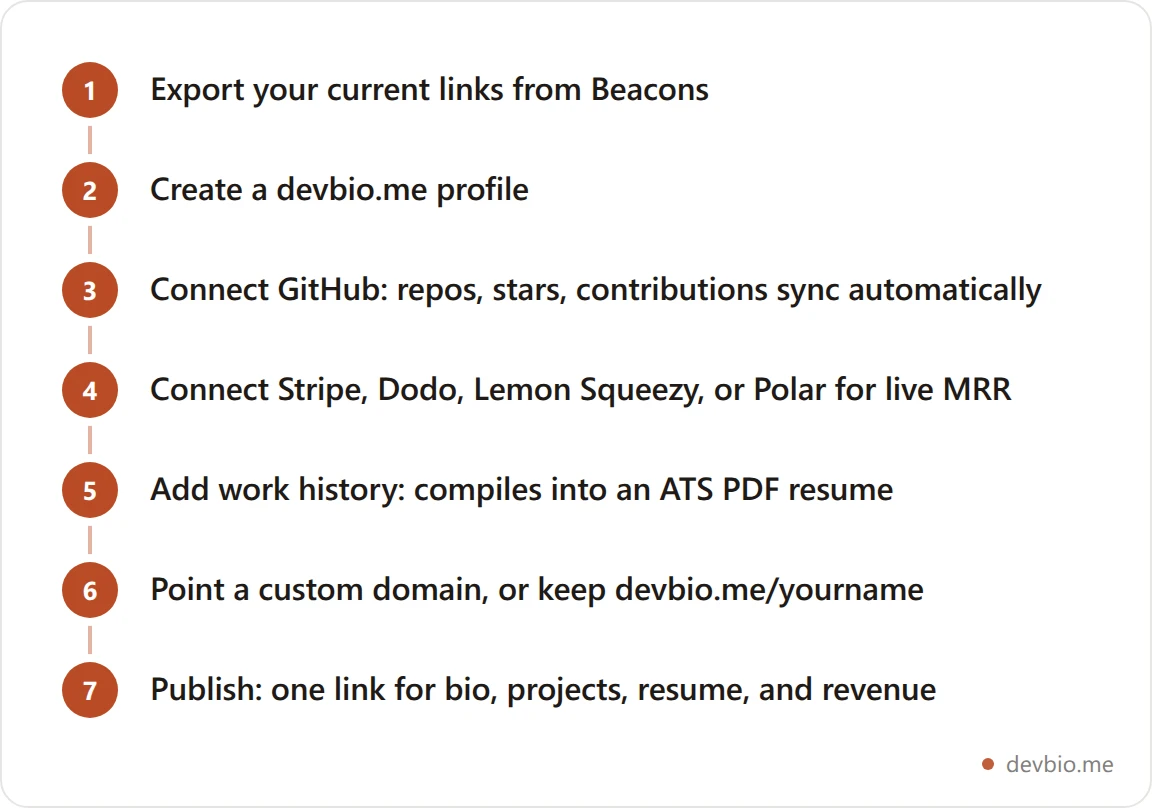
You don't need to delete your Beacons account to try this. Most developers run both for a few weeks, then quietly drop the one that stops getting clicks.
A few things worth knowing before you start:
Your links carry over as-is. Every component in a developer bio, from basic info to project cards, is modular, so you add only the pieces that fit.
GitHub sync isn't a one-time import. Stars, commits, and the contribution heatmap refresh on a schedule (roughly every six hours on the free plan, hourly on Pro), so the numbers stay current without you touching the page again.
The resume comes from the same data. You're not maintaining two versions of your story in two different tools.
The free plan isn't a trial. A public profile, GitHub metadata, the PDF resume, and a marketplace listing are all available before you pay anything. Start a free profile at devbio.me to see your own GitHub data pulled in before deciding on anything else.
Before and After: A Freelance Developer's Bio Link#
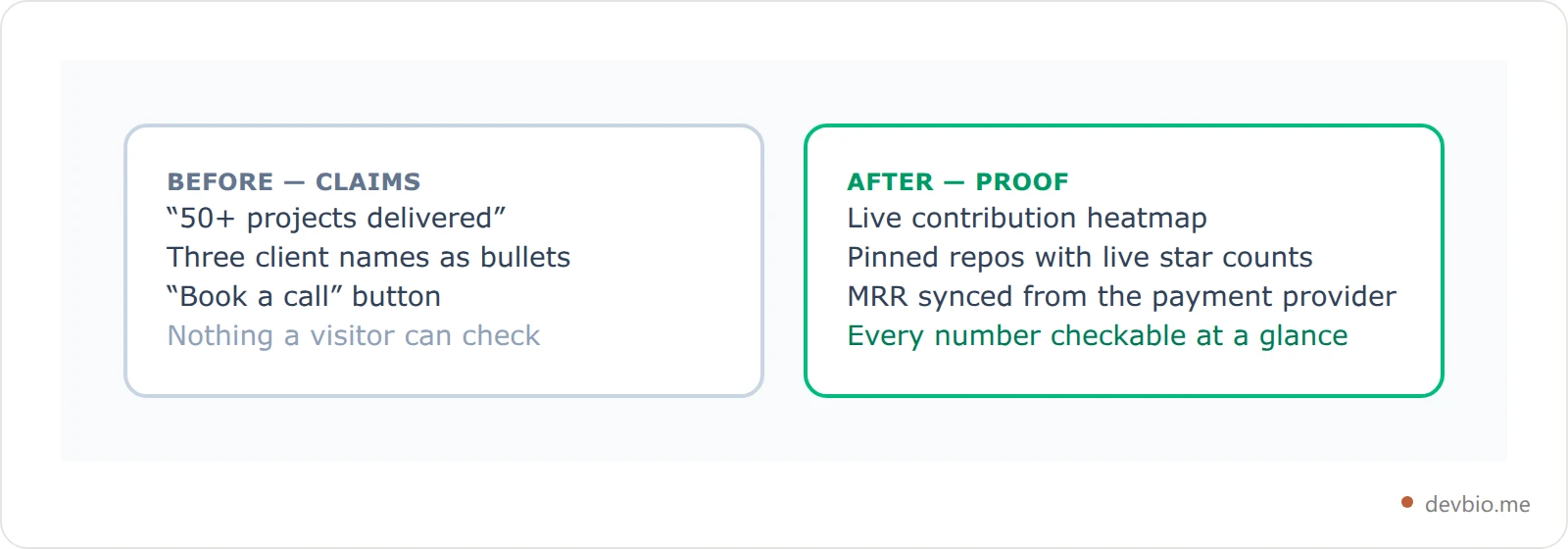
Take a common case: a freelance backend developer with a Beacons page listing three past clients as bullet points, a "Book a call" button, and a static line reading "50+ projects delivered." It looks fine at a glance. It also asks every visitor to just take the developer's word for it.
A prospective client has no way to verify any of it. The bullet points could be from two years ago. The "50+ projects" line isn't tied to anything, and the "Book a call" button is the only interactive part of the entire page. If two freelancers send a near-identical proposal, the page itself does nothing to break the tie.
After switching to a Proof-over-Claims profile, the same developer's page shows: a GitHub contribution heatmap with a visible, current streak, three pinned repos with live star counts, an MRR chart connected to a Lemon Squeezy account for a paid side tool, and an ATS-formatted resume one click away. Nothing on the page is a claim anymore. Every number is either live from an API or downloadable as a structured document. The same "50+ projects delivered" line still shows up, but now it sits next to a commit graph that backs it up instead of asking to be believed on its own. That's the entire pitch of showing proof instead of writing copy about yourself: it does the convincing so you don't have to. It's the same shift indie hackers have been making with revenue-transparent profiles built before hitting their first $10K in MRR, just applied to freelance client work instead of a product launch.
The trust gap this closes matters more than it looks on paper. Link-in-bio pages convert clicks into action at roughly 1-5% on average, but niche, high-intent audiences (like a hiring manager who already clicked through from a resume) convert far higher when the page actually answers their question instead of asking them to trust a claim.
Your Migration Checklist#
Copy this before you start moving off Beacons:
Export or screenshot your current Beacons links and media kit copy
List every payment provider you actually use (Stripe, Dodo, Lemon Squeezy, Polar)
Pick 3-5 repos or projects worth pinning, not all of them
Confirm your GitHub bio and pinned repos are current before connecting
Decide if you need a custom domain now or later
Draft your work history once, since it feeds both the profile and the resume
Set a reminder to re-check the page in a week and compare click data
Frequently Asked Questions#
Is Beacons good for developers?#
Beacons works well for creators monetizing an audience through courses, brand deals, or affiliate links. It has no GitHub integration, no live revenue proof, and no resume export, so it doesn't map well to how developers actually prove their work to recruiters or clients.
Does Beacons take a commission on sales?#
Yes. The free plan takes 9% of anything sold through the Beacons storefront, and so does the $10/month Creator tier. Removing the commission requires Creator Plus at $30/month, or $300 billed annually, according to Beacons' own pricing page. Our full Beacons pricing breakdown works through when that upgrade pays for itself.
What's the best link-in-bio tool for a software engineer?#
The best option shows proof, not just links: a GitHub contribution graph, live project stats, and (if relevant) real revenue from a connected payment account. Generic creator tools like Beacons, Linktree, or Stan Store don't offer any of that natively.
Can I use my GitHub profile instead of a link-in-bio tool?#
Your GitHub profile README is a solid start, but it can't hold a resume, a custom domain, live revenue, or a marketplace listing, and it only reaches people who already use GitHub. Most developers use both: a GitHub README for the open-source crowd, and a dedicated profile for recruiters, clients, and everyone else who won't dig through your repos to figure out what you actually do.
How much does a developer-native bio cost compared to Beacons?#
A free plan typically covers a public profile, GitHub metadata, a PDF resume, and a marketplace listing. Removing platform branding and adding a custom domain runs closer to $2-3/month on a developer-focused tool, versus $30/month for the Beacons tier that removes the commission fee.
Can I sell a SaaS side project from my bio link?#
Not on Beacons, which is built for digital products like courses and templates, not software businesses. A developer-focused profile with a marketplace listing lets you show a project's live stats alongside a path for buyers to make an offer.
Do I need a custom domain for a developer bio?#
Not to start. A subpath like devbio.me/yourname is fine for sharing on LinkedIn, in a resume, or in a GitHub bio. A custom domain becomes worth it once the profile is doing real work: appearing on a resume, a conference badge, or a business card.
Will switching away from Beacons hurt my existing links?#
No. Nothing stops you from keeping a Beacons page for its storefront and monetization features while using a developer-native profile as the link you actually put on your resume, GitHub bio, and LinkedIn. Many developers run both for different audiences: Beacons for anything tied to selling a digital product, and a proof-driven profile for anyone deciding whether to hire, fund, or acquire what you've built.
Key Takeaways#
Beacons charges a flat 9% seller fee on both its free plan and the $10/month Creator tier. Only Creator Plus at $30/month removes it.
There is no GitHub integration, no live revenue proof, and no resume export, so none of a developer's strongest credibility signals can appear on the page.
A proof-over-claims profile swaps static text for live data: repo stats from the GitHub API, MRR from your own payment provider, and a resume compiled from the same source.
You don't have to pick exclusively. Keep Beacons for a storefront and use a developer profile as the link on your resume, GitHub bio, and LinkedIn.
The strongest beacons.ai alternative for an engineer isn't another link-in-bio tool. It's a page that proves shipped work.
Final Verdict: The Beacons Alternative for Developers#
Beacons is a strong tool for creators selling courses and chasing brand deals. It was never built to show a contribution heatmap, verify real MRR, or export an ATS resume, and the 9% commission it charges on both the free and $10 plans makes it actively expensive for anyone not running a digital storefront.
A developer's actual asset is proof: shipped code, real revenue, a work history that holds up under scrutiny. The Proof-over-Claims profile puts all three in one place, refreshed automatically, instead of a page you have to remember to update.
Your code already proves you can build. Put it on one link, live, at devbio.me.