

Entry-level developer job postings are running roughly 45% below their 2023 level, and actual junior hiring has dropped even further — one 2026 analysis put it at 73% in a single year, even as listings for "junior" roles kept climbing. Recent-graduate unemployment sat near 5.7% in late 2025, with underemployment closer to 42%, and 70% of the Class of 2026 computer science majors say they feel at least somewhat pessimistic about their career prospects. If you're a CS student or new grad with zero professional experience, that's the market you're walking into.
Here's the part that gets buried under the bad news: a computer science student portfolio was never really about experience. It was always about proof. You don't need a job to prove you can write working code, ship something real, and explain your decisions clearly. You need three or four finished things and one place to put them where a recruiter looks first.
The direct answer: a strong computer science student portfolio in 2026 needs three to five original (not tutorial) projects with live links, a GitHub history showing consistent recent work, a one-paragraph problem-and-result explanation for each project, and an ATS-safe resume built from the same data. Everything below shows exactly how to build all four.
The 2026 Job Market Behind Every Computer Science Student Portfolio#
The entry-level developer market shrank, but it didn't disappear — it got more selective, and selection increasingly runs on proof instead of credentials.
Coding bootcamp grads now start around $65,000–$72,000 with 71–79% placement within six months. CS degree holders start around $79,000–$80,000 with 93–94% placement in the same window. The gap isn't really the credential — 72% of employers say they view bootcamp graduates as equally prepared for entry-level roles, as long as the portfolio and demonstrated skills match what a degree holder brings. Employers already told you what matters more than the diploma.

AI tooling raised the bar on the junior side too. Employers increasingly expect first-job candidates to arrive already showing real project experience, Git fluency, testing habits, and AI-tool literacy — skills most degree programs and bootcamps don't formally grade. A portfolio is how you demonstrate all four without a job title attached to your name.
The Student Proof Ladder: A Framework for a Portfolio With No Experience#
Every developer portfolio with no work history has to answer the same skeptical question a hiring manager is silently asking: is this real, or is this a class assignment dressed up? The Student Proof Ladder is a four-rung answer — each rung removes one layer of doubt.

Most student portfolios stop at rung one — a repo with code and nothing else. That's why so many read as interchangeable. The next four sections walk each rung in order.
Rung 1 — Ship: What Counts as a Real Project With No Job#
The direct answer: a project counts as real when it solves a problem that existed before you decided to build something, and it's live at a URL a stranger can open today. Class assignments and tutorials don't automatically fail that test — how you finish them does.
One hiring manager's take, from a 2026 developer community post, is blunt about what doesn't work: "If your portfolio is all clones and tutorials, hiring managers have no signal that you can own a feature in a live system. They've already seen a hundred to-do apps this week."
Projects that clear the bar with zero job experience:
A real fix for a real annoyance. A scheduling tool for your campus club, a scraper that tracks a price you actually watch, a Discord bot your friend group actually uses. The test isn't complexity — it's whether it kept running after you turned it in.
A meaningfully extended class project. Your database course's final project, rebuilt with auth, deployed, and given a UI that isn't the default framework scaffold. A grader saw the original; a recruiter should see the version you kept improving after the grade posted.
A merged open-source contribution. A real pull request accepted into a project other people depend on — even a small one, like a bug fix or a docs improvement. It's verified by someone other than you, which is exactly what makes it worth more than a solo repo.
Freelance or pro-bono work. A website or internal tool built for a local business, a professor's lab, or a student org. Real users, real constraints, a real deadline that wasn't a syllabus. If it's paid, a rate calculator helps you land on a number that's fair for both sides.
A hackathon build, finished after the clock ran out. Most hackathon projects die the moment the weekend ends. The ones that get cleaned up, deployed, and given a proper README afterward stand out precisely because almost nobody does that last step.
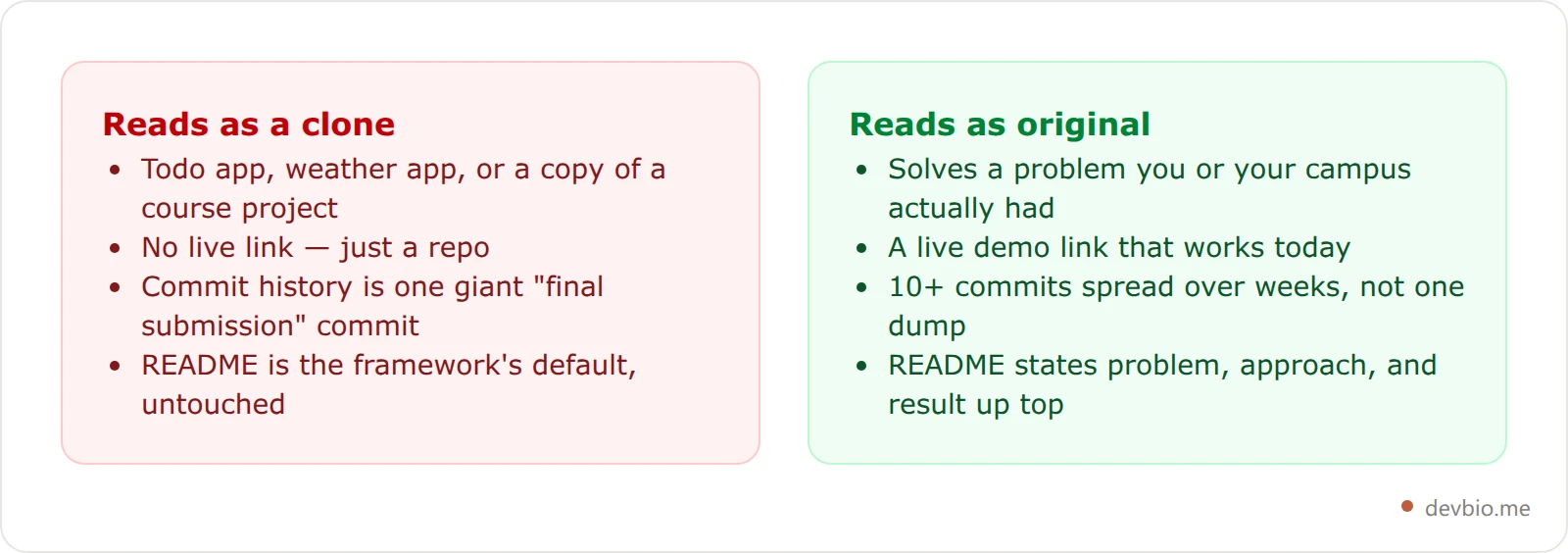
Three to five of these outperform ten half-finished ones. A good portfolio is far more important than years of experience for most junior roles — but it has to be your best three or four, not your complete GitHub history.
Rung 2 — Explain: The README That Does the Interview for You#
A recruiter spending 11 seconds on your profile is not reading your code. They're reading your README, and it needs to answer four questions before they scroll away: what problem, what approach, what result, what link.
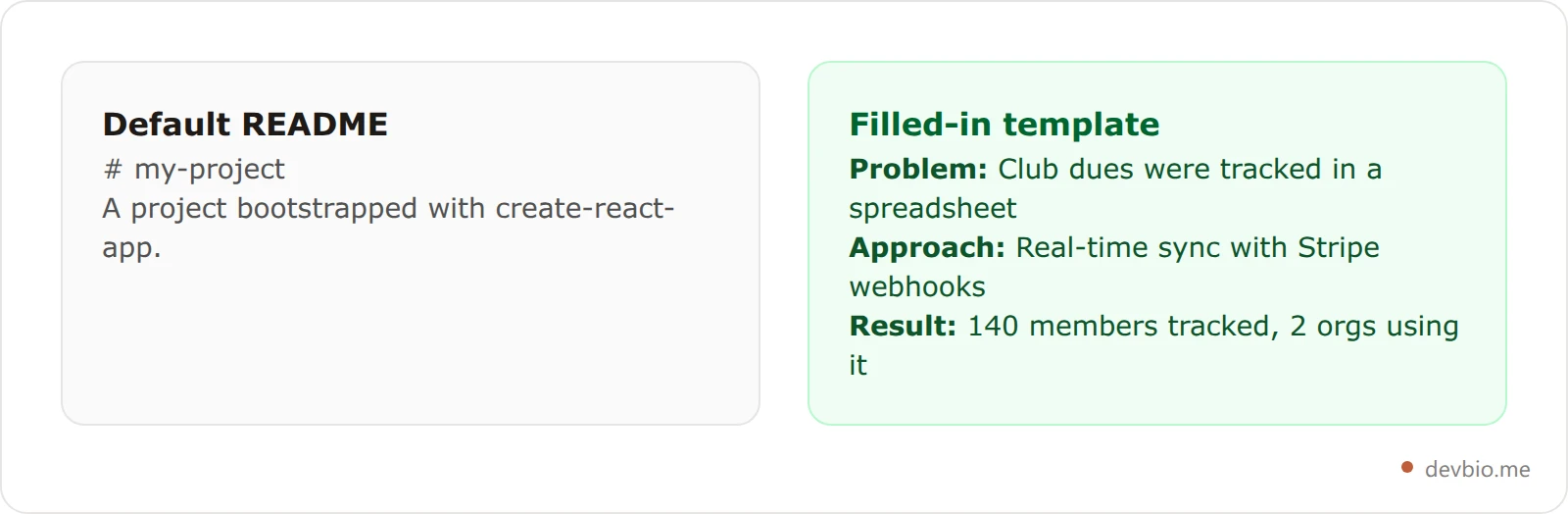
Copy this template into every project's README and fill in the brackets — it's the same structure that turns "built a React app" into a project a recruiter remembers:
## [Project Name]

**Problem:** [One sentence — what was broken or missing, and for whom]

**Approach:** [What made your solution non-obvious — the technical decision
you're proud of, not just the tech stack]

**Result:** [A number. Users, response time, lines of data processed,
GitHub stars, anything measurable]

**Try it:** [Live demo link] · **Code:** [Repo link]
"Subscription tracker for student club dues, built solo in three weeks, now used by two campus orgs to track 140 members" tells a screener something a tech-stack list never will. If your best work is currently a coursework repo with no explanation, our guide on what to include in a GitHub profile README walks through the format line by line.
Rung 3 — Verify: Building GitHub History Without a Job#
Sourcing tools and recruiters check the same three things on your GitHub before they check anything else: is the contribution graph recent, are the pinned repos real, do the READMEs explain what's there. With no job, all three are still fully in your control.
The bar for "active" keeps rising, too. More than 36 million new developers joined GitHub in the past year alone, pushing the platform past 180 million total — an average of one new developer every second. A sparse, dated graph doesn't just look inactive in isolation; it looks inactive next to a platform where "active" is the baseline, not the exception.
Consistency beats volume. A graph with three or four green squares a week, sustained for two months, reads stronger than a burst of forty commits the night before an application deadline. See our breakdown of the GitHub contribution heatmap for exactly what counts toward each cell and what doesn't.
Pin your best four, not your first four. GitHub allows six pinned repos — use three or four of them for your strongest, most recent, best-explained work. Unpin anything you can't defend in an interview.
Contribute somewhere real. Look at a library or tool you already use, check its "good first issue" label, and submit one real pull request. If it's accepted, it's a credibility signal you didn't generate yourself — our guide on building an open-source portfolio beyond the README covers how to find approachable projects and what maintainers actually want to see in a PR.
Use what you already have access to. As a student, GitHub's education program bundles free tooling and hosting credits worth using while you're still enrolled — grab it before you graduate and lose eligibility.
Rung 4 — Package: One Profile, One Resume, One Link#
Once you have three shipped projects, explained clearly, backed by real GitHub activity, the last problem is distribution: getting all of it in front of one recruiter in one click, in a format both a human and an ATS can read.
This is the layer most student portfolios skip entirely — a GitHub link in one tab, a Google Doc resume in another, a LinkedIn "about" section that says none of it. A profile that holds the components that actually matter — basic info, skills, projects, and a work-experience section even if it's just internships or club leadership — solves that with one URL.
The resume problem specifically is worth automating rather than manually re-formatting for each application. If your projects, skills, and any experience already live as structured fields in your profile, the same data can compile straight into a single-column, ATS-clean PDF at a URL like devbio.me/yourname/resume — no two-column layout for a parser to mangle, no separately maintained file going stale the moment you finish a new project. Our guide on building an ATS-ready resume from your GitHub profile covers the formatting rules that trip up most automated screens. On a free plan, eight project slots is more room than the three to five you actually need — and if you want it parked on your own domain later, like firstlast.dev, that's roughly a $2-a-month upgrade, not a project. Set up your free profile at devbio.me.
"Work experience" doesn't require a job offer. If you've never had an internship, that section doesn't have to stay blank — it just needs real, dated activity. A teaching assistant role, a paid or unpaid research assistantship, a hackathon placement, or leading a student org's technical projects all belong there. List them the same way you'd list a job: title, dates, one line on what you actually did and what came of it. A screener reading "TA for Data Structures, Fall 2025 — held weekly office hours, wrote three grading rubrics used by 140 students" gets a clearer signal than an empty section pretending the last two years didn't happen.
Before any of that, lock a consistent handle across GitHub, your profile URL, and LinkedIn — check that your name is actually available everywhere before you build around one that isn't.
What to Cut From a Junior Developer Portfolio#
More isn't the goal. Most student portfolios are diluted, not thin — good work buried under filler that actively lowers the average.
Your GPA. Unless a specific employer explicitly requires it, it adds no signal a screener acts on and it's one more line competing for attention with your projects.
A skills list with 20 languages and frameworks. Nobody believes fluency in twenty tools from a student with no job. List what you've actually shipped with, and let the projects prove the rest.
Every class assignment you ever submitted. A grading rubric is not a hiring rubric. Show the two or three you extended past the assignment's minimum, and archive the rest.
Dead links. A broken demo is a worse signal than no demo at all — it tells a recruiter you didn't check your own work before sending it out. Test every link before every application push.
A wall of text with no visual hierarchy. If a recruiter has to read a paragraph to find your GitHub link, they won't.
GitHub Alone vs. Personal Site vs. a Live Computer Science Student Portfolio#
Students usually default to whichever option requires the least setup, which isn't always the option that gets read. Here's how the common formats actually compare for someone building a computer science student portfolio from zero:
Format | Setup time | Live project proof | ATS resume included | Custom domain | Ongoing upkeep |
|---|---|---|---|---|---|
GitHub profile alone | None | Strong for code, weak for framing | No | No | Manual README edits |
Hand-built personal site | Days to weeks | Depends on effort | No | Yes, if you set it up | You maintain the code forever |
LinkedIn "About" section only | Minutes | None — text claims only | No | No | Manual |
A live profile (DevBio-style) | Under an hour | Yes — GitHub stats pulled in automatically | Yes, generated from the same data | Optional, paid | Auto-updates as you edit fields |
No format is disqualifying on its own — plenty of students land interviews off a clean GitHub profile alone. The gap shows up in Rung 4: distribution and persistence. A hand-built site proves you can build a site, which is a fine signal for a frontend role and a wasted week for anyone else. See what a live profile looks like.
Before and After: A Realistic Student Portfolio Overhaul#
The same applicant, two states — a composite of the patterns recruiters describe, not one specific person.
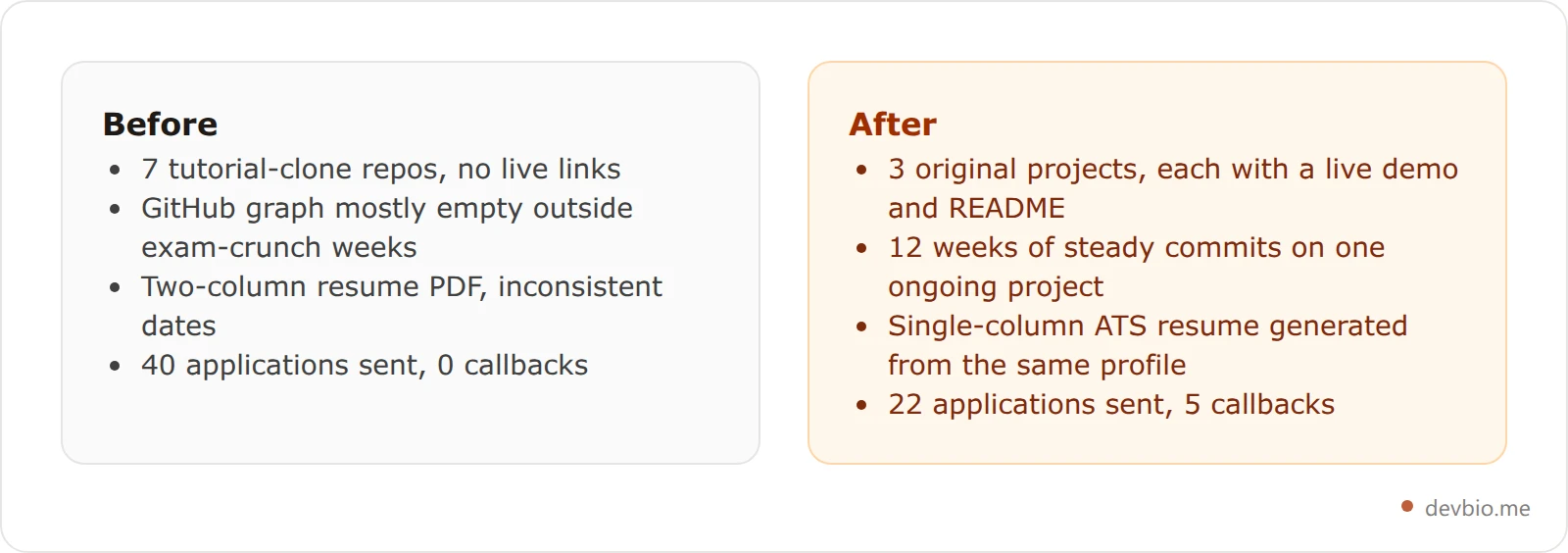
Fewer projects, better framing, and one link instead of four scattered tabs. Nothing in the "after" column requires an internship that hasn't happened yet — it requires finishing three things properly and explaining them clearly. With roughly 1,428 applications competing per hire on LinkedIn alone, the applicant sending fewer, better-targeted applications with proof attached is playing a different game than the one sending forty identical ones. Start building your proof stack free.
Frequently Asked Questions#
Do I need work experience to build a developer portfolio?#
No. A portfolio built entirely from personal projects, class work extended past the assignment, and open-source contributions is standard for students and new grads. What matters is that the projects are finished, live, and explained — not whether an employer's name is attached to them.
How many projects should a CS student include in their portfolio?#
Three to five, chosen as your strongest and most recent. Quality and clarity of explanation outperform quantity every time — ten half-finished repos read worse than three complete ones with working demos and clear READMEs.
Should I use GitHub alone instead of building a separate portfolio?#
GitHub alone works for showing code, but it doesn't hold a formatted resume, a custom URL, or space to frame your projects for a non-technical reader like an HR screener. Pairing your GitHub with one profile that packages everything together covers both audiences.
What if my only real projects are class assignments?#
Extend two or three of them past the grading rubric — add authentication, deploy them live, give them a real README — and they stop reading as homework. A rebuilt final project with a working demo is a stronger signal than an untouched tutorial clone.
Do bootcamp grads need a different portfolio than CS majors?#
Not structurally. The same four rungs apply. The main difference is volume of formal coursework to draw on, which bootcamp grads offset with more, tighter, faster-shipped personal projects — 72% of employers already say they view a strong portfolio as equivalent to a degree.
Should I include my GPA or full coursework list on a developer portfolio?#
Generally no. Unless a specific employer requires it, a GPA adds no signal a screener acts on. Space is better spent on project explanations, which do the actual convincing.
How do I build GitHub contribution history without a job?#
Commit to one ongoing personal project several times a week rather than in bursts, and submit pull requests to existing open-source projects you already use. Both count toward your public contribution graph and both are fully available with zero employer involvement.
Is a custom domain worth it for a student on the job market?#
It's a nice-to-have, not a requirement. A clean profile URL works fine for most applications. A custom domain like firstlast.dev becomes more valuable once you're also applying to freelance work or senior-adjacent roles where it signals longer-term intent.
Key Takeaways: Building the Proof Before the Job Exists#
The entry-level market didn't get impossible — it got more selective, and selection now runs on evidence over credentials. Three things carry that evidence: original, finished, deployed projects; a GitHub history that's consistent rather than dramatic; and a resume built from the same data you used to build the profile, not a separate document going stale in a folder.
None of it requires a job you don't have yet. It requires shipping, explaining, and packaging what you've already built — the Proof Ladder, in order, starting today.
Your code already proves you can build. Put it on one link — devbio.me


