

Updated for the 2026 hiring cycle.
To get hired with your GitHub profile in 2026, you need more than activity — you need proof a recruiter can verify in under a minute. Applications per hire have roughly tripled since 2021, and an estimated 70% of resumes are now rejected at the initial screening stage before a human ever opens them. At the same time, a resume can't prove anything a hiring manager actually needs verified — that you shipped something real, that you're still active, that the claims line up with the public record. That's the gap this guide closes.
Getting hired with your GitHub profile means turning your commit history, shipped projects, and any real usage or revenue into proof a recruiter can check in under a minute — instead of asking them to trust a bullet point. In 2026, that verification layer is often the difference between a resume that sits in a queue and a profile that gets a reply.
This is the full playbook: why the resume-only application is losing ground, the four kinds of proof that actually move a decision, a resume that doesn't contradict your public profile, and the mistakes that quietly kill an otherwise solid GitHub. It pairs with the 4-layer developer personal brand guide if you want the broader picture beyond just hiring.
Why a Resume Alone Stopped Working#
A resume is a claim. In 2026, a claim alone often doesn't clear the first filter — not because every company has an AI bot reading resumes (fewer than half of organizations expect to use AI in HR this year, per SHRM's research, as cited by Jobscan), but because the volume of applications per role has made careful human review the exception, not the default.
Applications per hire have roughly tripled since 2021, according to Ashby's 2026 Talent Trends Report, and an estimated 70% of resumes are rejected at the initial screening stage before a human ever reads them, per CareerBuilder data cited in RecruitAI Suite's 2026 analysis. Whether that first pass is a keyword filter or an overwhelmed recruiter skimming for six seconds, the effect is the same: your resume gets judged fast, on surface pattern-matching, before anyone has a reason to trust the claims inside it.
A GitHub profile doesn't go through that same filter — but it's exactly what a person opens the moment your resume survives it, and it's harder to overstate than a bullet point, because the commit history is right there to check.
Part of why that check matters more every year is scale. GitHub added roughly 36 million new developers in 2025 alone, pushing its total past 180 million, with developers collectively pushing nearly 1 billion commits — a 25% year-over-year increase (GitHub Blog, Octoverse 2025). Nearly 80% of new developers adopted GitHub Copilot within their first week on the platform, per the same report. More developers, more AI-assisted output, more applicants who all look similarly qualified on paper — which is exactly the environment where a reviewer stops asking "what does the resume say" and starts asking "what can I actually check."
Gergely Orosz, who writes The Pragmatic Engineer, put a version of this bluntly: "One surprising thing I'm hearing from startup founders and eng managers hiring software engineers: Posting jobs on LinkedIn is basically useless, because all they get is junk applications. Like hundreds of clearly not qualified inbounds / seemingly AI-generated profiles" (X). When every applicant's resume starts to read the same — helped along by the fact that 84% of developers now use or plan to use AI coding assistants themselves, per the 2025 Stack Overflow Developer Survey — hiring managers lean harder on whatever they can actually verify. That's your GitHub, your shipped work, and anything with a live link behind it.

What Recruiters and Hiring Managers Actually Check First#
Once a resume clears that first pass, review behavior on GitHub is fast and pattern-based, not exhaustive. Recruiters and hiring managers scan for the same handful of signals regardless of role or seniority:
What do you build? Answered by pinned repos and a README, not by bio text or a skills list.
Is this real work? Answered by commit history, issue threads, and whether a linked demo actually loads.
Are you still active? Answered by the contribution graph, not by a "currently learning" badge that hasn't changed in a year.
A profile cluttered with forked tutorials, half-finished to-do apps, and abandoned weekend experiments hurts more than a sparse one — it dilutes the signal a reviewer is scanning for. The practical guidance that shows up consistently across hiring-side writing on this (see Flatiron School's guide for job seekers) is quality over quantity: a handful of finished, documented projects reads as more credible than a long list of shallow ones, because it gives a reviewer enough depth to judge decision-making, not just syntax.
Past that first scan, a slightly more technical reviewer — a hiring manager or a senior engineer doing a screen — looks for secondary signals that separate "code that runs" from "code someone else could maintain": a test suite, a CI badge showing it actually passes, a license file, and whether issues or pull requests from other people got a response. None of these are dealbreakers on their own. Together, they're the difference between a repo that reads as a finished artifact and one that reads as an assignment left half-graded.
None of this replaces your resume. It's what gets checked alongside it, and increasingly, before anyone decides the resume is worth reading closely.

The 4-Proof Hiring Stack#
Once you accept that reviewers verify before they trust, the fix isn't "post more content." It's showing four specific kinds of proof, each in a form that takes a reviewer under a minute to check.
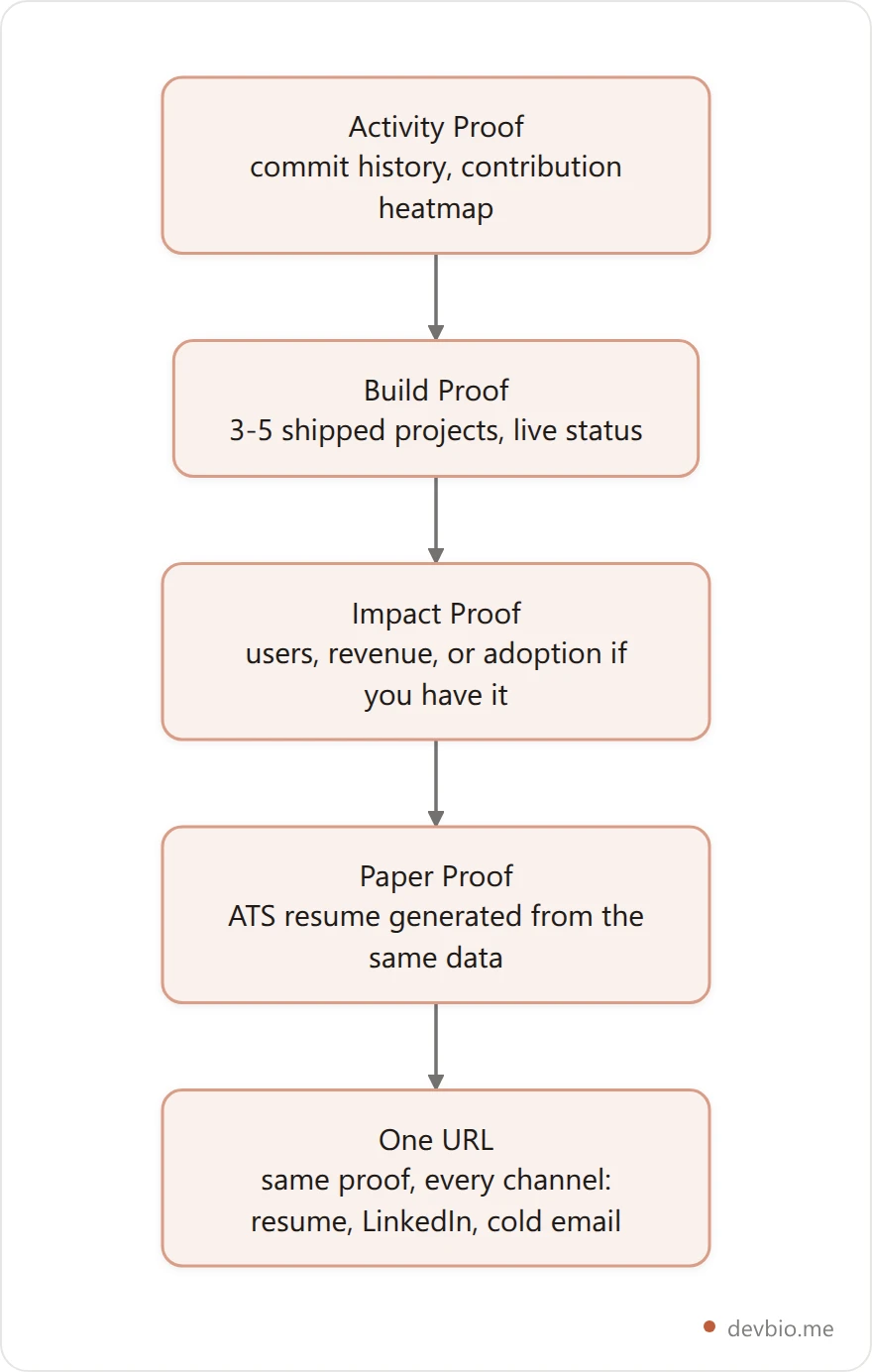
Call it the 4-Proof Hiring Stack. Each layer answers a different doubt a hiring manager has, and each one is cheap to build once you know what it's for:
Proof layer | What it answers | Where it lives |
|---|---|---|
Activity Proof | "Are you still coding, or is this old?" | Commit history, contribution heatmap |
Build Proof | "Can you ship something real end-to-end?" | 3-5 finished, linked projects |
Impact Proof | "Did anyone actually use this?" | Users, stars, revenue, adoption |
Paper Proof | "Does the resume match the public record?" | ATS resume generated from the same facts |
You don't need all four to be impressive. You need all four to be present and consistent. A junior candidate with a thin but honest Impact Proof beats a senior candidate whose resume claims contradict their public GitHub.
Proof #1: Activity Proof — Make Your Commit History Legible#
Activity Proof is the fastest signal a reviewer checks and the easiest one to get wrong. A green contribution graph reads as "still building." A graph that stops six months ago reads as "moved on," fairly or not — even if the real explanation is that your current work lives in a private repo.
Two mechanical fixes matter more than raw volume:
Make private-repo activity visible. If most of your real work happens behind a company's private repos, your public graph can look empty even when you code daily. Most tools that render a GitHub heatmap need explicit permission to count private contributions — check that setting before you assume your graph reflects reality.
Pin a README that answers the three questions above in the first two lines. Not a bio. A one-paragraph answer to what you build, what stack, and what you're looking for next — DevBio's free GitHub README generator can draft the starting structure if you're not sure where to begin, and if you want a structure already matched to a specific goal — job search, OSS maintaining, freelancing — the GitHub profile README templates guide has ten patterns to pick from.
DevBio's contribution heatmap component pulls this directly from the GitHub API and keeps it live on your profile rather than a static screenshot you have to remember to update — the same graph a recruiter would see on GitHub itself, just attached to the rest of your proof instead of standing alone. For the full setup on structuring the profile page itself, see the complete GitHub profile guide for 2026.
Proof #2: Build Proof — Fewer Projects, Read as Real Work#
Build Proof is where most profiles overcorrect. More repos is not more proof. A reviewer spending 30 seconds on your projects section needs three to five finished things, not fifteen attempts.
For each project you keep visible, three details do the actual convincing:
A live link. A deployed demo, an app store listing, or a running instance is checkable in seconds — a README screenshot isn't, and a reviewer has no reason to assume it's current.
What broke and how you fixed it. One sentence on a real technical decision signals judgment. "Built with React" signals nothing a thousand other profiles don't also say.
Current status, told honestly. "Maintained," "archived," or "prototype" costs you nothing and reads as more credible than silence.
If your best work is contributions to someone else's codebase rather than your own repos, that still counts as Build Proof — arguably stronger, since it was reviewed and merged by someone else first. The open source portfolio guide covers how to surface merged PRs and issue threads as evidence, not just your own green squares. And if you're weighing a full project showcase against a plain resume as your primary artifact, portfolio vs. resume breaks down when each one should lead.
Proof #3: Impact Proof — When Something You Built Got Used#
Not every candidate has this layer, and that's fine — it's a bonus tier, not a requirement. But if you've shipped a side project, a tool other developers use, or a small SaaS product, Impact Proof is the single highest-leverage thing you can add to an application.
"500 GitHub stars" is a claim. A live star count next to a live repo link is proof. "$1,200 MRR" on a resume is a claim a recruiter has no way to check and every reason to discount — it's exactly the kind of unverifiable line that invites the follow-up question you don't want to fumble in an interview. A connected payment integration showing real, current revenue is proof they can verify themselves in one click, without you having to bring it up first.
This matters even for candidates applying to traditional roles, not just founders. A hiring manager evaluating a backend engineer who also runs a small profitable side project generally reads that as evidence of ownership, not a distraction. The indie hacker profile setup guide and live MRR profile guide cover how to wire up live revenue data from Stripe, Dodo Payments, Lemon Squeezy, or Polar without exposing anything you don't want public — and if you haven't picked a processor yet, the payment processor comparison for indie hackers breaks down fees and payout speed across all four.
If you don't have this layer yet, skip it. A missing Impact Proof section is invisible. A fabricated one is a background-check risk.
A concrete version of this: two candidates apply for the same senior role with near-identical resumes. One writes "built a SaaS tool used by small teams." The other links a project card showing 340 GitHub stars, a changelog with commits from the last week, and a live subscriber count pulled from Stripe. The second candidate said less in words and proved more — the reviewer didn't have to decide whether to believe the claim, because it was sitting right there to check.
Proof #4: Paper Proof — The Resume That Matches the Public Record#
Here's the part most "GitHub over resume" advice gets wrong: the resume still matters, because most application pipelines still require one, and most first-pass filtering still happens there. The fix isn't dropping the resume. It's making sure it says exactly what your public profile already proves — no more, no less.
A resume that claims "led development of X" when your GitHub shows you as a minor contributor doesn't just look bad. It's the first thing a technical interviewer probes when something feels off, and a contradiction there costs more trust than a modest but accurate resume ever would.
There's a mechanical layer to this too. A resume still has to survive a plain-text parse: avoid tables, text boxes, icons-as-text, and multi-column layouts that scramble when a parser reads them top-to-bottom. Keep section headers conventional ("Experience," "Projects," "Skills") rather than clever, and let your project descriptions mirror the terms in the job posting where they're honestly true — not stuffed, just not avoided either.
The bigger fix is structural: generate your resume from the same data behind your public profile — your listed projects, your role on each, your stack — instead of writing it separately from memory months later. DevBio compiles a bio's project and experience components into an ATS-readable PDF at /{username}/resume, so the two artifacts can't drift apart because they're the same source. For the format and parsing rules that matter in 2026, see the developer resume formats guide and ATS-ready resume from your GitHub profile. If you're building a resume programmatically or want a portable, tool-agnostic format, the JSON Resume explainer is worth a read before you commit to a template.
Resume-Only vs. the Full Proof Stack#
Resume only | Full Proof Stack | |
|---|---|---|
Passes automated ATS screening | Sometimes | Sometimes (same resume, still needed) |
Verifiable by a reviewer in under 60 seconds | No | Yes |
Survives a "let me check your GitHub" moment | Depends | Built for it |
Update effort after each new project | Manual rewrite | Add one project card |
Cost of one exaggerated claim | High — no way to check | Low — public record catches it early |
Works for cold outreach, not just applications | No | Yes — one URL |
The resume isn't obsolete. It's necessary but no longer sufficient. The Proof Stack is what makes the resume credible instead of just present.
Build the profile that backs up your resume
What This Looks Like by Career Stage#
The four layers don't weigh the same for everyone applying.
Students and new grads (computer science student portfolio covers this in depth) usually have the thinnest Activity and Build layers and no Impact layer at all — that's normal, not a red flag. Two or three course or hackathon projects, finished and deployed, with an honest README beats a padded list of tutorials every time. Impact Proof isn't expected here; don't manufacture it.
Mid-level engineers typically have the opposite problem: real work, but almost all of it locked in private company repos. The fix is surfacing what's actually shareable — open-source contributions, a side project, talks or write-ups about problems solved at work — rather than treating a thin public GitHub as disqualifying.
Freelancers and contractors (freelance developer portfolio) lean hardest on Impact Proof, because client work is often the strongest, most concrete evidence of outcomes — but it's also the layer most likely to be gated behind an NDA. Anonymized metrics ("cut page load time 40% for a Series A fintech client") thread that needle.
Career changers carry the heaviest burden of proof, precisely because their resume doesn't yet explain their trajectory. A Proof Stack does that explaining for you: recent, consistent activity signals genuine commitment in a way a resume objective statement can't.
Audit Your Current Profile in 15 Minutes#
Before you touch anything, look at your own profile the way a reviewer would — cold, in a new tab, with no context you'd normally supply out loud.
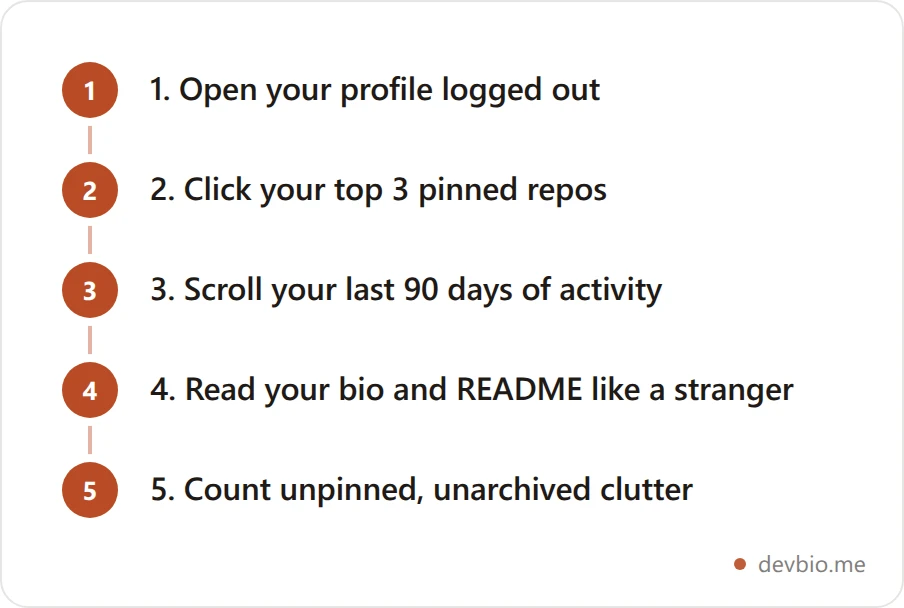
Open your profile logged out. Note the first three things you see. If it's a contribution graph with six months of gray, a bio with no link, and a pinned repo called
hello-world, that's the actual first impression — not what you'd say if someone asked.Click your top three pinned repos. For each: does the README explain what it does in the first two lines? Is there a live link? Does that link actually load? A dead link here is worse than an empty pin slot.
Scroll your contribution graph for the last 90 days. If it's mostly empty and your real work is in private repos, that's a configuration problem to fix, not a work-ethic problem to hide.
Read your bio and README like a stranger. Does it say what you build and what you're looking for, or does it read like a LinkedIn headline copy-pasted twice?
Count your unpinned, unarchived clutter. Old bootcamp exercises, forked-and-untouched repos, and abandoned experiments don't need to be deleted — but they shouldn't be competing for attention with your best work. Unpin, don't delete.
Most profiles fail on step 2 or step 3 — a great project with a broken demo link, or genuinely active work that just isn't visible because of a private-repo setting nobody checked. Both are 20-minute fixes once you've actually looked.
Case Study: Same Candidate, Two Application Rounds#

Consider a composite, illustrative scenario — not a single named person, but a shape that shows up often enough in hiring-manager and indie-hacker discussions to be worth walking through.
Round one: A mid-level backend developer applies to 40 roles with a standard resume — job history, a bullet-pointed skills list, no links beyond a LinkedIn profile. Two callbacks. Both recruiters mention, on the same call, that they "took a quick look at your GitHub" and found three forked tutorial repos and no recent activity.
Round two, six weeks later: Same experience, same target roles. This time the application links to one profile: a live contribution heatmap, four finished projects each with a working demo and one sentence on a real tradeoff, and an ATS resume generated from the same project data. Same 40 applications sent. Ten callbacks, several of which reference a specific project by name in the first email.
Nothing about the candidate's actual skill changed between rounds. What changed was whether a reviewer could verify the claim in under a minute instead of taking it on faith — and whether what they found, once they looked, backed up the resume instead of undercutting it.
See what a Proof Stack profile looks like
How AI Hiring Tools Score Verifiable Signals Differently Than Humans#
AI screening tools and human recruiters aren't looking for the same thing, and conflating them is how candidates over-optimize for the wrong reader.
Resume-parsing software scores keyword and title overlap against a job description — in most implementations it doesn't check your GitHub link at all, and it can't verify whether "expert in distributed systems" is true. The newer generation of AI-assisted screening is starting to weigh structured, checkable data — verified employment history, linked portfolios, activity signals — more heavily, precisely because free-text claims have gotten cheaper to generate and easier to fake now that most applicants have an AI assistant helping write them too.
The practical implication: keep your resume keyword-relevant for whatever automated pass exists, and keep your linked profile fact-consistent for the human pass that follows. They're solving different problems, and a Proof Stack is built for the second one. For a deeper breakdown of what AI-driven hiring pipelines specifically weigh in 2026, see developer profile in AI hiring.
One URL, Every Channel#
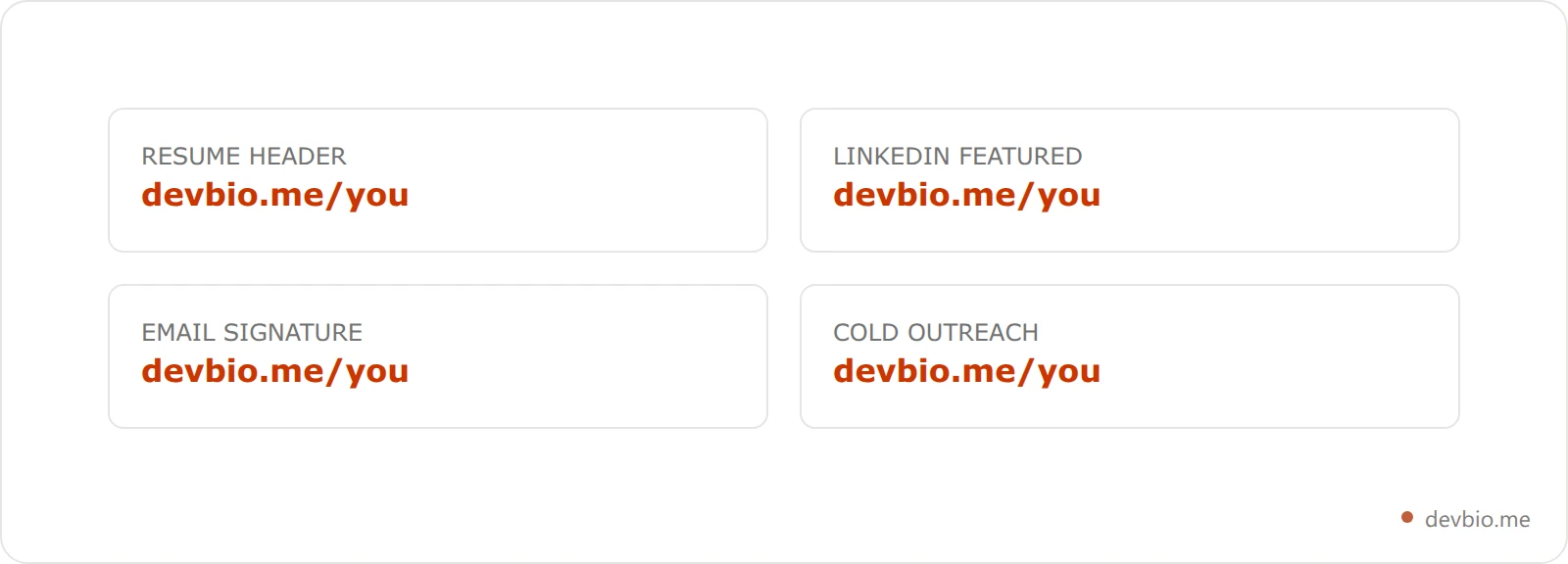
The Proof Stack only compounds if it's the same URL everywhere — not a different portfolio link on your resume, a different one in your LinkedIn bio, and a stale GitHub profile nobody actually finds.
Put one link in your resume header, your LinkedIn "Contact info" field, your email signature, and your cold outreach messages. Every one of those channels currently asks you to summarize yourself in a sentence or two; each summary should point at the same proof instead of re-explaining it.
In practice that means: the URL under your name on the resume, not buried at the bottom of page two. The same URL pinned in LinkedIn's "Featured" section, not just typed once in a post six months ago. The same URL in your email signature, so a warm intro or a cold reply-back leads somewhere verifiable instead of just a name. If you keep three different links live across those three places, you're maintaining three profiles nobody fully sees instead of one that compounds every time someone new looks at it.
The developer profile vs. LinkedIn comparison covers where LinkedIn still wins and where it doesn't. If you're deciding what that GitHub-adjacent bio text should actually say, GitHub profile bio examples has 50+ patterns. And for the full checklist hiring managers say they look for before a first call, developer profile for job search is the companion piece to this guide.
Build your Proof Stack on one link — pull your GitHub activity, projects, and resume into one profile instead of maintaining four.
The Proof Stack Checklist#
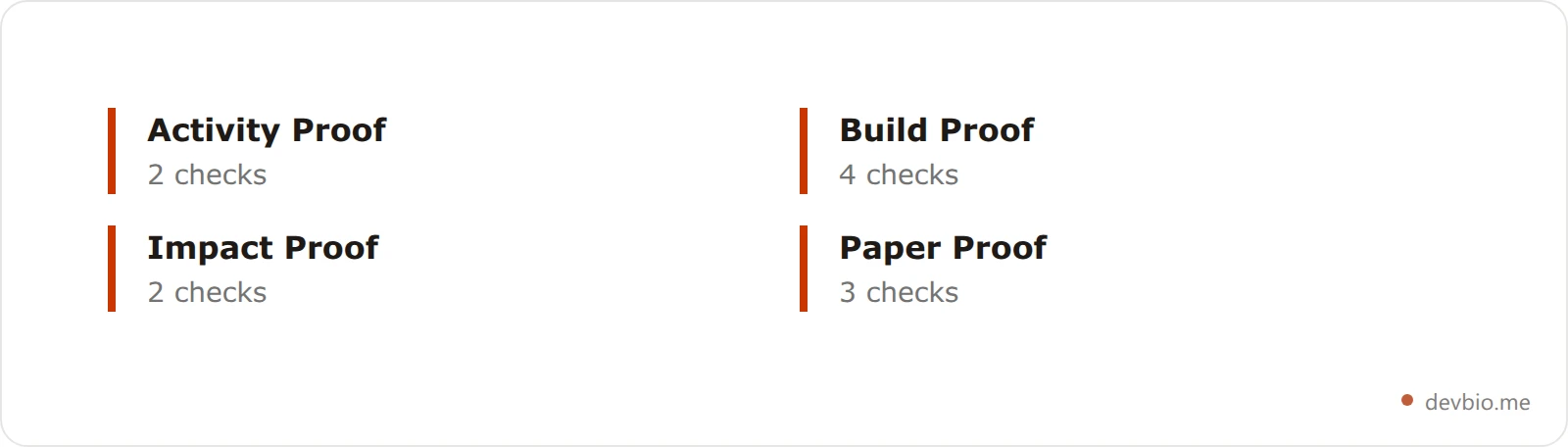
Copy this before your next application round:
Activity Proof
[ ] Contribution graph reflects real recent work (private repos included if relevant)
[ ] Pinned README answers: what I build, what stack, what I'm looking for

Build Proof
[ ] 3-5 finished projects, not 10+ half-finished ones
[ ] Every project has a live link, not just source
[ ] Each project has one sentence on a real decision or tradeoff
[ ] Status labeled honestly: maintained / archived / prototype

Impact Proof (if you have it)
[ ] Star counts, user counts, or revenue are live, not typed
[ ] Nothing here that isn't independently verifiable

Paper Proof
[ ] Resume claims match what the public profile shows, line for line
[ ] Resume generated from the same project data, not rewritten from memory
[ ] Passes a plain-text ATS parse (no tables, no icons-as-text)

Distribution
[ ] Same URL in resume header, LinkedIn, email signature, cold outreach
Common Mistakes That Tank a Proof Stack#
A resume claim your GitHub can't back up. This is the single most common trust-breaker. If you can't point to the repo, don't put it on the resume.
A dead demo link. A broken "live demo" button is worse than no demo at all — it signals the project was abandoned mid-deploy.
A stale heatmap next to a resume that says "actively building." Six months of gray squares contradicts the story you're telling.
Ten repos, zero context. Volume without a sentence of explanation reads as noise, not signal.
Different links on different channels. A recruiter who finds an outdated portfolio through Google before finding your current one loses trust in both.
Copy-pasted READMEs from templates. Reviewers see the same badges-and-shields.io template constantly; it reads as effort spent decorating instead of building.
A private-repo blind spot you didn't know you had. If your day job is where most of your recent code lives, an unconfigured heatmap can make an actively-employed engineer look dormant. Check this before you assume your graph is honest.
No link at all. Not putting your profile anywhere the reviewer is already looking — resume header, LinkedIn, email signature — means the strongest artifact in your application never gets opened.
Frequently Asked Questions#
Do recruiters actually check GitHub profiles before an interview?#
Many do, especially for roles where hands-on ability matters as much as the resume. It's typically a fast, pattern-based scan — pinned repos, recent activity, README — rather than a deep audit. An inactive or template-only profile won't disqualify you outright, but an active, consistent one gives a reviewer a reason to move faster.
How many GitHub projects should I show to get hired?#
Three to five finished, working projects generally read better than ten or more incomplete ones. Reviewers are scanning for depth and follow-through, not volume. Pin your strongest work and archive or unpin abandoned experiments and tutorial forks.
Does GitHub activity matter if most of my code is private at work?#
It can still be represented if your profile tool has permission to count private contributions in your heatmap without exposing the code itself. If that's not set up, your public graph may understate how active you actually are — worth checking before you assume it's accurate.
Should I still have a resume if I have a strong GitHub profile?#
Yes. Most application pipelines still require a resume for the initial pass. The goal isn't to replace the resume — it's to make sure it says exactly what your public profile already proves, generated from the same facts instead of written separately.
What's the fastest way to get hired with your GitHub profile?#
Pin three to five finished projects with live links, write a two-line README answering what you build and what you're looking for, and confirm your contribution graph reflects recent work. That's a one-afternoon fix that addresses what reviewers check first.
Does a side project with real revenue actually help a traditional job application?#
It can, when it's verifiable. A live, connected revenue figure reads as ownership and follow-through, even for roles unrelated to the project itself. An unverifiable number typed onto a resume reads as a claim like any other and can backfire if you're asked about it in an interview and the details don't hold up.
How is this different from just having a personal portfolio site?#
A portfolio site can go stale the moment you stop updating it manually — most do, within a few months of the initial build. The Proof Stack approach ties your proof to live data — GitHub activity, project status, resume — so it stays current as you keep working, instead of requiring a manual rebuild every time your situation, your projects, or your revenue changes.
What if I'm applying to non-technical or hybrid roles — does a GitHub profile still matter?#
Less than for a pure engineering role, but often more than expected for product, DevRel, technical writing, or hybrid PM roles where hands-on ability is a differentiator. In those cases, one or two well-documented side projects can do more to signal genuine technical comfort than a resume line claiming it.
The Takeaway#
If you take one thing from this guide on how to get hired with your GitHub profile, make it this: three things carry the whole playbook. Application volume has made the resume-only pass fast and unforgiving, GitHub and shipped work are what a reviewer actually verifies once your resume clears that pass, and the fix isn't posting more — it's showing four specific kinds of proof (activity, build, impact, paper) that hold up to a minute of scrutiny.
Build the Proof Stack once, keep the resume and the profile consistent with each other, and put the same link everywhere you currently paste a different one. Your code already proves you can build. Put it on one link — devbio.me.


